The Advantages Of Air Conditioning In Schools
School buildings have to work hard. A classroom can be cool and comfortable first thing in the morning, then become warm, stuffy and distracting once pupils arrive, computers are switched on and afternoon sunshine reaches the windows.
Effective school air conditioning helps create a more consistent environment for learning. It can control classroom temperature, reduce overheating, support pupil and teacher comfort and, when designed alongside appropriate ventilation, contribute to better indoor environmental conditions.
The key advantages at a glance
- More comfortable classrooms: Better temperature control can prevent rooms becoming excessively hot and uncomfortable.
- Improved focus: A comfortable learning environment removes one potential distraction for pupils trying to concentrate.
- Support for teachers: Thermal comfort matters to staff as well as students, particularly when teaching throughout a busy school day.
- Better control throughout the building: Different rooms can have very different cooling requirements, making zoned climate control particularly useful.
- Year-round flexibility: Modern systems can often provide both cooling and heating.
- Better management of the indoor environment: Air conditioning can work alongside school ventilation to support temperature, humidity and air movement.
- Potential efficiency benefits: Correctly specified modern systems can provide targeted heating and cooling rather than treating every area of a school identically.
In short: the biggest benefit isn’t simply making a classroom “colder”. Good air conditioning for schools is about creating stable, comfortable conditions in which pupils can learn and teachers can teach without the indoor temperature becoming an unnecessary obstacle.
Helping students be the best they can be, by creating a pleasant learning environment. Raising attainment levels in general, but also at exam time.
Why classroom temperature matters more than you might think
Think about the last uncomfortably hot room you spent an hour in.
After a while, the heat becomes difficult to ignore. Concentration drifts. You feel tired. Small irritations become more noticeable. Opening a window might help—or it might introduce traffic noise, pollen or another blast of warm air.
Now put 25 or 30 pupils in that room.
This is why classroom temperature deserves consideration as part of the wider learning environment. Pupils are being asked to listen, read, write, solve problems and retain new information for hours at a time. Teachers, meanwhile, need to maintain their own concentration while explaining lessons, moving around the classroom and keeping students engaged.
Air conditioning provides schools with something that relying on open windows alone cannot always offer: active temperature control.
Instead of simply reacting when a room has already become uncomfortable, an appropriately designed system can help maintain a more consistent temperature as conditions change throughout the day.
That can be particularly valuable in:
- South- or west-facing classrooms exposed to strong sunlight.
- ICT suites containing numerous computers and monitors.
- Busy classrooms with high occupancy.
- Libraries and study areas intended for prolonged periods of concentration.
- Staff rooms and administrative offices.
- Halls and communal spaces where occupancy changes dramatically.
- Older buildings that retain heat during warmer weather.
The result is a more predictable classroom climate rather than a daily battle with hot, stuffy rooms.
1. Air conditioning can create a more comfortable learning environment
One of the clearest benefits of air conditioning in schools is also one of the simplest: comfort.
Classrooms do not generate heat in the same way as an empty room. Pupils, teachers, lighting, interactive displays, computers and other equipment all contribute to internal heat gains. Add solar gain through windows and even relatively mild weather can leave certain rooms noticeably warmer than others.
With professionally specified air conditioning systems, schools can manage those variations instead of depending solely on outside conditions.
This idea of thermal comfort is important. The objective isn’t to turn classrooms into refrigerators. Nor should pupils have to move between an overheated corridor and an excessively chilled classroom.
The aim is balance: a stable classroom temperature that feels comfortable without constantly drawing attention to itself.
What does better classroom comfort look like in practice?
A well-controlled environment may mean:
- fewer lessons disrupted by rooms becoming excessively warm;
- less dependence on opening every available window simply to lose heat;
- more consistent temperatures as outdoor conditions change;
- improved staff comfort during long teaching days;
- reduced heat-related discomfort and fatigue;
- individual areas being controlled according to their actual requirements.
That last point is easily overlooked.
A school’s cooling needs are rarely uniform. A sunny top-floor classroom may need cooling while a shaded ground-floor room is perfectly comfortable. An ICT suite full of equipment behaves differently from a small meeting room. A packed assembly hall has different requirements again.
Zoned temperature control allows these spaces to be treated according to how they’re actually used.
2. Comfortable pupils may find it easier to concentrate
Air conditioning cannot make a lesson interesting, turn revision into a hobby or guarantee better grades.
What it can do is remove an avoidable source of distraction.
When pupils are too warm, attention can shift from the lesson to the discomfort itself. Feeling hot, tired or stuffy isn’t an ideal backdrop for mathematics, reading comprehension or an afternoon science lesson.
Creating a comfortable environment therefore supports focus and concentration in a very practical way.
The relationship can be thought of as a simple chain:
Temperature control → improved thermal comfort → fewer environmental distractions → better conditions for concentration and learning
That distinction matters. It would be misleading to claim that installing classroom air conditioning automatically improves academic performance. Learning outcomes depend on a huge range of factors.
Instead, the benefit lies in creating optimal learning conditions where the physical environment is less likely to work against pupils and teachers.
From student alertness to classroom productivity
Comfort also becomes particularly relevant later in the school day.
A warm classroom after lunch can feel very different from the same room at 9am. As internal and external temperatures rise, pupils may experience tiredness, irritation or reduced alertness.
Maintaining a comfortable temperature can help minimise that environmental burden.
Potential practical benefits include:
- supporting student concentration during longer lessons;
- helping to reduce heat-related fatigue;
- maintaining a more comfortable environment for examinations and assessments;
- reducing temperature-related distractions;
- supporting student engagement;
- creating better conditions for sustained cognitive work.
The same applies to teachers.
Effective teaching requires concentration, communication and energy. Teacher comfort and staff wellbeing therefore belong in the conversation just as much as pupil comfort does.
A productive learning environment is, after all, a working environment too.
3. School air conditioning can help tackle classroom overheating
Hot classrooms are not limited to the warmest days of summer.
Modern school buildings may contain substantial glazing, electronic equipment and densely occupied rooms. Older properties can have their own challenges, particularly where layouts or windows make natural airflow difficult.
Some areas can therefore experience classroom overheating even when the outdoor temperature doesn’t initially appear extreme.
Opening windows is an obvious response—and natural ventilation can certainly play an important role—but it isn’t a complete temperature-control strategy in every building.
There may be competing considerations such as:
- external traffic or playground noise;
- security;
- poor outdoor air quality;
- pollen and other airborne allergens;
- rooms with limited opening windows;
- hot outdoor air providing little useful cooling;
- different temperatures across different parts of the building;
- OR the nightmare of a Wasp coming into the class.
Mechanical cooling gives schools another way to respond.
Rather than waiting for heat to build up and then attempting to disperse it, classroom air conditioning can actively remove excess heat from the occupied space.
What about heat stress during particularly warm weather?
As temperatures rise, comfort can eventually become a wellbeing issue rather than simply an inconvenience.
Children and adults need suitable conditions during periods of hot weather, and schools naturally need to consider the broader measures required to manage heat. Air conditioning can form one part of that approach by providing controlled cooling in appropriate spaces.
It should not be viewed in isolation. Shading, sensible use of blinds, appropriate ventilation, hydration and good building management all matter too.
This is where a considered building-services approach is preferable to simply installing the biggest cooling unit available.
Good school climate control is about designing the environment as a system.
4. Better indoor air quality requires thinking beyond temperature
“Air conditioning” and “ventilation” are sometimes used as though they mean exactly the same thing.
They don’t.
Air conditioning primarily manages indoor conditions such as temperature and, depending on the system, aspects of humidity and air movement. Ventilation deals with replacing or diluting indoor air using outdoor air.
Schools need to understand that distinction because a classroom can be comfortably cool while still requiring adequate fresh-air ventilation.
This is especially important in busy spaces where carbon dioxide levels can increase as rooms remain occupied.
For that reason, the strongest approach to indoor air quality considers several factors together:
temperature + ventilation + filtration + humidity + occupancy + air movement
A carefully designed HVAC strategy can therefore look beyond cooling alone and consider how the whole building breathes.
Air filtration has benefits too
Air conditioning systems typically incorporate filters designed to protect the equipment and capture certain particles circulating through the system. Depending on system design and filtration level, this can contribute to cleaner recirculated air.
That can be useful in environments where dust, pollen and airborne particles are considerations.
However, filtration shouldn’t be presented as a substitute for ventilation, nor should an ordinary air-conditioning filter be assumed to remove every pollutant, germ or virus from a classroom.
For schools seeking healthier indoor conditions, the better question is:
How should cooling, heating, filtration and fresh-air ventilation work together in this particular building?
That leads to better decisions than treating any single piece of equipment as a universal solution.
And it highlights one of the broader advantages of air conditioning in schools: control.
Control over temperature. Control over individual zones. Better management of changing occupancy and heat loads. And, as part of a wider building-services design, greater control over the environment in which pupils and staff spend much of their day.
5. Managing humidity can make classrooms more comfortable
Temperature is the obvious thing people notice when a classroom feels uncomfortable, but it isn’t the only factor.
Humidity levels can significantly affect how warm or stuffy an indoor space feels. High humidity can make an already warm classroom feel more oppressive, while excessive moisture can contribute to condensation and create undesirable conditions within a building.
Air conditioning can provide a degree of humidity control as part of the cooling process, helping schools maintain more comfortable indoor conditions during warm, humid periods.
This matters because thermal comfort is influenced by several interacting factors:
- air temperature;
- relative humidity;
- air movement;
- radiant heat from windows and surfaces;
- clothing;
- activity levels.
A classroom full of pupils will therefore feel very different from the same empty room.
Managing temperature and moisture together can contribute to year-round comfort, particularly in rooms that regularly experience high occupancy or solar heat gain.
Humidity, condensation and the wider school environment
Moisture management also matters from a building perspective.
Persistent condensation can affect windows, walls and other surfaces, while poorly controlled moisture may contribute to conditions in which damp and mould become more likely.
Air conditioning isn’t a standalone cure for damp—the underlying source of excess moisture always needs to be identified—but sensible moisture control, appropriate heating and adequate ventilation can all form part of a healthier building strategy.
For schools, the objective should be a balanced indoor environment rather than simply chasing a particular thermostat reading.
6. Air conditioning can support teachers as well as pupils
Much of the discussion around air conditioning in classrooms understandably focuses on children.
But teachers and support staff spend their working lives in those same rooms.
A teacher might move between several classrooms, teach consecutive lessons and remain on their feet for much of the day. During warmer weather, an uncomfortable indoor temperature can make an already demanding job more tiring.
Providing sensible climate control can therefore contribute to teacher comfort, staff wellbeing and a more productive working environment.
That has consequences for the classroom as a whole.
Teachers need to maintain attention, communicate clearly, respond to pupils and manage classroom behaviour. A comfortable physical environment doesn’t do those jobs for them, but it can remove one unnecessary source of discomfort.
A classroom designed for effective learning should be comfortable for the person teaching the lesson as well as the pupils receiving it.
The same principle extends beyond classrooms.
Schools contain offices, meeting rooms, staff rooms, reception areas, libraries, server rooms, ICT suites and communal spaces. Each may have different occupancy patterns and temperature requirements.
This is one reason school HVAC should be considered at building level rather than approached as a collection of unrelated appliances.
7. Modern systems can provide heating as well as cooling
One misconception about school air conditioning is that it is useful only when the weather is hot.
Many modern systems are capable of both cooling and heating.
In practical terms, a suitable system can transfer heat in one direction during warm weather and reverse the process when heating is required. This gives schools a potentially flexible means of providing year-round climate control.
That can be especially useful for individual rooms, extensions or areas of a building with different heating requirements from the main school.
For example, consider a classroom extension that heats rapidly in spring sunshine but becomes cold during winter mornings. A heating-and-cooling system provides considerably more flexibility than equipment designed purely for summer cooling.
Different rooms, different demands
Schools rarely behave as one uniform thermal zone.
Imagine the following on the same autumn morning:
- A south-facing ICT room is already warm because of computers and sunlight.
- A shaded classroom on the opposite side of the building needs heating.
- A meeting room is empty and requires very little conditioning.
- A hall is about to accommodate a large group of pupils.
- Administrative offices have a relatively stable occupancy throughout the day.
Trying to treat all five spaces identically isn’t particularly efficient.
With appropriate system design, zoned temperature control allows individual spaces or groups of rooms to respond to their actual requirements.
This is where good specification matters.
The right solution depends on factors including room size, occupancy, building fabric, orientation, glazing, existing services and how each area is used.
8. Energy efficiency is an important part of the equation
Schools have to consider operating costs carefully, so installing additional mechanical equipment naturally raises an important question:
How much energy will it use?
There is no single answer.
Energy consumption depends on system type, efficiency, building condition, usage patterns, controls, maintenance and the temperatures occupants are trying to maintain.
But modern energy-efficient air conditioning can offer schools much more precise control than simply running equipment at maximum output all day.
Systems can be designed around actual demand, with individual zones conditioned only when required.
For example, there is little value in cooling an empty meeting room simply because a neighbouring classroom is occupied.
Good controls can help prevent that.
Ways schools can reduce unnecessary energy consumption
An efficient approach might include:
- zoning classrooms and other areas according to use;
- setting sensible temperature targets rather than excessive cooling;
- using timers and scheduling;
- ensuring doors and windows aren’t unnecessarily left open while systems operate;
- maintaining filters and equipment;
- selecting appropriately sized systems;
- combining cooling with sensible solar shading;
- reviewing operating patterns as the school’s needs change.
Correct sizing is particularly important.
An oversized system isn’t automatically better. Nor should a school choose equipment based solely on its maximum cooling capacity.
Professional specification considers the actual heating and cooling load of the space.
That means examining factors such as occupancy, windows, insulation, equipment and solar gain before deciding what capacity is appropriate.
Can air conditioning help reduce running costs?
Potentially—but claims need to be made carefully.
The effect on energy costs depends heavily on what system is being replaced or supplemented, how the building is used and how the new equipment is controlled.
Modern heat-pump air conditioning can provide efficient heating as well as cooling, which may make it useful in certain school applications. However, every site is different.
The most credible approach is therefore to evaluate lifecycle costs rather than focusing solely on purchase price.
Schools should consider:
installation cost + expected energy consumption + maintenance + equipment lifespan + operational flexibility
That gives a much more useful picture of long-term value.
9. Energy efficiency and comfort don’t have to be opposites
There’s sometimes an assumption that improving classroom comfort inevitably means consuming substantially more energy.
It doesn’t have to.
The better objective is to avoid wasting energy while still maintaining suitable conditions.
A well-designed system can respond to individual spaces instead of conditioning an entire building unnecessarily. Appropriate controls can reduce operation when rooms aren’t occupied, while sensible temperature settings can prevent excessive cooling.
Building design matters too.
Blinds, solar-control measures, insulation and effective ventilation can reduce the amount of work mechanical cooling has to do.
The most efficient cooling load is, after all, the heat you prevent from entering the room in the first place.
This means schools considering air conditioning should think holistically:
- Can solar gain be reduced?
- Is the building adequately insulated?
- Is existing ventilation working effectively?
- Which rooms genuinely experience overheating?
- When are those rooms occupied?
- Can separate areas be independently controlled?
- Could heat-pump technology provide useful heating during colder periods?
These questions can lead to a more efficient solution and potentially reduce both energy consumption and running costs over the system’s life.
10. Air conditioning can be particularly valuable in ICT suites
Some rooms present a much greater cooling challenge than an ordinary classroom.
ICT suites are a prime example.
Computers, monitors, networking equipment and other electronics all generate heat. Put numerous devices alongside a class of pupils and the internal heat load can rise quickly.
Even when outdoor conditions are moderate, the room itself can become uncomfortable.
Classroom air conditioning can remove that excess heat and help maintain a stable classroom temperature, benefiting both the people using the room and the environment in which electronic equipment operates. This can reduce the chances of overheated
The same principle can apply to:
- server and communications rooms;
- technology classrooms;
- media suites;
- laboratories;
- offices containing substantial electronic equipment;
- heavily occupied study spaces.
These areas may also have cooling requirements outside normal classroom hours, which is another reason system design should be based on how a school actually operates.
11. Ventilation and air conditioning should work together
A common mistake is to frame the choice as air conditioning versus ventilation.
In many schools, the better answer is both—used appropriately.
Air conditioning and ventilation perform different jobs.
Air conditioning can control temperature and provide cooling or heating. Ventilation introduces or exchanges air to help manage indoor pollutants, moisture and CO2 levels in classrooms.
One does not automatically replace the other.
For a busy classroom, this distinction is crucial.
Pupils and teachers continuously produce carbon dioxide through respiration. In an occupied room with insufficient fresh-air exchange, CO2 concentrations can increase even if an air-conditioning unit keeps the temperature perfectly comfortable.
That means a room can feel cool without necessarily being adequately ventilated.
A considered indoor environmental strategy therefore looks at:
| Requirement | Main consideration |
| Classroom temperature | Heating and cooling |
| Thermal comfort | Temperature, humidity and air movement |
| Fresh air | Ventilation |
| CO2 management | Appropriate air exchange |
| Airborne particles | Filtration and ventilation strategy |
| Humidity | Ventilation, cooling and moisture management |
| Energy efficiency | Controls, equipment selection and building performance |
Understanding those relationships helps schools avoid treating a single system as the answer to every indoor air-quality challenge.
12. Better air management can support a healthier classroom environment
Schools naturally attract discussions about germs, viruses, allergies, asthma, pollen and other airborne contaminants because large numbers of people share relatively small indoor spaces.
It is important not to overstate what air conditioning can achieve here.
A standard air-conditioning system should not be presented as a device that prevents illness or eliminates viruses. Indoor health is much more complicated than that.
What properly designed building services can do is help schools manage environmental conditions more effectively.
Filtration can capture certain particles passing through a system. Appropriate ventilation can dilute indoor pollutants by introducing outdoor air. Temperature and humidity management can improve comfort. Maintenance can help systems continue to perform as intended.
Together, these measures contribute to a more considered approach to indoor air quality.
For pupils affected by pollen, dust or other airborne allergens, simply opening windows isn’t always an ideal solution either. Outdoor air quality, location and season all influence what enters a classroom.
This reinforces an important point:
Good indoor air quality isn’t achieved by choosing between sealed windows and permanently open windows. It comes from understanding the building, its occupants and how air should move through it.
For schools planning upgrades, cooling and ventilation services should therefore be considered as complementary parts of the wider indoor environment rather than interchangeable technologies.
13. Year-round control makes school buildings more adaptable
British weather doesn’t always follow the calendar.
A classroom can need heating in the morning and become uncomfortably warm after several hours of sunshine. Spring and autumn can be particularly unpredictable, with significant temperature changes over a single school day.
Modern climate control gives schools more flexibility to respond.
Instead of relying entirely on fixed seasonal assumptions—heating in winter, windows open in summer—individual areas can be managed according to their actual conditions.
That flexibility can be especially useful where a school has:
- extended opening hours;
- breakfast or after-school clubs;
- holiday programmes;
- community use of school facilities;
- evening events;
- rooms with unusually high heat loads.
In those situations, year-round comfort becomes less about luxury and more about making the building adaptable to the way it is genuinely used.
And that leads to another important advantage: choosing the right air conditioning doesn’t simply solve today’s overheating problem. Done properly, it can give a school much greater control over its indoor environment throughout the year.
14. Air conditioning can help schools use spaces more effectively
One advantage that is easy to overlook is simply being able to use a room comfortably when it is needed.
A classroom that regularly overheats may technically be available, but that doesn’t mean it provides good conditions for teaching. The same applies to computer rooms, libraries, offices, meeting rooms and communal areas.
Effective climate control can make these spaces more dependable throughout the year.
This becomes particularly relevant as schools change how buildings are used. A room originally designed for occasional meetings might become a full-time classroom. An old storage space may become an ICT suite. Extensions can introduce areas with completely different thermal characteristics from the original building.
The cooling requirements change with them.
Rather than accepting overheating as an unavoidable feature of a particular room, schools can assess the actual heat load and choose a solution appropriate to its new purpose.
Different spaces need different solutions
There is no universal air-conditioning specification for a school.
A small administrative office does not have the same requirements as a hall occupied by hundreds of pupils. Likewise, a computer suite full of heat-generating equipment needs to be assessed differently from an ordinary classroom.
Factors that influence system selection include:
- room dimensions and ceiling height;
- number of occupants;
- hours of use;
- window area and orientation;
- solar gain;
- insulation and building fabric;
- lighting and electrical equipment;
- existing heating and ventilation;
- desired temperature range;
- noise requirements;
- available locations for indoor and outdoor equipment.
This is why professional assessment should come before equipment selection.
Air conditioning for schools should be designed around the building—not the other way around.
15. Quieter temperature control can help reduce classroom distractions
Opening windows is free, simple and useful.
But it can have drawbacks.
Schools beside busy roads, industrial areas, railway lines or bustling town centres may find that opening windows introduces substantial external noise. Even within the school grounds, playgrounds, sports areas and nearby classrooms can create distractions.
That creates an awkward choice during warm weather:
keep the windows closed and tolerate the heat, or open them and tolerate the noise.
Mechanical cooling can give schools another option.
Windows do not necessarily need to remain open simply because the classroom has become warm, allowing the school to manage temperature without automatically introducing as much external noise.
This can be especially valuable during:
- examinations;
- reading sessions;
- assessments;
- lessons requiring sustained concentration;
- one-to-one support;
- music recording or media work;
- meetings and staff training.
Air-conditioning equipment itself generates sound, of course, which is why acoustic performance should form part of the specification.
Correct positioning, suitable equipment and professional installation can all help keep operational noise appropriate for a learning environment.
The objective is not silence. It is fewer unnecessary distractions.
16. Improved classroom conditions can support student wellbeing
A healthy learning environment isn’t defined by temperature alone.
Nevertheless, physical comfort forms part of the wider picture of student wellbeing.
Pupils spend a significant portion of their waking weekday hours at school. The classrooms and other spaces they occupy therefore need to support prolonged periods of learning, interaction and activity.
When a room becomes excessively hot, the discomfort can affect mood and alertness. Pupils may feel tired or irritable, and concentrating on the task in front of them can become harder.
Maintaining comfortable indoor conditions helps remove that particular environmental pressure.
This is especially relevant during prolonged warm spells, when heat can accumulate within buildings over successive days.
A nice environment encourages attendance for students that might easily stay at home.
Comfort matters during examinations too
Examination halls provide a particularly good example.
Students may sit in one place for several hours while undertaking work requiring sustained cognitive function, concentration and attention.
An excessively warm environment adds a distraction that neither the pupil nor the school needs.
Temperature control can help maintain more consistent conditions for:
- GCSE and A-level examinations;
- mock examinations;
- internal assessments;
- entrance examinations;
- computer-based testing;
- extended study sessions.
Again, air conditioning does not improve somebody’s knowledge of the subject.
It simply helps create an environment in which uncomfortable heat is less likely to interfere with the task.
17. A comfortable classroom can support effective teaching
Much of the value of classroom air conditioning comes from what doesn’t happen.
The teacher doesn’t need to interrupt the lesson because pupils are complaining about the heat.
Blinds and windows don’t need constant adjustment.
Students are less preoccupied with how stuffy the room feels.
Staff don’t have to move classes simply because one room has become intolerably warm.
These may sound like small things individually. Across an entire school year, however, repeated environmental disruptions add up.
A more stable indoor climate can therefore support uninterrupted lessons and effective teaching.
It creates consistency.
And consistency matters in schools.
The best classroom environment is often one pupils barely notice: comfortable enough that their attention remains on the lesson rather than the room.
18. Could better classroom conditions support attendance?
This is an area where careful wording matters.
It would be inappropriate to claim that installing air conditioning automatically improves school attendance or reduces pupil absences. Attendance is affected by numerous social, personal, health and educational factors.
However, school attendance and student wellbeing are useful considerations within the wider discussion about indoor environmental quality.
Schools are occupied environments, and pupils and staff spend long periods inside them. Managing overheating, maintaining appropriate ventilation and creating comfortable working conditions are therefore sensible objectives regardless of whether they can be directly translated into attendance statistics.
The same applies to allergies and respiratory sensitivities.
Good air filtration, appropriate ventilation and sensible building maintenance may contribute to better management of airborne particles, but an air-conditioning system should never be marketed as a medical treatment for asthma, hay fever or allergies.
The responsible objective is straightforward:
create cleaner, more comfortable and appropriately ventilated indoor spaces wherever practical.
19. Choosing the right type of air conditioning for a school
Once a school decides cooling would be beneficial, the next question is usually: what kind of system?
There isn’t one correct answer.
Different buildings, budgets and room layouts call for different approaches.
Split air conditioning
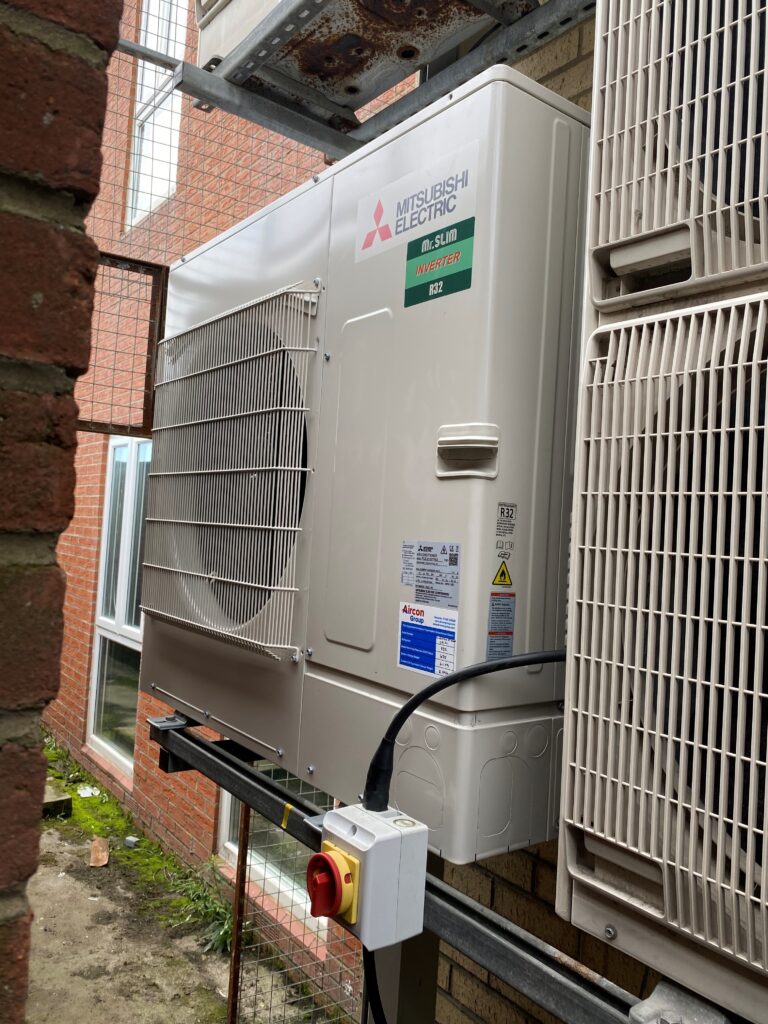
A split air conditioning system typically connects an indoor unit with an outdoor unit.
This type of arrangement can be suitable where individual classrooms, offices or specific problem areas require independent heating and cooling.
Its advantages can include relatively straightforward control and the ability to target individual spaces rather than conditioning areas that don’t need it.
Multi-split systems
A multi-split arrangement can connect multiple indoor units to outdoor equipment, potentially making it useful where several nearby rooms need climate control.
The suitability depends on building layout and the individual requirements of the spaces involved.
VRF or VRV systems
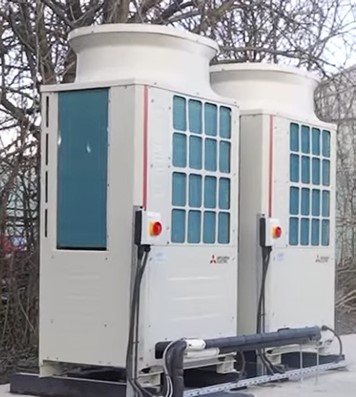
For larger or more complex buildings, VRF air conditioning may be considered.
Variable refrigerant flow systems are designed to serve multiple indoor zones and adjust output according to demand. This can make them useful where a school has numerous rooms with different heating and cooling requirements.
Depending on the system design, heat recovery may also allow heat to be moved between different parts of a building.
For example, one sunny area might require cooling while another part of the school requires heating.
Rather than treating those requirements as completely separate problems, an appropriately designed heat recovery system may be able to use energy more intelligently.
The correct choice depends on a detailed assessment—not simply which technology sounds most sophisticated.
20. Good air conditioning starts with good system design
Buying equipment is only one part of an air conditioning installation.
System design is arguably more important.
If equipment is incorrectly sized, poorly positioned or controlled badly, even high-quality technology may fail to provide the expected comfort or efficiency.
Before specifying a system, an installer should understand how each space behaves.
That means considering heat gains from:
people + sunlight + lighting + computers + equipment + building fabric + neighbouring spaces
From there, the required heating and cooling loads can be calculated.
Why correct sizing matters
A system needs sufficient capacity to deal with expected loads, but simply choosing an unnecessarily large unit isn’t good design.
Correct specification helps support:
- effective temperature regulation;
- appropriate energy efficiency;
- comfortable air distribution;
- manageable noise levels;
- reliable operation;
- sensible running costs;
- equipment longevity.
Placement matters as well.
Cold air shouldn’t be directed continuously onto pupils or teachers. Indoor units need suitable locations for distributing conditioned air around the room, while outdoor equipment needs to be positioned with consideration for airflow, access, security and noise.
In a school environment, installation planning may also need to account for lessons, examinations, safeguarding requirements and access restrictions.
This makes early planning particularly valuable.
21. Maintenance is essential for long-term performance
An air-conditioning system doesn’t stop needing attention once it has been installed.
Like other mechanical equipment, it requires ongoing inspection and maintenance.
Filters become dirty. Components wear. Drainage needs checking. Heat exchangers can accumulate debris. Controls need to continue operating correctly.
Neglecting maintenance can affect performance, energy efficiency, air circulation and system reliability.
For schools, planned maintenance also provides an opportunity to identify problems before they become disruptive. Nobody wants an important classroom cooling system to fail during the hottest week of the year.
A sensible maintenance programme may include:
- filter inspection and cleaning;
- checking indoor and outdoor units;
- cleaning heat-exchange surfaces where necessary;
- checking condensate drainage;
- testing controls and temperature settings;
- inspecting refrigerant circuits as appropriate;
- checking for unusual noise or vibration;
- assessing general system performance.
Schools should follow the maintenance requirements appropriate to their equipment and applicable regulations.
Timing maintenance around the academic year
The school calendar can actually make planned maintenance easier.
At Aircon Group we have a specialist School Liaison Executive, an ex-teacher of 20 years, school governor and PTA member. He will help to have maintenance or installations at a suitable time for the school.
Larger inspections, upgrades, maintenance and repairs can often be scheduled around holidays or quieter periods, reducing disruption to lessons.
Preventative maintenance also gives schools greater visibility over the condition of their equipment, making future replacement and budgeting easier to plan.
22. What should a school consider before installing air conditioning?
The decision shouldn’t begin with:
“Which air conditioner should we buy?”
It should begin with:
“What problem are we trying to solve?”
Perhaps one classroom overheats every afternoon. Maybe an ICT suite remains warm throughout the year. Perhaps an extension needs independent heating and cooling, or several parts of the school have become difficult to manage using the existing system.
Defining the problem makes it easier to design the right solution.
A useful pre-installation checklist includes:
- Identify the rooms that experience overheating or poor temperature control.
- Record when those problems occur.
- Consider typical and maximum occupancy.
- Review existing heating and ventilation.
- Assess window orientation and solar gain.
- Identify significant heat-generating equipment.
- Consider fresh-air requirements.
- Decide whether heating as well as cooling is required.
- Consider individual room or zone control.
- Review likely operating hours.
- Consider noise requirements.
- Plan for future maintenance access.
- Evaluate energy consumption and expected running costs.
- Consider how installation work can minimise disruption to the school.
Taking this approach helps move the discussion away from individual products and towards the overall performance of the building.
23. Is air conditioning suitable for older school buildings?
Generally, yes.
Older schools can actually have some of the most challenging indoor environments because their buildings were designed for a very different era.
However, installation may require additional planning.
Traditional construction, thick walls, unusual layouts, heritage considerations and limited service routes can affect what is practical.
This doesn’t necessarily rule out air conditioning.
Instead, it makes careful design even more important.
In some cases, targeted cooling in the worst-affected rooms may be more sensible than attempting to condition the entire property. In others, a broader HVAC upgrade may provide better long-term value.
Existing building problems should also be understood first.
If a room suffers from excessive heat because of uncontrolled solar gain, poor insulation or another identifiable issue, it may be sensible to address those factors alongside mechanical cooling.
Air conditioning works best as part of a building strategy—not as a way of ignoring problems elsewhere.
24. What are the main advantages of air conditioning in schools?
Taken together, the case for school air conditioning isn’t based on one dramatic benefit.
It’s the combination that matters.
Appropriately designed systems can provide:
- Better temperature control in classrooms and other occupied spaces.
- Greater thermal comfort for pupils and staff.
- A more comfortable learning environment during warm weather.
- Reduced disruption caused by classroom overheating.
- Better conditions for focus and concentration.
- Flexible heating and cooling throughout the year.
- Individual control for rooms with different requirements.
- Support for ICT suites and other high-heat-load spaces.
- Improved management of humidity and indoor conditions.
- Potential energy-efficiency advantages through modern controls and zoning.
- Less reliance on opening windows solely for temperature relief.
- Greater flexibility in how school spaces are used.
Perhaps most importantly, modern air conditioning in schools allows the indoor environment to become something that can be actively managed.
Rather than hoping that classrooms remain comfortable, schools can design for comfort.
25. Creating better classrooms starts with the environment
Education will always depend primarily on people: pupils willing to learn, teachers capable of inspiring them and schools providing the resources they need.
Air conditioning isn’t a substitute for any of that.
But the physical environment matters.
A classroom that is excessively hot, humid or uncomfortable creates an unnecessary barrier. A room with controlled temperatures, appropriate ventilation and good air movement provides a much better foundation for teaching and learning.
That is the strongest argument for investing in school climate control.
It isn’t about making classrooms artificially cold.
It is about creating consistent, comfortable and productive learning environments in which the building quietly supports the people using it.
For schools considering improvements, the best starting point is a proper assessment of the building, its occupancy, existing services and the areas where overheating is actually occurring. From there, an appropriately designed solution can balance classroom comfort with energy efficiency, running costs and long-term maintainability.
Aircon Group provides commercial air-conditioning solutions for organisations looking to improve control of their indoor environment. Schools considering an upgrade can learn more about Aircon Group and discuss the requirements of individual classrooms, specialist spaces or a wider school building before deciding which approach is most appropriate.
Ultimately, the advantages are not found in the equipment itself. They are found in what good climate control helps create: comfortable pupils, supported teachers, fewer environmental distractions and classrooms better prepared for learning.
Frequently Asked Questions About Air Conditioning in Schools
1. Is air conditioning in schools safe for children?
Yes, when it is correctly designed, installed, operated and maintained, air conditioning can be safely used in schools. The important considerations are appropriate temperature settings, sensible airflow and regular maintenance.
Indoor units should be positioned so that pupils aren’t subjected to an uncomfortable stream of cold air for long periods. Schools should also avoid excessive cooling. The objective is thermal comfort and a stable classroom temperature, rather than making rooms unnecessarily cold.
2. What temperature should an air-conditioned classroom be?
There isn’t one perfect classroom temperature that suits every pupil, building and season. Thermal comfort depends on factors including humidity, clothing, activity levels, air movement and outdoor conditions.
In practice, schools should aim for a comfortable, consistent temperature rather than creating a dramatic difference between indoor and outdoor conditions. Good controls allow staff to make sensible adjustments while preventing continual changes to thermostat settings.
3. Can air conditioning make pupils ill or cause colds?
Air conditioning itself doesn’t cause the common cold; colds are caused by viruses. During maintenance indoor units are cleaned with an anti viral.
However, poorly maintained equipment, uncomfortable temperature settings or excessive airflow can make an indoor environment unpleasant. This is one reason regular servicing, filter maintenance and correct system operation are important.
A well-maintained system should be used as part of a wider strategy incorporating suitable classroom ventilation, air circulation and indoor air quality management.
4. Does school air conditioning need to run all day?
Not necessarily.
One of the benefits of modern school air conditioning is that systems can be controlled according to occupancy and demand. A classroom may require cooling during an afternoon lesson but very little conditioning when it is empty.
Timers, schedules, thermostats and zoned temperature control can help schools operate systems only when required. This can reduce unnecessary energy consumption while still maintaining a comfortable learning environment when rooms are occupied.
5. Will classroom air conditioning be too noisy for lessons?
It shouldn’t be when the system is correctly selected and installed.
Noise performance is an important consideration for educational environments because excessive background sound can become a distraction during teaching, reading, examinations and other activities requiring focus and concentration.
Equipment selection, capacity and positioning can all influence operating noise. Schools should therefore discuss acoustic requirements during system design, particularly for libraries, examination rooms, SEN spaces and other noise-sensitive areas.
6. Can air conditioning be installed without closing the school?
In many cases, installation work can be planned to minimise disruption to pupils and staff.
Depending on the scale of the project, work may be phased by classroom, floor or building area. More disruptive elements can potentially be scheduled during school holidays, weekends or other periods when occupancy is lower.
Planning is particularly important for larger projects because an air conditioning installation may involve indoor and outdoor equipment, pipework, electrical supplies, drainage and control systems.
Carrying out a detailed site assessment beforehand allows the installation programme to be coordinated around the school’s timetable wherever practical.
7. Can schools control the temperature of each classroom separately?
Yes, depending on the type and design of the system.
Individual or zoned control can be particularly valuable in schools because classrooms rarely experience identical conditions. One room may receive strong afternoon sunshine while another remains shaded. An ICT suite might generate considerable internal heat while a neighbouring classroom requires very little cooling.
Appropriate controls allow different areas to respond to their own heating and cooling requirements.
This can improve classroom comfort while helping avoid unnecessary energy consumption in spaces that don’t require conditioning.
8. Can school air conditioning be controlled remotely?
Many modern air-conditioning systems can support centralised or remote control, depending on the equipment and controls installed.
This can be particularly useful across larger schools where facilities teams need oversight of numerous classrooms and zones.
Depending on the system, central controls may allow authorised staff to monitor or manage:
- temperature settings;
- operating schedules;
- individual zones;
- heating and cooling modes;
- system operation;
- energy-management settings.
Centralised control can also help prevent situations where individual rooms are being excessively heated or cooled, supporting more consistent conditions and potentially improving energy efficiency.
9. How long does school air conditioning last?
There is no fixed lifespan for every air-conditioning system. Longevity depends on the equipment, installation quality, operating hours, environmental conditions and how well the system is maintained.
Schools can help protect their investment through regular servicing and preventative maintenance. Keeping filters, heat exchangers, drainage and other components in suitable condition can support reliable operation and help equipment continue working efficiently.
Long-term planning should therefore consider more than the initial purchase price. Maintenance requirements, energy consumption, expected service life and eventual replacement costs should all form part of the decision.
10. Is air conditioning in schools worth the investment?
That depends on the building and the problem the school is trying to solve.
Where classrooms regularly overheat, specialist rooms generate substantial heat or staff and pupils experience persistent temperature-related discomfort, air conditioning can provide much greater control over the learning environment.
The value isn’t simply measured by how cool a classroom becomes. Schools should consider the wider benefits: student comfort, teacher comfort, reduced heat-related distractions, flexible temperature control, year-round heating and cooling, better use of individual spaces and potential energy-efficiency benefits from modern controls.
For that reason, the best decision usually begins with an assessment rather than a product choice. Understanding where and why overheating occurs makes it possible to determine whether air conditioning is appropriate and what type of system offers the best long-term solution.
Ultimately, the strongest case for air conditioning in schools is straightforward: it gives schools greater control over an environmental factor that can otherwise interfere with teaching, concentration and everyday classroom comfort.