Commercial Air Conditioning Costs: What Businesses Should Budget
Commercial air conditioning is rarely a single-line expense. A realistic budget needs to account for the equipment itself, installation labour, electrical work, controls, commissioning and the energy and maintenance costs that follow. The size and layout of the building, cooling load, number of rooms or zones, operating hours and type of system can all change the final figure substantially.
The short version for businesses: budget for the whole life of the system, rather than simply comparing the initial purchase price. A lower upfront quote can become the more expensive option if the equipment consumes more electricity, is poorly sized or requires greater maintenance over its service life.
For most businesses, an air conditioning budget should therefore consider:
- CAPEX: equipment, installation, electrical works, pipework, controls and commissioning.
- OPEX: electricity, planned maintenance, servicing and repairs.
- Building requirements: floor area, occupancy, glazing, insulation, ventilation and internal heat gains.
- System choice: single-split, multi-split, cassette, ducted or VRF/VRV.
- Efficiency: seasonal performance, controls and the amount of electricity actually consumed.
- Contingency: access complications, electrical upgrades, remedial work and unexpected installation requirements.
- Long-term expenditure: maintenance, component replacement and eventually replacement air conditioning.
Budgeting principle: the cheapest system to buy is not necessarily the cheapest system to own. Businesses should compare installation cost, expected annual energy use, maintenance and anticipated lifespan before deciding what represents good value.
This first part explains what goes into a commercial air conditioning quotation, why two apparently similar premises can receive very different estimates, and how businesses can establish a more useful initial budget.
How Much Does Commercial Air Conditioning Cost in the UK?
There is no reliable universal figure for commercial air conditioning cost in the UK because a commercial installation is designed around the building and how that building is used.
A small office requiring one wall-mounted indoor unit and an outdoor condenser is fundamentally different from a multi-storey workplace requiring dozens of indoor units, zoning, sophisticated controls and extensive refrigerant pipework.
The same applies when comparing a shop, restaurant, warehouse and office. Their floor areas might be similar, but their cooling loads can be very different.
That is why an accurate commercial air conditioning installation cost normally begins with an assessment of the premises rather than a price pulled from a generic £ per m² figure.
Businesses considering a new system can explore our commercial air conditioning services to understand the wider installation requirements involved.
Think in three budgets, not one
A useful way to approach commercial HVAC costs is to divide expenditure into three buckets:
| Budget | What it covers | Typical considerations |
| Initial CAPEX | Buying and installing the system | Indoor and outdoor units, labour, pipework, electrical works, controls, access and commissioning |
| Annual OPEX | Keeping it operating | Electricity consumption, servicing, planned maintenance and repairs |
| Lifecycle budget | Owning it over the long term | Component replacement, efficiency deterioration, major repairs and eventual system replacement |
This distinction matters.
Imagine Business A chooses a system because its initial cost is lower. Business B spends more initially on correctly sized, efficient equipment with effective zone control. If Business B subsequently consumes less electricity every working day, its higher CAPEX may be offset by lower OPEX.
The question, therefore, should not simply be:
“How much does commercial air conditioning cost?”
A more useful question is:
“What will this air conditioning system cost our business to own and operate over its expected service life?”
That shift brings total cost of ownership, energy consumption, maintenance costs and eventual replacement costs into the purchasing decision.
What Makes Up a Commercial Air Conditioning Installation Cost?
The equipment is the obvious expense, but it is only one part of an installation.
Depending on the project, a commercial air conditioning quote may need to account for:
- Indoor units
- Outdoor units or condensers
- Refrigerant pipework
- Condensate routes
- Electrical works and supplies
- Controls and zoning
- Installation labour
- Access equipment
- Builders’ work or making good
- Testing and commissioning
Larger projects may also involve project management, specialist lifting equipment, roof access and work outside normal business hours.
This is one reason comparing quotations solely by their headline totals can be misleading. Businesses should establish what is actually included.
An itemised proposal is considerably more useful than a number without context.
Equipment and system type
The type of air conditioning selected has a major influence on initial system costs.
A single-split system typically connects one indoor unit with one outdoor unit. This can make sense for a smaller commercial room or individual office.
A multi-split system can serve several indoor units from an outdoor system, while larger or more complex commercial buildings may benefit from VRF or VRV systems capable of serving multiple zones.
Other projects might use:
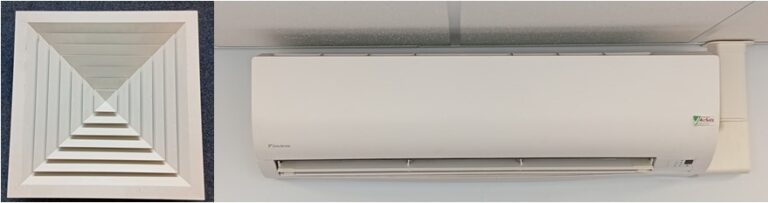
- Wall-mounted air conditioning
- Cassette air conditioning
- Ducted air conditioning
- Heat recovery VRF
- Reverse-cycle air conditioning
There is no automatic winner.
A system should suit the layout, usage pattern and cooling and heating requirements of the premises. Paying for complexity that a building does not require wastes capital; choosing an overly simplistic solution for a complex building can create operational compromises for years.
Why Floor Area Alone Cannot Tell You the Cost
Cost per square metre can be useful during very early-stage budgeting. It is not, however, a substitute for proper system sizing.
Consider two 200 m² commercial spaces.
The first is a well-insulated office with moderate glazing, relatively low occupancy and conventional working hours. The second has large south-facing windows, dense occupancy, computers and other heat-producing equipment and substantially longer operating hours.
Both occupy 200 m².
They do not necessarily require the same cooling capacity.
A proper assessment considers the cooling load rather than floor area in isolation.
Factors that influence cooling load
Important variables can include:
- Floor area and ceiling height
- Number of occupants
- Hours of occupation
- Solar gain
- Size and orientation of glazing
- Building insulation
- Lighting
- Computers and IT equipment
- Machinery and other internal heat gains
- Ventilation rates
- Number and use of individual rooms
- Desired indoor temperature
Restaurants, for example, can experience considerable internal heat gains. Offices may have dense IT loads. Retail spaces can combine lighting, glazing, customers and frequently opening doors.
Ventilation requirements can also interact with the wider mechanical strategy of a commercial property. Where this forms part of the project, our commercial ventilation services cover this distinct but closely related aspect of building comfort and air movement.
Do not size an AC budget from floor area alone. Two buildings of identical size can require different cooling capacities, different equipment and consequently very different installation and running budgets.
System Sizing: Bigger Is Not Automatically Better
It is tempting to treat additional cooling capacity as insurance. In practice, oversized air conditioning is not necessarily desirable.
Correct system sizing aims to match equipment capacity with the calculated demand of the building.
Oversizing can mean paying for capacity that is not required. It can also affect the way equipment cycles and operates at part load. Undersizing creates the opposite problem: the system may struggle to maintain the required conditions during periods of high demand.
Both can undermine the original business case.
For commercial projects, sizing should therefore take into account both peak conditions and how the system is likely to operate during ordinary working days.
That matters because air conditioning rarely spends every hour of every year operating at maximum output.
Occupancy can change the calculation
Occupancy is especially important.
A meeting room might be empty for much of the day and then suddenly contain 15 people. An open-plan office may maintain fairly predictable occupancy. A retail business can experience peaks and troughs throughout its trading day.
A multi-zone building consequently benefits from thinking about where cooling is needed and when, rather than treating the entire property as one uniform space.
This is where zoning, scheduling, occupancy sensors and smart controls can become financially relevant rather than merely convenient.
Site Conditions Can Add to the Installation Budget
Two businesses can select similar equipment and still receive different installation quotations because the physical difficulty of installing it is different.
An outdoor unit positioned conveniently at ground level is one proposition. Equipment requiring specialist roof access or lifting equipment is another.
Likewise, short and straightforward refrigerant pipework is different from a route that must travel considerable distances through a complex occupied building.
Potential cost factors include:
- Difficult site access
- Long refrigerant pipework runs
- Complex condensate routes
- Roof-mounted outdoor equipment
- Cranes, hoists or other lifting equipment
- Restricted working areas
- Out-of-hours installation
- Additional electrical works
- Electrical supply upgrades
- Making good after installation
- Existing services that complicate routing
These items are easy to overlook when creating an initial AC installation budget, yet they can be important contributors to the eventual project cost.
Do not forget the electrical side
Commercial air conditioning requires an appropriate electrical supply. Depending on the existing building infrastructure and the proposed equipment, additional circuits, isolation or an electrical supply upgrade may be necessary.
This should be established early rather than appearing as an unwelcome addition after equipment has been selected.
The same principle applies to businesses whose cooling requirements extend beyond conventional comfort air conditioning. Temperature-controlled environments can have quite different operating requirements, which is why commercial refrigeration should be treated as its own design and budgeting consideration rather than assumed to be interchangeable with comfort cooling.
A Site Survey Turns a Guess Into a Useful Budget
Online figures are helpful for orientation. They cannot see your building.
A commercial site survey gives an installer the opportunity to understand the factors that actually determine the project:
- Where indoor units can be positioned
- Where outdoor equipment can be located
- Suitable refrigerant pipework routes
- Condensate drainage
- Electrical requirements
- Access constraints
- Cooling and heating loads
- Noise considerations
- Building use and occupancy
- Required controls and zoning
This information helps transform a rough budget estimate into a meaningful commercial air conditioning quotation.
It also reduces the risk of hidden installation costs appearing later.
For a business planning expenditure, that certainty has value in itself. A quotation that properly reflects the site is much easier to put through an internal capital approval process than an attractive headline number surrounded by exclusions.
And once the installation budget is understood, there is a second number that deserves just as much attention: what the system will cost to run every year.
That is where electricity tariffs, operating hours, annual kWh, seasonal efficiency and control strategy begin to reshape the economics of commercial air conditioning.
What Does Commercial Air Conditioning Cost to Run?
Installation is only the beginning of the financial picture.
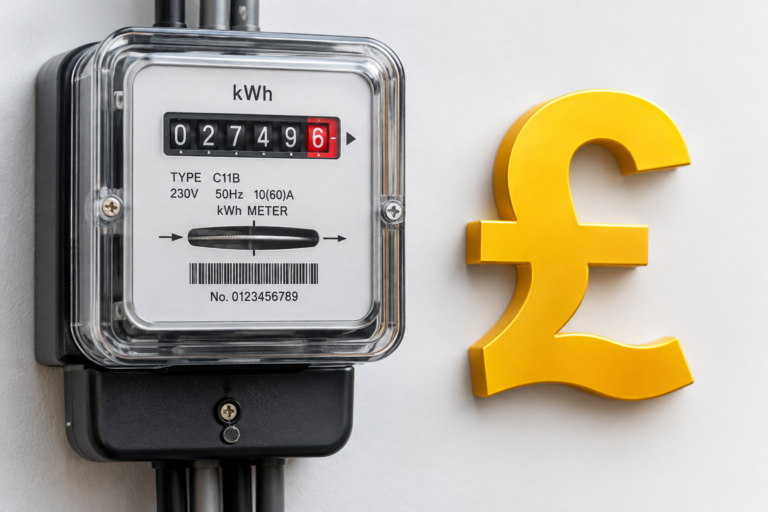
Once a system is operating, electricity becomes one of the most significant contributors to its whole-life cost. For a business running air conditioning throughout the working week — particularly across several rooms or zones — relatively small differences in efficiency and operating behaviour can accumulate over thousands of hours.
This is why commercial AC running costs deserve to be considered alongside the initial quotation rather than after the system has been installed.
At a basic level, running cost is influenced by three things:
Electricity consumed × electricity unit rate × operating time = energy cost
The real calculation is more nuanced because modern systems modulate their output rather than continuously drawing their maximum rated power. Nevertheless, those three variables provide a useful framework for understanding where the money goes.
The biggest influences on annual running costs
A commercial property’s annual air conditioning running costs can be affected by:
- Cooling and heating demand
- System efficiency
- Operating hours
- Number of conditioned zones
- Temperature setpoints
- Occupancy patterns
- Outdoor temperatures
- Internal heat gains
- Building insulation and glazing
- Control strategy
- Maintenance condition
- Commercial electricity tariff
A system operating eight hours a day in a conventional office will have a very different energy profile from equipment serving a hospitality business for 14 hours a day.
Likewise, a rarely occupied meeting room should not necessarily be conditioned in exactly the same way as a permanently occupied open-plan office.
How the building operates matters almost as much as what equipment is installed.
Calculating an Estimated Annual Air Conditioning Energy Cost
Businesses wanting to establish an annual AC operating budget can start with electricity consumption.
Electricity is billed in kilowatt-hours, or kWh. If estimated annual consumption and the applicable electricity unit rate are known, a basic cost estimate can be made:
Annual electricity cost = annual kWh × electricity price per kWh
For example, if a system consumed a hypothetical 1,200 kWh over a year and the business paid £0.25 per kWh:
1,200 × £0.25 = £300 per year
This is deliberately a simplified example rather than a prediction of what a particular commercial system will consume.
Actual consumption depends on the equipment, demand, controls, climate, building and usage. A system’s nominal cooling capacity should also not be mistaken for its electrical consumption.
That distinction is important when businesses compare quotes.
Cooling capacity is not electricity consumption
An air conditioning system described as having a particular kW cooling capacity is stating how much cooling it can provide. It does not mean it continuously consumes that same number of kilowatts of electricity.
Modern inverter-driven equipment adjusts output according to demand.
When a room approaches its desired temperature, an inverter compressor can reduce its output instead of simply operating continuously at full capacity. Consequently, real-world energy consumption depends heavily on the amount of work the system actually needs to perform.
This is one reason a basic calculation based solely on equipment capacity can give a misleading estimate of commercial air conditioning running costs.
Why Energy Efficiency Matters to the Business Case
A difference in purchase price happens once.
A difference in energy consumption can affect the electricity bill every day the system operates.
That makes energy efficiency particularly important for commercial buildings with long operating hours.
Efficiency measures such as SEER, SCOP, EER and COP can help describe equipment performance, although they measure different aspects of that performance and should not simply be treated as interchangeable numbers.
For budgeting purposes, the broader point is straightforward: look beyond the equipment price and consider how efficiently the system is expected to deliver the heating or cooling the building needs.
Seasonal efficiency matters more than a single perfect moment
Commercial systems rarely operate under identical conditions all year.
Outdoor temperatures change. Occupancy changes. Solar gain varies. Different zones experience different loads, and the building may need substantially less cooling on one day than another.
That makes seasonal efficiency and part-load efficiency relevant to real-world operating costs.
An efficient system that can adapt effectively to varying demand may offer a stronger whole-life proposition than equipment chosen primarily because its initial cost is lower.
When evaluating options, businesses should therefore consider:
- The required cooling capacity
- Expected operating hours
- Seasonal efficiency
- Part-load performance
- Expected annual electricity consumption
- Current electricity unit rate
- Likely changes in building use
- Controls available to prevent unnecessary operation
These factors give considerably more context than purchase price alone.
Controls Can Reduce Wasted Operating Hours
One of the simplest ways to waste energy is to condition space that does not need conditioning.
A commercial building might contain offices, meeting rooms, reception areas, kitchens, stock rooms and other spaces with completely different patterns of use.
Running all of those spaces identically can be inefficient.
Zone control allows different areas to respond to their own requirements. Depending on the system and building, this can be supported by scheduling, occupancy sensors, local controllers, centralised controls or integration with a Building Management System (BMS).
Smart controls and remote monitoring can also make it easier to identify unnecessary operation.
Consider a meeting room used for three hours during an otherwise quiet day. There may be little value in treating that room as though it has the same occupancy profile as the main office.
The same principle applies after everyone has gone home.
Temperature setpoints matter too
Extreme temperature settings can increase energy demand without necessarily improving comfort.
Setting cooling unnecessarily low can make equipment work harder and for longer. In a commercial environment, an appropriate temperature strategy can therefore contribute to both occupant comfort and energy management.
A sensible control policy might include:
- Defined operating schedules
- Appropriate temperature setpoints
- Separate control of different zones
- Prevention of unnecessary after-hours operation
- Regular review of occupancy patterns
- Monitoring unusual increases in electricity consumption
For larger properties, these operational details can become meaningful components of the annual energy budget.
Split, Multi-Split, Ducted or VRF: How System Choice Affects Cost
System architecture influences both CAPEX and OPEX.
There is no rule that one type of commercial air conditioning is always cheapest because the right choice depends on the building.
Single-split systems
A single-split air conditioning system connects an indoor unit to its own outdoor unit.
For smaller premises or individual rooms, this can provide a relatively straightforward solution. It can also allow individual areas to operate independently.
As the number of rooms grows, however, installing numerous separate outdoor units may become less practical.
Multi-split systems
A multi-split system enables several indoor units to work with an outdoor system.
This can reduce the number of outdoor units required and provide a useful solution where several individual rooms need conditioning.
Installation complexity, pipework routes and the required combination of indoor units still need to be considered when establishing the budget.
Ducted air conditioning
Ducted air conditioning can provide a discreet solution because conditioned air is distributed through ductwork and grilles.
The equipment price, however, is not the only consideration. Ceiling voids, duct routes, access and associated building work can influence installation labour and total project cost.
Where air distribution and fresh-air requirements need to work together, the wider building-services design becomes particularly important.
VRF and VRV systems
For larger and more complex commercial properties, VRF or VRV systems can provide sophisticated multi-zone control.
These systems can be particularly relevant where a building contains many areas with different demands.
Some heat-recovery configurations can also move heat between zones — useful, for example, where one part of a building requires cooling while another requires heating.
The initial capital cost may be greater than for a simpler arrangement, but that does not automatically make the system more expensive over its life.
Again, total cost of ownership is the better comparison.
Budget According to the Building, Not Just the System
Different businesses impose very different demands on their cooling equipment.
Small and medium-sized offices
Office air conditioning may need to deal with:
- Staff occupancy
- Computers and monitors
- Meeting-room peaks
- Solar gain through glazing
- Variable working patterns
- Server or communications equipment
Hybrid working can make occupancy less predictable than it once was. This increases the value of effective zoning and scheduling because cooling a mostly empty floor throughout the working day can create unnecessary energy consumption.
Retail premises
Retail air conditioning has its own challenges.
Customer numbers fluctuate, doors may open frequently, lighting can contribute heat and large areas of glazing can increase solar gain. It might also have refrigerated equipment that might struggle in higher temperatures, the refrigeration also produces heat. An example of this is petrol station shops. Large retail area with refrigeration and a large footfall with the door opening on a regular basis. The refrigeration and air conditioning must work together.
Comfort is also commercially important. The environment forms part of the customer experience, meaning system reliability can matter beyond its direct energy cost.
Restaurants and hospitality
Restaurants, cafés and hospitality venues can have high and highly variable internal heat loads.
Customers, lighting and equipment can all contribute heat, while kitchens and occupied dining areas introduce ventilation considerations that need to be assessed properly.
These are cases where comfort cooling should not be considered in isolation from the wider building environment.
Warehouses and larger commercial buildings
Warehouse air conditioning can vary enormously depending on what the building contains and which areas actually require temperature control.
Conditioning an entire large-volume building is a very different proposition from cooling offices or designated working zones within it.
A detailed assessment can identify whether the whole space needs treatment or whether a more targeted approach is appropriate.
The Hidden Costs Businesses Should Put in the Budget
A good commercial air conditioning budget contains some breathing room.
Not because unexpected costs are inevitable, but because existing commercial buildings are not always predictable until the proposed installation has been properly surveyed.
Potential additional costs can include:
- Electrical supply upgrades
- Specialist access equipment
- Additional pipework
- Condensate pumps or complex drainage routes
- Roof access
- Lifting equipment
- Builders’ work
- Making good
- Out-of-hours installation
- Changes required to existing services
- Additional control equipment
- Remedial works discovered during installation
A contingency budget can therefore be sensible, particularly for refurbishment and retrofit projects.
This should not replace a detailed survey. Quite the opposite: the better the initial investigation, the more accurately potential complications can be identified and priced before work begins.
Maintenance Is an Operating Cost, Not an Optional Extra
Once installation and electricity have been budgeted, planned maintenance becomes the next part of the whole-life calculation.
Air conditioning contains filters, coils, fans, electrical components, refrigerant circuits and condensate systems that require appropriate attention during the equipment’s life.
Ignoring maintenance to reduce short-term OPEX can prove to be false economy.
Dirty filters and coils, restricted airflow or undetected faults can affect performance. Small issues may also develop into larger repair costs when left unresolved.
An annual air conditioning budget should therefore make provision for:
- Routine inspection
- Filter maintenance
- Coil cleaning where required
- System performance checks
- Condensate checks
- Electrical inspection
- Refrigerant-related checks where applicable
- Preventative maintenance
- Repair allowance
The exact maintenance requirement depends on the system, its environment, usage and applicable manufacturer and regulatory requirements.
Maintenance can protect more than efficiency
Commercial air conditioning servicing is not solely about lowering electricity consumption.
Planned maintenance can also contribute to:
Reliability. Problems may be identified before they result in disruption.
Equipment lifespan. Correctly maintained systems have a better opportunity to deliver their intended service life.
Budget predictability. Planned expenditure is generally easier for a business to manage than unexpected emergency repair costs.
Warranty considerations. Maintenance requirements associated with the system warranty should be understood and followed.
Compliance. Certain commercial systems may also have inspection, refrigerant-management or other regulatory obligations.
That means the maintenance budget should be established when the system is purchased — not several years afterwards when something goes wrong.
The Real Question: What Will the System Cost Over 5 or 10 Years?
This is where the individual pieces of the budget begin to come together.
A business comparing two systems can consider a simplified lifecycle calculation:
Initial installation cost + energy costs + maintenance + repairs + other ownership costs = whole-life expenditure
Suppose System A has the lowest installation price but higher projected energy consumption. System B costs more upfront but offers lower expected annual energy use and more appropriate control for the building.
Looking only at CAPEX favours System A.
Looking at five-year or ten-year cost may produce a completely different result.
This is the basis of lifecycle budgeting.
A stronger commercial comparison can therefore include:
| Cost category | Year 1 | Years 2–5 | Longer term |
| Equipment and installation | Major | — | Replacement eventually |
| Electricity | Ongoing | Ongoing | Ongoing |
| Planned maintenance | Ongoing | Ongoing | Ongoing |
| Repairs | Possible | Allowance advisable | Potentially increases with age |
| Compliance/inspection | Where applicable | Where applicable | Where applicable |
| Major components | Unlikely in normal circumstances | Possible | Greater consideration as equipment ages |
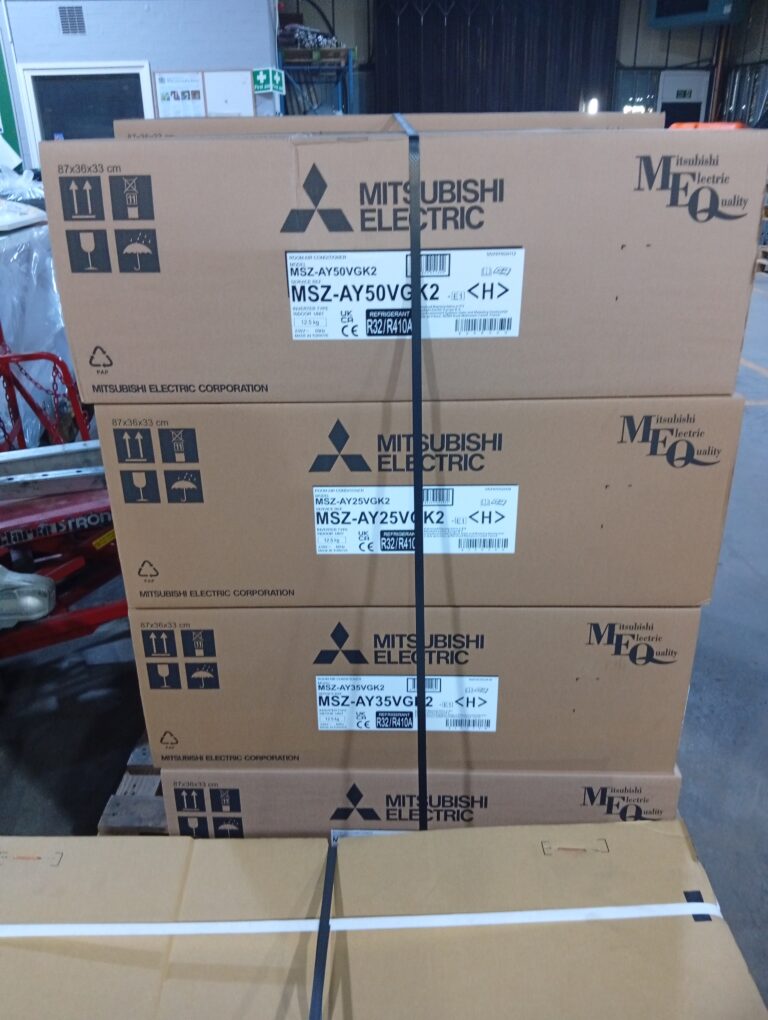
The objective is not to predict every future repair to the pound. It is to avoid pretending that the initial invoice represents the complete cost. An obvious advantage is a longer warranty, Aircon Group offers a longer warranty than most companies, due to their relationship with manufacturers. They are Mitsubishi Diamond partners, the highest level you can get. With the highest expectations from Mitsubishi on Aircon Group.
ROI and Payback: When Spending More Can Make Financial Sense
A higher-efficiency system or controls upgrade can require additional capital expenditure. The commercial question is whether that expenditure produces sufficient savings or other benefits to justify it.
A basic payback period compares additional investment with expected annual savings.
For example, if one option hypothetically costs £4,000 more but is expected to save £1,000 a year in energy, the simple payback period would be approximately four years:
£4,000 ÷ £1,000 = 4 years
Again, that is an illustrative calculation rather than a claim about the savings available from a particular system.
A more complete return on investment (ROI) assessment might also consider:
- Maintenance differences
- Expected service life
- Energy price assumptions
- Repair requirements
- Business operating hours
- Changes in occupancy
- Heating as well as cooling performance
- Control improvements
- Replacement timing
This becomes particularly useful when comparing an ageing installation with a modern air conditioning retrofit or system upgrade.
The cheapest decision this financial year may not be the cheapest decision over the next decade.
Replacement Versus Repair Deserves Its Own Budget Conversation
Commercial equipment eventually reaches a point where repeated repairs need to be considered against replacement.
One breakdown does not automatically justify a new system. Equally, repeatedly spending money on ageing equipment can become increasingly difficult to justify.
When considering repair versus replacement, businesses can examine:
- Age of the existing system
- Frequency of breakdowns
- Cost and availability of replacement components
- Refrigerant considerations
- Current energy consumption
- Efficiency compared with newer equipment
- Suitability for current building use
- Expected remaining service life
- Cost of business disruption
- Likely future repair expenditure
This turns replacement from an emergency purchase into an HVAC asset management decision.
Businesses can then create a replacement allowance within longer-term capital planning instead of waiting for critical equipment to fail before finding the money.
For organisations with temporary or specialist cold-storage requirements, capital investment is not always the only model available. Refrigerated trailer hire can, for appropriate applications, provide a different route to temporary temperature-controlled capacity.
Build the Budget Around Total Cost of Ownership
At this stage, a commercial air conditioning budget should contain much more than an equipment figure.
It should begin to answer four separate questions:
- What will the system cost to install?
- What is it likely to cost to operate each year?
- What should be allowed for maintenance and repairs?
- What is the likely whole-life financial commitment?
Only then can two proposals be compared on genuinely commercial terms.
A cheaper quotation can still be the right choice. A more expensive quotation can also be the right choice.
The important point is understanding why.
Compliance Costs Belong in the Budget Too
Commercial air conditioning is not simply an equipment, electricity and maintenance decision. Depending on the type, size and refrigerant charge of the installation, businesses may also have regulatory and inspection responsibilities.
These should be considered during procurement rather than discovered after the system has been commissioned.
Two terms businesses are likely to encounter are F-Gas and TM44.
F-Gas considerations
Many commercial air conditioning systems use fluorinated refrigerants, making appropriate refrigerant handling and F-Gas compliance an important consideration.
Where regulated refrigerants are involved, installation, servicing and refrigerant-related work should be carried out by appropriately qualified personnel. Depending on the system and applicable requirements, refrigerant leak checks and associated records may also form part of ongoing system management.
From a budgeting perspective, this reinforces the importance of accounting for professional installation and planned maintenance rather than treating servicing as an optional expense to be removed when budgets become tight.
It also makes refrigerant choice relevant when considering the long-term future of an installation.
What about TM44 inspections?
Businesses operating larger air conditioning installations should also be aware of TM44 air conditioning inspections and whether the combined output of their system brings it within the applicable requirements.
Systems with an effective rated output of more than 12 kW can fall within the scope of statutory air conditioning inspection requirements in England and Wales.
For businesses, the practical point is simple: compliance requirements should form part of the ownership plan.
Ask about them before installation.
That way, the business can understand potential inspection and maintenance obligations alongside electricity costs, servicing costs and system lifespan.
What Should Be Included in a Commercial Air Conditioning Quote?
A quotation should help a business understand what it is buying.
A headline figure with very little supporting detail makes comparison difficult because two contractors may have included completely different scopes of work.
When reviewing a commercial air conditioning quote, look for clarity around:
- Equipment make and specification (Compare like for like in quotes)
- Number and type of indoor units
- Outdoor units
- Cooling and heating capacity
- Controls and zoning
- Refrigerant pipework
- Condensate drainage
- Electrical works
- Installation labour
- Access requirements
- Commissioning
- Making good
- Warranty
- Maintenance requirements
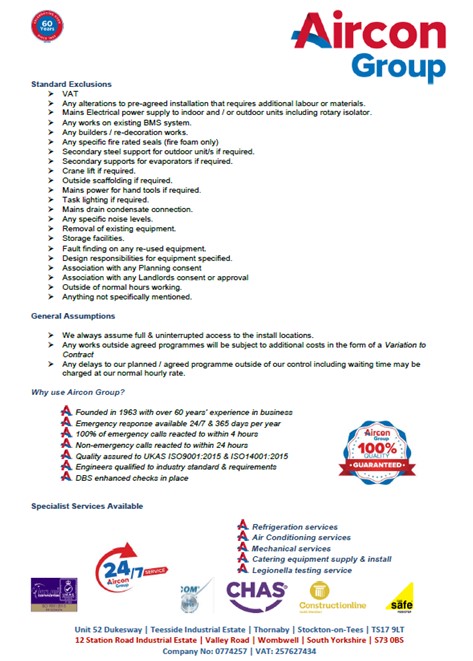
- Exclusions
- VAT treatment
- Expected installation timeline
For more complex projects, the quotation or proposal may also need to explain project management, specialist lifting requirements, phased installation and out-of-hours working.
An itemised proposal makes it much easier to compare competing options on a like-for-like basis.
A lower quote is only genuinely cheaper when it provides the specification, capacity, controls and scope of work the business actually needs.
This distinction is particularly important where one quotation appears dramatically cheaper than the others. Check what has been excluded before assuming the difference represents a saving.
Questions to Ask Before Approving the Budget
Price is important, but the questions surrounding the price often reveal more about long-term value.
Before approving an AC installation budget, a business should be able to answer the following:
- How was the cooling load calculated?
The proposed capacity should reflect the actual building, occupancy, heat gains and usage rather than floor area alone. - Why has this particular system been recommended?
There should be a reason for choosing split, multi-split, cassette, ducted or VRF/VRV equipment. - What exactly is included in the installation price?
Confirm electrical works, pipework, condensate drainage, controls, access and commissioning. - Are there foreseeable additional costs?
Ask about electrical upgrades, specialist access, builders’ work and making good. - How energy efficient is the proposed equipment?
Consider seasonal efficiency and likely part-load operation rather than purchase price alone. - How will the system be controlled?
Zoning, schedules and sensible temperature control can have a direct impact on annual running costs. - What maintenance will be required?
Establish likely servicing requirements before building the annual operating budget. - What warranty applies?
Understand both the warranty period and any conditions attached to it. - What compliance obligations apply?
Establish relevant F-Gas, inspection and record-keeping considerations for the proposed installation. - What is the expected service life?
This provides context for lifecycle budgeting and eventual replacement planning.
A good proposal should make these conversations easier, not harder.
How to Build a Realistic Commercial Air Conditioning Budget
With the main cost categories established, businesses can create a more useful budget by working from the building outward rather than starting with an arbitrary equipment allowance.
Step 1: Define what the building actually needs
Start with the practical requirement.
Which rooms need air conditioning? How many people normally occupy them? What are the working hours? Are there areas with substantial glazing, IT equipment, machinery or other internal heat gains?
Separate needs from nice-to-haves.
For example, a business may discover that several lightly used storage areas do not require the same treatment as occupied offices. Conversely, a meeting room with substantial occupancy peaks may need more cooling capacity than its floor area initially suggests.
Step 2: Establish the cooling and heating load
System sizing should follow the building’s requirements.
The calculation may need to consider:
- Floor area
- Room volume
- Occupancy
- Solar gain
- Glazing
- Insulation
- Internal heat gains
- Ventilation
- Equipment
- Operating hours
This establishes the required cooling capacity and provides the foundation for equipment selection.
Step 3: Establish the capital expenditure
The CAPEX budget should cover more than the air conditioning units.
Include the full installed project:
equipment + controls + pipework + electrical works + labour + access + commissioning + associated works
For refurbishment projects or complicated sites, it may also be prudent to maintain an appropriate contingency.
Step 4: Estimate annual energy expenditure
Next, consider the likely electricity consumption.
A useful estimate should reflect expected operating hours and equipment efficiency rather than assuming that the system constantly operates at maximum capacity.
Businesses can then apply an appropriate commercial electricity tariff or p/kWh assumption to estimate annual energy expenditure.
Because electricity prices change, lifecycle calculations can also be tested against different future energy-cost assumptions.
Step 5: Add planned maintenance
Establish what routine servicing the equipment requires and incorporate this into the annual OPEX budget.
Do not assume maintenance expenditure is zero simply because the equipment is new.
Step 6: Include a repair allowance
No responsible lifecycle budget can predict precisely which component might fail eight years from now.
It can, however, recognise that repair costs exist.
An allowance for future repairs becomes increasingly relevant as equipment ages.
Step 7: Plan for replacement
Commercial air conditioning is a physical asset with a finite service life.
Eventually, equipment will need replacement or substantial upgrading.
Businesses managing multiple properties or systems can benefit from incorporating anticipated replacement cycles into longer-term capital expenditure planning rather than treating every end-of-life system as an unexpected emergency.
A Simple 10-Year Budgeting Model
For strategic planning, it can help to stop thinking in terms of “the AC price” and instead create a basic lifecycle model.
For example:
| Budget element | What to estimate |
| Initial installation | Complete installed CAPEX |
| Annual electricity | Estimated kWh × applicable electricity tariff |
| Annual servicing | Planned maintenance expenditure |
| Repairs | Sensible lifecycle allowance |
| Compliance | Applicable inspection and refrigerant-related obligations |
| Controls/upgrades | Possible improvements during system life |
| Replacement reserve | Longer-term allowance for asset replacement |
From there:
10-year ownership cost = initial CAPEX + 10 years of energy + maintenance + repairs + compliance + relevant upgrades
This does not need to produce a perfectly accurate prediction to be useful.
Its value is in exposing the financial variables.
A business can then model what happens if electricity costs increase, operating hours change or one proposed system consumes less electricity than another.
This is far more informative than comparing two installation prices in isolation.
Where Businesses Commonly Under-Budget
Most air conditioning budget problems do not arise because somebody forgot that the equipment costs money.
They arise because something around the equipment was overlooked.
1. Electrical works
An existing electrical installation may require additional work to accommodate new equipment. Assuming this will automatically be covered by the unit price can create a budget gap.
2. Difficult access
Roof installations, restricted external areas and difficult plant locations can increase labour requirements or require specialist access and lifting equipment.
3. Long pipework routes
The position of indoor and outdoor units matters. Complex or lengthy refrigerant and condensate routes can affect both material and installation costs.
4. Out-of-hours installation
Some businesses cannot have significant installation work taking place while customers or employees are present.
Evening, overnight or weekend working can change project costs.
5. Controls
A basic controller and a sophisticated multi-zone control strategy are not the same thing.
Controls should be specified as part of the project rather than treated as an afterthought.
6. Maintenance
Businesses sometimes approve CAPEX without simultaneously allocating an annual maintenance budget.
That separates two costs which should really be considered together.
7. Future repairs
Repair expenditure is irregular, which makes it easy to ignore during planning. A lifecycle budget should acknowledge that components eventually wear.
8. Business disruption
Downtime can have a cost even when it does not appear on an engineer’s invoice.
If a failed system affects staff productivity, customers, stock, equipment or critical areas, reliability has a commercial value.
Cheap Air Conditioning Can Become Expensive Air Conditioning
There is nothing wrong with seeking a competitive installation price.
The danger lies in confusing low price with low total cost.
A cheap system can become expensive if it is:
- Incorrectly sized
- Inefficient for the required operating pattern
- Poorly controlled
- Difficult to maintain
- Unsuitable for the building
- Expensive to repair
- Frequently running when spaces are unoccupied
Conversely, paying more does not automatically guarantee a better result.
The objective is not to buy the most expensive system available. It is to choose the right specification for the building and its actual use.
That is where lifecycle cost, rather than purchase price, becomes valuable.
Don’t be the person that goes for the cheapest install and everyone complains about it being unfit for purpose.
Energy Savings Should Be Calculated, Not Assumed
Claims about energy savings deserve scrutiny.
If a new system is expected to reduce electricity consumption, ask what the estimate is based on.
A useful comparison might consider:
Existing annual kWh – projected annual kWh = estimated annual energy saving
That saving can then be multiplied by an assumed electricity unit rate to create an indicative annual financial saving.
For example:
5,000 kWh saved × £0.25/kWh = £1,250 indicative annual saving
If achieving that saving requires an additional £5,000 of capital expenditure, the simple payback would be:
£5,000 ÷ £1,250 = 4 years
The actual business case may be more complicated because tariffs, operating patterns and maintenance costs can change, but this provides a transparent starting point.
It is preferable to vague promises that a system will “save money” without explaining how.
Consider Heating as Part of the Equation
Commercial air conditioning should not always be viewed as cooling-only expenditure.
Many modern systems operate as reverse-cycle air conditioning, allowing them to provide both cooling and heating.
That means the financial assessment may need to consider how the proposed system interacts with the building’s existing heating strategy.
For some businesses, the relevant comparison is not simply:
old air conditioning vs new air conditioning
It may be:
existing cooling + existing heating vs a new combined heating and cooling strategy
That broader comparison can materially alter the investment case.
Where a business is considering a commercial heat pump upgrade, decarbonisation strategy or changes intended to improve building energy performance, the implications should therefore be considered at whole-building level rather than viewing the air conditioning equipment in isolation.
Commercial Air Conditioning Budget Checklist
Before approving a commercial air conditioning project, use this checklist to test whether the budget is genuinely complete.
- Has a site survey been completed?
- Has the cooling load been properly assessed?
- Does the proposed capacity reflect occupancy and internal heat gains?
- Is the recommended system appropriate for the building?
- Are all indoor and outdoor units included?
- Is refrigerant pipework included?
- Is condensate drainage included?
- Are electrical works included?
- Have potential electrical supply upgrades been considered?
- Are controls and zoning included?
- Have access requirements been assessed?
- Is specialist lifting equipment required?
- Is commissioning included?
- Is making good included where necessary?
- Are exclusions clearly identified?
- Has estimated annual electricity consumption been considered?
- Has the applicable electricity tariff been considered?
- Has planned maintenance been budgeted?
- Is there an allowance for future repair costs?
- Have warranty conditions been checked?
- Have relevant compliance obligations been identified?
- Has the expected system lifespan been considered?
- Has eventual replacement expenditure been considered?
- Have competing options been compared on total cost of ownership rather than purchase price alone?
If several of those questions cannot be answered, the business may have a price — but it does not yet have a complete budget.
Frequently Asked Questions About Commercial Air Conditioning Costs
How much should a business budget for commercial air conditioning?
There is no single figure suitable for every commercial property. The budget depends on cooling capacity, building size and layout, number of zones, system type, installation complexity, electrical requirements and controls.
A site-specific assessment provides a much more meaningful cost estimate than a generic price based solely on floor area.
What affects commercial air conditioning installation costs the most?
Major influences include system type and capacity, number of indoor units, refrigerant pipework, installation labour, electrical works, site access and controls.
Complex multi-zone buildings will generally require a different design and scope from a small office requiring only one or two conditioned rooms.
How can a business estimate commercial AC running costs?
Start with projected electricity consumption in kWh, expected operating hours and the applicable electricity unit rate.
Remember that cooling capacity in kW is not the same as electrical power consumption. Equipment efficiency, part-load performance, temperature setpoints and controls all affect actual energy use.
Is VRF more expensive than split air conditioning?
A VRF system can involve greater initial complexity and capital expenditure than a simple split installation, but direct price comparisons can be misleading.
VRF may be appropriate for larger multi-zone buildings, whereas split equipment can be suitable for simpler applications. The correct comparison is the system that meets the building’s requirements most effectively over its anticipated life.
Should maintenance be included in the original budget?
Yes.
Planned maintenance is part of the operating cost of commercial air conditioning and should be considered from the outset. Businesses should also understand any maintenance conditions associated with the equipment warranty.
Is the cheapest commercial air conditioning quote the best option?
Not necessarily.
Check whether quotations contain equivalent equipment, capacity, controls, electrical works, installation scope, commissioning and warranties.
A cheaper quotation containing substantial exclusions may ultimately cost more than a more comprehensive proposal.
How important is energy efficiency?
It becomes increasingly important as operating hours and electricity consumption increase.
For equipment expected to operate regularly over many years, differences in seasonal and part-load efficiency can influence total cost of ownership considerably.
Should businesses budget for replacement air conditioning?
Yes, particularly as part of longer-term asset planning.
Equipment has a finite service life. Creating a replacement allowance can prevent an ageing system from eventually turning into an unplanned capital expenditure problem.
From Installation Price to a Proper Business Budget
The central lesson is simple: commercial air conditioning costs should never be reduced to the price of the equipment.
A realistic business budget considers the entire system.
It starts with a site survey and accurate system sizing. It accounts for equipment, installation labour, refrigerant pipework, electrical works, controls, access and commissioning. It then looks beyond installation to electricity consumption, planned maintenance, repair costs, compliance and eventual replacement.
For businesses comparing proposals, the most useful calculation is therefore not:
“Which quotation has the lowest number at the bottom?”
It is:
“Which solution gives us the appropriate performance, reliability and efficiency at the best total cost of ownership?”
That distinction matters because commercial air conditioning is a long-term building asset. A decision made during procurement can influence energy bills and maintenance expenditure for years afterwards.
Plan CAPEX.
Forecast OPEX.
Allow for maintenance.
Consider future repairs.
Understand compliance.
And compare the whole-life cost before committing the budget.
Businesses planning a new installation, system replacement or commercial air conditioning upgrade can speak with Aircon Group about the requirements of their premises and the options available.
A properly planned system should do more than cool a building. It should provide the capacity the business needs, where it needs it, while giving decision-makers a clear understanding of what they are buying — and what they should expect to spend throughout its working life.