Office Air Conditioning Running Costs Explained
The cost of running office air conditioning depends on far more than the size of the unit. Electricity price, cooling demand, system efficiency, office size, occupancy, working hours, insulation, solar gain and temperature settings all affect what eventually appears on the electricity bill. A correctly sized, modern inverter system that cools occupied areas only will generally consume less electricity than an older, inefficient or poorly controlled system. To estimate costs properly, start with the system’s electrical input in kW, multiply it by its hours of operation, and then multiply the resulting kWh by your business electricity unit rate. For a more meaningful long-term comparison, also consider SEER, part-load efficiency, maintenance and how the building is actually used. If a system is not maintained it will cost more to run.
In simple terms: office heating/cooling costs are driven by the amount of heating/cooling the building needs, how efficiently the air conditioning produces it, how long the equipment operates and how much the business pays for electricity.
How Much Does Office Air Conditioning Cost to Run?
There isn’t one useful flat-rate answer.
Two offices can have air conditioning systems with similar cooling capacities and end up with very different annual running costs. One might be a shaded, well-insulated office occupied from 9am to 5pm. The other could have large south-facing windows, 30 computers, high occupancy, a meeting room that fills several times a day and equipment running well into the evening.
The cooling demand is different, so the energy use will be different too.
At its simplest, the cost to run air conditioning can be estimated using:
Electrical input (kW) × operating time (hours) = electricity consumed (kWh)
Then:
Electricity consumed (kWh) × electricity unit rate (£/kWh) = running cost
For example, if an air conditioning system were drawing an average of 2 kW for five hours, it would consume:
2 kW × 5 hours = 10 kWh
If the business were paying an illustrative electricity rate of £0.25 per kWh, those five hours would cost:
10 kWh × £0.25 = £2.50
That is an example rather than a quote for a particular system or a prediction of your electricity bill. Commercial electricity tariffs vary, and an inverter air conditioner does not necessarily draw its maximum rated input continuously.
This last point matters.
Modern systems can regulate their output as conditions change. Once an office approaches its desired indoor temperature, an inverter compressor can reduce its workload instead of repeatedly operating at full output and stopping. Consequently, simply multiplying a unit’s maximum electrical input by every hour it is switched on can substantially oversimplify real-world air conditioning energy consumption.
If you’re planning a new system rather than trying to estimate an existing one, Aircon Group’s air conditioning services cover commercial air conditioning requirements where correct design and system selection are an important part of controlling both comfort and operating costs.
What Actually Determines Office Air Conditioning Running Costs?
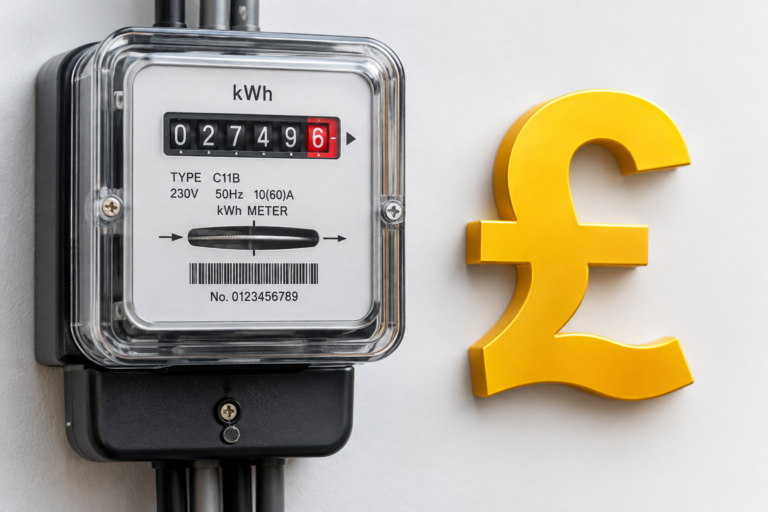
The electricity meter does not care how much the air conditioner cost to buy. It records energy consumption.
That makes the upfront cost and operating cost two separate parts of the financial picture. A cheaper system that consumes more electricity, struggles with the building’s cooling load or requires frequent intervention can prove more expensive over its lifetime. Equally, paying for unnecessary capacity does not automatically produce a better result.
For most offices, the biggest influences on commercial AC running costs include:
- System capacity and electrical input – Larger systems can consume more power, although cooling capacity in kW should not be confused with electrical input in kW.
- Hours of operation – Eight hours of weekday cooling creates a very different annual usage profile from a system running evenings and weekends.
- Electricity price – The business’s actual commercial electricity tariff determines the cost of every kWh consumed.
- Energy efficiency – More efficient equipment can deliver the required cooling using less electrical energy.
- Office size and layout – Floor area matters, but so do ceiling height, separate rooms, open-plan areas and how the space is divided.
- Occupancy – People generate heat. A busy office typically creates more cooling demand than a lightly occupied space of identical dimensions. (But helps with heating in winter.)
- Computers, screens and equipment – Electrical equipment releases heat into the room and contributes to the internal cooling load.
- Solar gain and glazing – Sunlight through windows can dramatically increase cooling demand, particularly in exposed areas.
- Insulation and building fabric – How readily heat enters or leaves the building affects the work the system must do.
- Temperature setpoint – Demanding a much colder indoor temperature can increase energy consumption unnecessarily.
- Controls and zoning – Cooling empty meeting rooms, corridors or unused sections of an office wastes energy.
- Maintenance condition – Restricted airflow, dirty filters and other maintenance issues can prevent a system from performing as intended.
The important lesson is that office air conditioning cost cannot sensibly be judged from floor area alone.
A square-metre estimate may be useful during an early conversation, but accurate system sizing requires consideration of the actual heat load.
Cooling Capacity Is Not the Same as Electricity Consumption
This is one of the easiest figures to misunderstand when comparing air conditioners.
An air conditioning unit might be described as a 5 kW system, but that does not necessarily mean it consumes 5 kW of electricity whenever it runs.
The quoted figure will often refer to the unit’s cooling capacity: the amount of heat it can remove from the room. Its electrical input can be considerably lower.
That difference exists because an air conditioner is effectively moving heat rather than converting electricity directly into an equivalent quantity of cooling.
So when estimating an air conditioner running cost per hour, check which number you are looking at:
- Cooling capacity (kW): the system’s ability to remove heat.
- Electrical input (kW): the power the equipment consumes.
- Energy consumption (kWh): the electrical energy used over a period of time.
- Electricity unit rate (pence or pounds per kWh): what the business pays for that energy.
Confusing cooling output with electrical input can produce a wildly misleading running-cost calculation.
A Simple Office AC Running Cost Formula
For a basic estimate:
Average electrical input (kW) × operating hours × electricity rate (£/kWh) = estimated electricity cost
To project the figure over a longer period:
Daily electricity cost × operating days = estimated monthly or annual running cost
Suppose, purely as an illustration, an office system averages 1.8 kW of electrical input while cooling and operates for six equivalent full-load hours per working day:
1.8 × 6 = 10.8 kWh per day
At an example tariff of £0.25/kWh:
10.8 × £0.25 = £2.70 per working day
Across 22 working days:
£2.70 × 22 = £59.40 per month
Again, this is an illustrative calculation, not a universal office AC running-cost benchmark. Actual consumption depends on the system, weather, controls, occupancy, thermostat settings and how frequently the compressor needs to work.
This is why an office AC running cost calculator is only as reliable as the assumptions entered into it.
Why Office Size Is Only the Beginning
A 100 m² office does not have one predetermined cooling load.
Imagine two identical floorplates.
Office A is well insulated, has moderate glazing, 10 employees and laptops, with blinds reducing direct afternoon sun.
Office B has extensive south-facing glazing, 25 employees, desktop computers, multiple monitors, printers, a busy meeting room and little external shading.
The square metres match. The heat loads don’t.
A proper heat load calculation therefore considers factors such as:
- room and building dimensions;
- number of employees and typical office occupancy levels;
- computers, monitors and other IT equipment;
- lighting heat gains;
- glazing and orientation;
- solar gain;
- insulation and building fabric;
- fresh-air and ventilation requirements;
- working hours and occupancy patterns;
- server rooms or other heat-producing spaces.
Ventilation deserves particular attention. Cooling an office and supplying suitable fresh air are related building-services requirements, but they are not the same thing. Where indoor air quality and fresh-air provision form part of the project, a properly considered commercial ventilation solution can be important to the wider design.
Internal Heat Gains: The Cost Factor You Can’t See From the Floorplan
People produce heat.
So do computers. So do monitors, lighting, printers, network equipment, kitchen appliances and server hardware.
All of that heat has to go somewhere.
During cooler weather, some internal heat gains may reduce the amount of heating required. During warm weather, however, they add to the design cooling load. An office packed with equipment can consequently require substantially more cooling than a similarly sized room with a lower occupancy and little electrical equipment.
This also explains why system sizing should not be reduced to “X kW per square metre” without understanding the space.
An undersized system may struggle to achieve the required indoor temperature during peak conditions. But oversized air conditioning is not automatically the answer either. Poor sizing can contribute to inefficient operation and, depending on the equipment and control strategy, unwanted cycling behaviour.
The aim is not the biggest AC unit that will fit.
It is the right capacity for the building’s actual cooling demand.
Energy Efficiency: Why Two Similar AC Systems Can Cost Different Amounts to Run
Once the cooling load is understood, efficiency becomes crucial.
An air conditioner uses electrical energy to transfer heat from one place to another. The more efficiently it does this, the less electricity it needs to deliver a given amount of cooling.
Several specifications can help describe that performance, including EER, SEER and, where heating performance is relevant, COP or SCOP.
What Does SEER Mean?
SEER stands for Seasonal Energy Efficiency Ratio.
Rather than looking only at performance under one fixed operating condition, seasonal efficiency is intended to give a more representative indication of cooling performance across a range of conditions.
In practical terms, a more efficient system can provide the required cooling with lower electrical energy consumption than a less efficient alternative under comparable conditions.
That matters because office air conditioning rarely operates under one unchanging load.
At 9am, the building may still be relatively cool. By lunchtime, outdoor temperature, solar gain, employees, computers and lighting may have increased the cooling requirement. Later, occupancy might fall again. Meeting rooms can go from empty to full and back to empty in an hour.
The cooling load moves throughout the day.
Modern inverter technology is particularly useful in this environment because the compressor can modulate its output to better match changing demand. Instead of treating every operating hour as an hour at maximum capacity, the system can spend substantial periods operating under part load.
And that leads to one of the most important principles when considering commercial air conditioning running costs:
The cheapest unit to purchase is not necessarily the cheapest system to own, and the largest unit is not necessarily the best-performing system for the office.
The more useful question is how efficiently the system can meet the building’s real cooling demand across its actual operating schedule.
Split, Multi-Split or VRF: Does the Type of Air Conditioning Affect Running Costs?
Very much so.
Once you know the cooling load of an office, the next question is how that cooling should be delivered.
A small office with one or two rooms has very different requirements from a multi-floor workplace containing open-plan areas, boardrooms, individual offices, reception spaces and server rooms. Installing the same type of system in both buildings would make little sense.
The main commercial options include:
- single split air conditioning;
- multi-split air conditioning;
- VRF or VRV systems;
- cassette air conditioning;
- ducted systems; and
- combinations of different indoor units serving separate zones.
Each has implications for installation, controls, maintenance and long-term energy use.
Single Split Air Conditioning
A single split normally connects one indoor air conditioning unit to one outdoor unit.
For smaller offices, individual rooms and defined zones, this simplicity can be useful. Each system can usually be controlled independently, meaning an unoccupied office doesn’t necessarily need to be cooled simply because another room does.
That ability to match operation to occupancy can help reduce wasted energy.
The trade-off becomes apparent as the building grows. Installing numerous independent split systems can mean more outdoor equipment, more individual controls and a less integrated approach to managing the building.
Multi-Split Air Conditioning
A multi-split arrangement allows multiple indoor units to connect to a single outdoor unit.
This can make sense where several office areas require cooling but external space is restricted. Different indoor unit styles may also be possible depending on the particular system, allowing the design to respond to different rooms.
Running costs still depend heavily on how many zones are operating, their cooling demand and the efficiency of the system.
A multi-split should not be viewed as inherently cheap or expensive to run. What matters is whether it has been correctly designed for the building and how intelligently it is controlled.
VRF and VRV Systems
For larger or more complex commercial buildings, Variable Refrigerant Flow (VRF) systems can provide much greater flexibility.
VRV is another term you may encounter when researching this type of commercial air conditioning technology.
A VRF system can serve multiple indoor zones while varying refrigerant flow according to demand. Instead of treating an entire office as one enormous room with one fixed cooling requirement, the system can respond to changing loads in different areas.
Consider a typical working day:
- reception is occupied from early morning;
- an open-plan office gradually fills;
- meeting rooms are used intermittently;
- a boardroom is empty for most of the day;
- one side of the building experiences strong afternoon solar gain;
- a server or communications room requires cooling for much longer periods.
Those spaces do not need identical cooling at identical times.
That is where zoning and part-load efficiency become extremely important.
Some configurations, including heat recovery VRF, can provide simultaneous heating and cooling to different areas where the system and building requirements allow it. In suitable applications, heat recovered from one zone can be transferred for use elsewhere rather than simply rejected.
The right choice, however, cannot be made from the acronym alone.
A sophisticated VRF system that has been badly selected, commissioned or controlled is not automatically efficient. Likewise, a straightforward split system can be an economical solution when it is appropriately matched to a smaller office.
System design comes before system type.
Why Part-Load Efficiency Matters in an Office
Air conditioning equipment is selected with peak conditions in mind, but an office does not sit at its peak cooling load every minute of every working day.
Think of a warm summer morning.
At 8am, perhaps only a few employees are present. Outdoor temperatures are still moderate and the sun has not yet heated the glazing significantly.
By 1pm, conditions may be completely different.
More people have arrived. Computers and monitors are operating. Lighting is on. The sun is striking one side of the building. A meeting room that was empty earlier now contains 10 people.
Cooling demand rises.
Then, at 4.30pm, employees begin leaving and demand falls again.
This constantly changing requirement is why part-load efficiency deserves attention when comparing energy-efficient air conditioning systems. Modern inverter-driven equipment can adjust compressor operation as cooling demand changes rather than simply behaving as though every hour represents peak conditions.
It also explains why estimates based solely on maximum rated electrical input can exaggerate actual consumption in some circumstances.
For budgeting purposes, maximum input can still be useful information. For understanding real office AC electricity consumption, however, operating patterns matter.
Temperature Settings Can Quietly Increase Your Electricity Bill
There is a surprisingly large behavioural element to office cooling costs.
Someone feels warm.
They reach for the controller.
The thermostat gets pushed down to an unnecessarily low temperature.
What happens next is important: setting the air conditioner extremely cold does not necessarily make the room cool down proportionally faster. Instead, it can simply tell the system to keep working towards a much lower target temperature.
That can mean longer compressor operation and higher energy use.
A sensible temperature setpoint should therefore balance comfort with efficiency rather than treating the controller as an accelerator pedal.
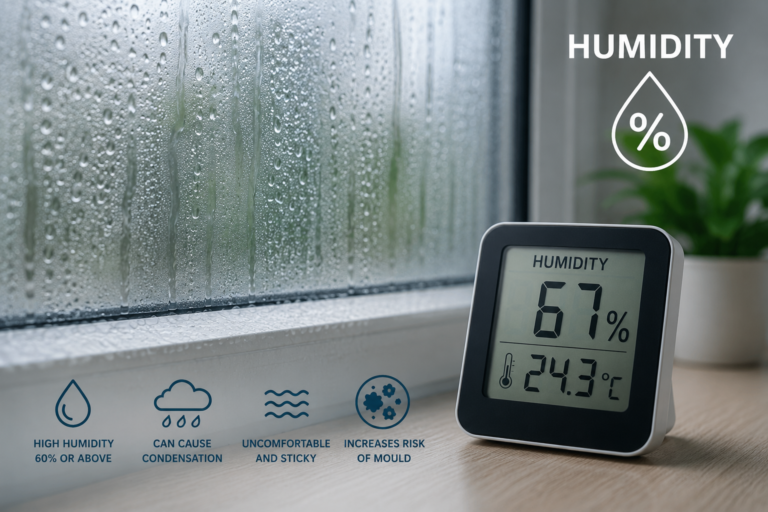
It is also worth remembering that office comfort is affected by more than air temperature. Air movement, humidity, clothing, activity levels, radiant heat from windows and even where someone sits within a room can change how warm or cool they feel.
This is why thermostat disputes are such a familiar feature of office life.
Avoid the “Thermostat Battle”
One employee sets the office to 18°C.
Another feels cold and changes it to 24°C.
Someone else opens a window.
Another person turns the air conditioning up because warm outside air is now entering the room.
The system has not necessarily become inefficient. The way it is being used has.
Clear temperature policies and properly configured air conditioning controls can remove much of this unnecessary intervention.
Where appropriate, controls can establish reasonable temperature ranges rather than allowing extreme settings. In larger workplaces, centralised management can also help prevent systems being left operating overnight or during unoccupied periods.
Zoning: Don’t Pay to Cool/Heat an Empty Room
Few principles of reducing office cooling/heating costs are simpler than this:
Do not condition space that does not need conditioning.
Yet commercial buildings do it all the time.
Meeting rooms remain cooled between bookings. Training rooms run all day despite being used for an hour. Individual offices are conditioned while their occupants are away. Entire floors operate according to one schedule even though different departments work different hours.
Effective zone control allows the air conditioning strategy to follow the building’s real occupancy.
Depending on the system and controls, this might involve:
- separate temperature control for different office zones;
- programmable operating schedules;
- timers or time clocks;
- occupancy sensors;
- automatic setback during unoccupied periods;
- centralised controls;
- smart thermostats; or
- integration with a Building Management System (BMS).
The potential benefit is not simply lower electricity consumption.
Better zoning can also improve comfort because different parts of a building frequently experience different heat loads.
A crowded south-facing meeting room may require cooling while a lightly occupied north-facing office does not. Forcing both spaces to follow the same control strategy can waste energy while satisfying neither group of occupants.
How a BMS Can Help Control Commercial AC Running Costs
In larger offices, a Building Management System can provide a much broader view of how building services are operating.
Rather than treating each air conditioner as an isolated appliance, a BMS can potentially coordinate schedules, temperatures and other building systems from a central point, depending on the installation and level of integration.
This can help facilities teams identify questions that are difficult to answer by walking around the building:
Which zones are running outside working hours?
Are temperature setpoints consistent?
Is one area demanding substantially more cooling than expected?
Are systems operating on weekends when the building is empty?
Do operating schedules still reflect current occupancy patterns?
For businesses looking seriously at HVAC optimisation, visibility can be as important as the equipment itself.
You cannot manage energy use particularly well if you cannot see when and where that energy is being consumed.
That is also why energy monitoring and sub-metering can become valuable in larger buildings. An electricity bill tells you how much energy the business consumed overall. More granular monitoring can help reveal where and when consumption occurred.
The Hidden Cost of Cooling an Empty Office
Imagine an office closes at 5.30pm.
The final employee leaves.
Lights switch off.
Computers go to sleep.
But the air conditioning continues running until 10pm because nobody has updated its schedule.
That is four and a half hours of potentially unnecessary operation every working day.
Across a five-day week:
4.5 hours × 5 = 22.5 unnecessary operating hours
Across 48 working weeks:
22.5 × 48 = 1,080 hours
That does not mean the compressor necessarily consumes maximum electrical power for all 1,080 hours. It does demonstrate how apparently minor scheduling mistakes can accumulate into substantial unnecessary operating time.
Checking timers, schedules and occupancy controls can therefore be one of the simplest places to begin when investigating unusually high air conditioning electricity costs.
The same logic applies to hybrid working.
If an office was originally programmed around five fully occupied weekdays but is now significantly quieter on Mondays and Fridays, yesterday’s operating schedule may no longer match today’s building.
Controls should follow how the workplace is actually used.
Solar Gain: When the Sun Becomes Part of Your Cooling Load
Walk into two rooms on opposite sides of the same building on a sunny afternoon and their cooling requirements can feel completely different.
That is solar gain at work.
Sunlight passing through glazing introduces heat into the building. The effect can become particularly noticeable with:
- large areas of glass;
- south- or west-facing windows;
- limited external shading;
- roof glazing;
- poorly performing glazing; and
- office layouts where workstations sit close to exposed windows.
The air conditioning then has to remove that additional heat.
This is why reducing cooling demand is not always about changing the air conditioner.
Sometimes the better question is:
Why is so much heat entering the office in the first place?
Blinds, suitable shading, improved glazing and appropriate solar-control measures may reduce unwanted heat gains in certain buildings. Improving insulation and the wider building fabric can also influence heating and cooling demand.
Every unit of unwanted heat that can sensibly be prevented from entering the conditioned space is heat the cooling system does not subsequently have to remove.
Ventilation and Air Conditioning Shouldn’t Fight Each Other
Commercial offices need to consider both temperature and indoor air quality.
Air conditioning and ventilation perform different jobs, even though they can form parts of the same wider HVAC strategy.
The problem comes when those systems work against each other.
For example, introducing excessive quantities of hot outdoor air during warm weather increases the load that the cooling system must handle. On the other hand, inadequate ventilation simply to reduce cooling demand is not an acceptable energy strategy.
The goal is controlled ventilation, designed around occupancy and the requirements of the building.
Depending on the application, technologies such as Mechanical Ventilation with Heat Recovery (MVHR) or appropriately designed air handling equipment may form part of the wider approach.
The design needs to consider fresh-air load alongside internal heat gains and solar gain rather than sizing cooling equipment as though the office were a sealed box.
10 Practical Ways to Reduce Office Air Conditioning Running Costs
You do not necessarily need to replace the entire system to start improving efficiency.
A sensible energy review should first look for waste.
1. Review Operating Schedules
Check when the system actually starts and stops.
Compare those times with genuine building occupancy, including evenings, weekends, bank holidays and hybrid-working patterns.
An old schedule can quietly become an expensive habit.
2. Use Sensible Temperature Setpoints
Avoid extreme thermostat settings and establish a reasonable comfort range appropriate to the workplace.
Small behavioural changes, consistently applied across many zones and many operating hours, can have a meaningful cumulative effect.
3. Cool Occupied Zones, Not the Entire Building
Use zoning wherever the system permits it.
Meeting rooms, training areas and intermittently occupied spaces are obvious places to look for unnecessary operation.
4. Keep Doors and Windows Closed While Cooling
Running air conditioning beside an open window creates an obvious conflict.
The system removes heat while more warm outside air is allowed to enter.
There will be situations where windows are intentionally used for natural ventilation, but uncontrolled simultaneous heating/cooling and open-window ventilation can waste energy.
5. Reduce Unnecessary Solar Gain
Make sensible use of blinds and shading, particularly before rooms become excessively hot.
Preventing heat gain can be more efficient than allowing the room to overheat and asking the air conditioning to remove all of that heat afterwards.
6. Reduce Avoidable Internal Heat
Switch off unnecessary lighting and equipment.
A device consuming electricity inside an air-conditioned room frequently creates heat as well. The business effectively pays once to operate the equipment and then potentially pays again for cooling to remove some of the heat it releases.
7. Check Filters and Airflow
Restricted airflow can affect system performance.
Dirty filters should therefore not be treated purely as a housekeeping problem. Keeping equipment in suitable condition forms part of maintaining efficient operation.
8. Use Timers and Smart Controls Properly
Buying sophisticated controls achieves very little if nobody configures them.
Review schedules periodically and make sure they still match actual working patterns.
9. Monitor Energy Consumption
Where practical, compare electricity consumption across time periods.
If usage rises sharply without an obvious explanation such as hotter weather, increased occupancy or longer working hours, investigate rather than accepting the higher bill as inevitable.
10. Maintain the System
Efficiency is not something established on installation day and then guaranteed forever.
Filters become dirty. Coils accumulate contamination. Components wear. Refrigerant-related faults can occur. Controls get changed. Office layouts and occupancy patterns evolve.
Planned air conditioning maintenance and servicing help keep the equipment operating as intended and provide opportunities to identify problems before they become expensive failures.
Running Cost Is Only One Part of the Real Cost
It is tempting to judge an office air conditioning system solely by its electricity consumption.
Businesses, however, ultimately pay the whole-life cost.
That can include:
Purchase price + installation + electricity + planned maintenance + repairs + downtime + eventual replacement
This distinction matters when comparing quotations.
The lowest air conditioning installation cost does not automatically represent the lowest lifetime cost, just as expensive equipment does not automatically guarantee low operating expenses.
A commercial decision should consider:
- expected energy consumption;
- equipment efficiency;
- anticipated hours of operation;
- control capabilities;
- servicing requirements;
- expected equipment life;
- availability of technical support;
- suitability for the building;
- flexibility if the office changes; and
- likely maintenance and replacement costs.
This is essentially a total cost of ownership question.
For some businesses, an efficient system or system upgrade may carry a higher initial capital expenditure (CapEx) but offer lower ongoing operating expenditure (OpEx). Whether that produces an attractive payback period or return on investment depends on the actual installation, energy use and business circumstances.
There is no responsible universal promise that a particular upgrade will “pay for itself in X years” without first understanding those numbers.
Don’t Forget the Cost of Downtime
There is another cost that rarely appears on an electricity bill.
A failed air conditioning system on one of the hottest working days of the year can affect staff comfort, productivity and, in temperature-sensitive spaces, equipment.
That makes preventative maintenance partly an energy decision and partly a business-continuity decision.
The principle extends beyond comfort cooling. Businesses with temperature-critical operations often need their wider cooling infrastructure to be dependable. Aircon Group’s refrigeration services cover commercial refrigeration requirements where temperature control forms an operational rather than simply comfort-related need.
For office air conditioning, the lesson is similar: running a system efficiently matters, but keeping it reliable matters too.
A system that looks inexpensive on a spreadsheet but is frequently unavailable, badly controlled or poorly matched to the building may have costs that extend well beyond its measured kWh consumption.
How Maintenance Affects Air Conditioning Energy Consumption
An office air conditioning system can be efficient when it leaves the factory and still become expensive to operate if its condition deteriorates.
Efficiency is not static.
Air moves through filters. Dust accumulates. Coils become contaminated. Components age. Controls get altered. Office layouts change. Refrigerant-related faults can develop.
Individually, some of these changes may seem minor. Together, they can affect airflow, cooling performance and the amount of work the system has to do to maintain the required indoor temperature.
That is why air conditioning maintenance belongs in any serious discussion about running costs.
Dirty Filters Can Cost More Than You Think
Filters perform an important job, but they cannot collect contamination indefinitely.
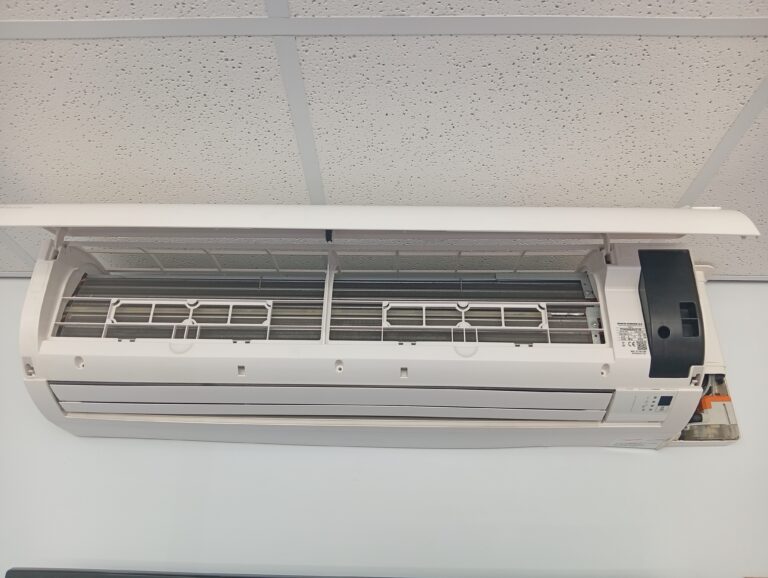
As filters become dirty, airflow can become restricted. If the system cannot move air through the indoor unit as intended, performance may suffer.
The result can be a system operating for longer while delivering poorer comfort.
Keeping clean filters is therefore about more than indoor cleanliness. It is part of maintaining appropriate airflow and efficient system operation.
The same principle applies to dirty coils.
Heat transfer is fundamental to refrigeration and air conditioning. Anything that interferes with that process can affect performance.
The exact maintenance schedule will depend on the equipment, operating environment and manufacturer requirements. A lightly used office system and equipment operating for extended hours in a demanding commercial environment should not automatically be treated identically.
Refrigerant Levels and System Efficiency
Refrigerant is central to the cooling cycle.
It absorbs and releases heat as it circulates through the system. The refrigerant charge therefore needs to be appropriate for the equipment to operate as designed.
If a system has lost refrigerant because of a leak, simply treating the symptom without identifying the underlying problem is not a sensible maintenance strategy.
Performance problems can have numerous causes, so refrigerant should not automatically be blamed whenever an office feels warm. Restricted airflow, contaminated heat exchangers, sensor problems, incorrect controls, extreme conditions and system-sizing issues can all affect cooling performance.
Proper diagnosis matters.
This is also where energy efficiency and maintenance begin to overlap with regulatory responsibilities.
F-Gas Regulations and Commercial Air Conditioning
Many commercial air conditioning systems use fluorinated greenhouse gases, meaning businesses and contractors may have obligations under applicable F-Gas regulations.
Requirements can depend on factors including the type and quantity of refrigerant contained within the equipment.
Depending on the system, responsibilities may include appropriate record keeping, leak prevention, leak checking and ensuring relevant work is undertaken by suitably qualified personnel.
From a running-cost perspective, the connection is straightforward:
a refrigerant leak is not merely a compliance issue — it can also indicate a system that is no longer operating as intended.
Businesses should therefore avoid viewing refrigerant management, F-Gas leak checks and energy performance as completely separate subjects.
Regulations can change, and the exact obligations applying to a particular installation should always be checked against current UK requirements rather than relying on a generic online guide.
What Is a TM44 Inspection?
Another term businesses may encounter is TM44.
In England and Wales, certain air conditioning systems are subject to statutory energy inspections where the combined effective rated output exceeds the applicable threshold. If your system’s output exceeds 12 kW (or several systems on the same site combined do, you must arrange an inspection every five years )
A TM44 inspection is intended to assess the energy efficiency of the air conditioning system and provide advice about opportunities for improvement.
It should not be confused with routine servicing.
Maintenance asks questions such as:
- Is the equipment operating correctly?
- Are filters and heat exchangers in suitable condition?
- Are there faults requiring attention?
- Is airflow appropriate?
- Are controls functioning?
A TM44 assessment has a different focus, looking at the efficiency and sizing of the wider air conditioning system and identifying recommendations that could improve energy performance.
For larger commercial premises, that distinction matters.
An air conditioner can be operational and still offer opportunities for better energy management.
Compliance does not automatically equal efficiency, and efficiency does not remove compliance responsibilities.
Businesses responsible for qualifying systems should establish whether TM44 inspection requirements apply to their installation and ensure the relevant statutory obligations are met.
What About Heating Costs?
Modern air conditioning is not necessarily cooling-only equipment.
Most modern systems operate as reverse-cycle air conditioning, allowing them to provide heating as well as cooling. In effect, they operate as an air-to-air heat pump.
Instead of creating heat directly from electricity in the way a basic resistance heater does, a heat pump transfers heat.
That makes heating efficiency another important consideration when looking at annual operating costs.
COP and SCOP Explained
Two terms you may encounter are COP and SCOP.
COP, or Coefficient of Performance, describes the relationship between heat output and electrical input under defined conditions.
In simplified terms, a COP of 4 would indicate 4 units of heat output for every unit of electrical energy input under the specified test conditions.
SCOP, or Seasonal Coefficient of Performance, takes a broader seasonal view.
Just as SEER can help describe seasonal cooling efficiency, SCOP provides information about heating performance across a range of conditions.
These figures are useful when comparing equipment, but they should not be mistaken for a guaranteed electricity bill.
Real-world performance can be influenced by:
- outdoor temperature;
- indoor temperature;
- required heating capacity;
- thermostat settings;
- system sizing;
- operating hours;
- controls;
- equipment condition; and
- how the office is occupied.
For businesses using the same equipment for both heating and cooling, looking only at summer office cooling costs gives an incomplete picture of annual energy use.
How to Estimate Annual Office Air Conditioning Costs
A business trying to prepare an annual budget needs more than a cost-per-hour figure.
The calculation needs to reflect how the office actually operates.
A useful starting framework is:
Average electrical input × equivalent operating hours × operating days × electricity unit rate
Suppose an office estimates that its air conditioning averages an equivalent electrical input of 3 kW during occupied cooling periods.
Assume:
- 7 equivalent operating hours per day;
- 5 days per week;
- 48 operational weeks per year; and
- an illustrative electricity rate of £0.25/kWh.
The annual equivalent operating hours would be:
7 × 5 × 48 = 1,680 hours
Estimated annual consumption:
3 kW × 1,680 hours = 5,040 kWh
At the illustrative tariff:
5,040 kWh × £0.25 = £1,260 per year
That calculation is useful for understanding the method.
It is not a prediction that an office with a particular floor area or nominal cooling capacity will pay £1,260.
Actual annual office cooling cost could be higher or lower depending on weather, efficiency, occupancy, controls, part-load operation, electricity rates and the cooling demand of the building.
From Annual Cost to Cost per m²
Businesses sometimes want to express energy expenditure as a cost per m².
If the example office above were 300 m²:
£1,260 ÷ 300 = £4.20 per m² per year
Again, that figure is illustrative rather than a benchmark.
Cost per square metre can be useful when comparing different buildings within the same property portfolio, particularly when the figures are normalised appropriately.
It becomes less useful when comparing unrelated offices without considering their differences.
A modern shaded office occupied 40 hours per week cannot fairly be compared with a highly glazed building containing substantial IT equipment and operating for 70 hours simply because their floor areas happen to match.
A Better Way to Build an Office AC Running Cost Calculator
If you want to create your own office AC running cost calculator, avoid relying on cooling capacity alone.
At minimum, collect:
| Input | Why it matters |
| Electrical input in kW | Estimates actual electrical demand |
| Average operating hours | Determines how long energy is consumed |
| Working days | Converts daily consumption into monthly or annual usage |
| Electricity unit rate | Converts kWh into financial cost |
| Number of systems | Accounts for multiple units |
| Typical load | Helps distinguish rated maximum from real operation |
| Occupancy schedule | Identifies occupied and unoccupied periods |
| Seasonal usage | Prevents summer demand being projected blindly across 12 months |
The basic calculation remains:
kW × hours = kWh
Then:
kWh × electricity price = estimated cost
But a more sophisticated model could use separate assumptions for different months, zones or occupancy levels.
For example, July should not necessarily be assigned the same cooling demand as October.
Likewise, a meeting room used for 15 hours each week should not automatically be modelled as though it operates for the same duration as an open-plan office.
The more accurately the assumptions reflect reality, the more useful the estimate becomes.
Why Electricity Tariffs Matter
Even perfectly efficient equipment still consumes electricity.
That means commercial electricity rates directly affect the financial result.
If two identical offices consume the same 10,000 kWh for cooling but one pays substantially more per kWh, their annual air conditioning electricity costs will differ even though the systems perform identically.
Businesses should therefore distinguish between:
energy efficiency — how much energy is being consumed to achieve the required result;
and
energy price — how much each unit of consumed electricity costs.
Reducing one does not automatically reduce the other.
Some commercial arrangements may also involve different tariff structures or time-of-use tariffs, making the timing of energy consumption financially relevant.
When comparing annual running costs from one year to another, it can therefore help to look at both:
- total kWh consumed; and
- total amount paid.
If the bill increased by 20% but electricity consumption remained virtually unchanged, the air conditioning system may not be the primary explanation.
If both kWh consumption and expenditure increased substantially, further investigation becomes more useful.
Should You Replace Old Office Air Conditioning to Save Energy?
Sometimes.
But replacement should be a decision based on evidence rather than age alone.
Newer equipment may offer advantages such as improved seasonal efficiency, inverter technology and better controls. An older installation might also use equipment or refrigerant technology that affects the practicality of continued maintenance.
However, replacing functioning equipment creates an upfront cost, so the business needs to consider the potential energy savings against the capital required.
A useful evaluation might include:
- present annual electricity consumption;
- current maintenance costs;
- repair history;
- reliability;
- remaining expected service life;
- existing energy efficiency;
- current control capability;
- estimated consumption of replacement equipment;
- installation cost;
- likely annual energy savings; and
- expected payback period.
Suppose an upgrade costs £12,000 and is genuinely estimated to reduce annual energy and maintenance expenditure by £2,000.
A simplified payback calculation would be:
£12,000 ÷ £2,000 = 6 years
Real investment decisions can be more complicated because energy prices, maintenance requirements, financing, equipment life and business needs can change.
Still, the exercise is useful because it turns vague claims about “energy-efficient air conditioning” into measurable financial assumptions.
Repair or Replace?
This becomes increasingly important as equipment ages.
A repair may be economical when the system remains fundamentally suitable for the office and has many useful years remaining.
Repeatedly repairing equipment can become less attractive when:
- faults are becoming frequent;
- replacement parts are difficult to obtain;
- maintenance costs are climbing;
- energy efficiency is poor;
- the system no longer suits the office layout;
- controls are inadequate;
- cooling demand has changed; or
- major components are approaching the end of their practical life.
The correct decision is not automatically “replace old equipment”.
Nor is it “keep repairing until replacement becomes unavoidable”.
The better question is:
Which option gives the business the strongest balance of reliability, efficiency, comfort and whole-life cost?
Office Changes Can Make the Original AC Design Obsolete
An often overlooked point is that buildings evolve.
Perhaps an air conditioning system was correctly designed 10 years ago.
Since then:
- 20 employees became 40;
- laptops were replaced with higher-powered workstations;
- meeting rooms were added;
- partitions moved;
- a previously open area became enclosed;
- working hours increased;
- a server room was created;
- hybrid working changed occupancy patterns; or
- an extension increased the conditioned floor area.
The air conditioning installation did not suddenly become “bad”.
The building simply stopped being the building it was designed for.
That is why an unexplained rise in commercial air conditioning energy costs should sometimes trigger a review of the space itself rather than an immediate assumption that the equipment is faulty.
A Practical Office Air Conditioning Cost Checklist
Before deciding whether your office AC is expensive to run, work through the following:
- Check your actual electricity unit rate.
- Identify the electrical input of the relevant systems.
- Record genuine operating hours rather than assumed working hours.
- Check whether systems operate overnight or at weekends.
- Review temperature setpoints.
- Identify empty areas being cooled unnecessarily.
- Check filters and maintenance condition.
- Review glazing, solar gain and shading.
- Consider changes in staff numbers and office equipment.
- Check whether current zoning still matches the office layout.
- Compare current kWh consumption with previous equivalent periods.
- Review SEER, EER, COP or SCOP data where appropriate.
- Establish whether older equipment warrants an efficiency assessment.
- Check whether applicable F-Gas obligations are being met.
- Establish whether the installation falls within TM44 inspection requirements.
That exercise gives you considerably more useful information than simply asking whether air conditioning is “expensive”.
Frequently Asked Questions About Office Air Conditioning Running Costs
How much electricity does office air conditioning use?
There is no universal figure.
Electricity consumption depends on system electrical input, cooling demand, efficiency, operating hours, occupancy, outdoor conditions, building fabric, internal heat gains and controls.
The most reliable starting point is the actual equipment specification combined with measured or realistically estimated operating patterns.
How do I calculate air conditioner running cost per hour?
For a simple estimate:
Electrical input in kW × electricity rate per kWh = estimated cost per hour
For example, equipment averaging 2 kW at an illustrative electricity price of £0.25/kWh would cost:
2 × £0.25 = £0.50 per hour
However, inverter equipment may vary its electrical input as demand changes, so actual consumption should not automatically be assumed to equal maximum rated input throughout every operating hour.
Is office air conditioning expensive to run?
It can be a significant business energy cost, particularly in large, highly occupied or poorly controlled buildings.
But “expensive” is relative.
A correctly sized, efficient system with good controls may cost less to operate than an inefficient system providing poorer comfort.
The useful measure is not simply the bill. It is the amount of useful heating or cooling being achieved for the energy consumed.
Does turning the thermostat lower cool an office faster?
Setting an unnecessarily low target temperature does not mean the room will cool in proportion to how far the thermostat is turned down.
Instead, it can cause the system to continue working towards a colder target, potentially increasing energy consumption.
A sensible temperature setpoint is generally preferable to extreme adjustments.
Is it cheaper to leave office air conditioning running all day?
Not automatically.
The answer depends on the building, system and occupancy pattern. Cooling unoccupied spaces for long periods can waste energy.
Good scheduling allows the system to operate when required rather than relying on a blanket rule that it should either always remain on or always be switched off.
Do inverter air conditioners use less electricity?
Inverter technology allows compressor output to vary according to demand.
That can provide efficient part-load operation compared with equipment that has less ability to modulate capacity.
Actual energy consumption still depends on correct sizing, controls, operating conditions and how the system is used.
What is the most energy-efficient temperature for office air conditioning?
There is no single temperature that is universally “most efficient” for every workplace.
The principle is to avoid unnecessarily aggressive temperature setpoints while maintaining appropriate comfort and working conditions.
The greater the difference the system is being asked to maintain between indoor conditions and the surrounding environment, the more work may be required.
Does opening windows increase air conditioning costs?
Yes
If warm outdoor air continuously enters an office while mechanical cooling is operating, the air conditioning may have to remove additional heat.
Windows and doors should therefore be managed sensibly when cooling is in use, while still ensuring the building has appropriate ventilation.
How can I reduce commercial AC running costs?
Start with the fundamentals:
correct system sizing, sensible setpoints, zoning, appropriate schedules, good maintenance, clean filters, controlled solar gain and monitoring actual energy consumption.
The cheapest kWh is the one you did not need to consume.
If systems are old, maybe new more efficient systems should be looked at. Especially if an older system requires an expensive repair.
Should office air conditioning be maintained every year?
The appropriate maintenance frequency depends on the equipment, manufacturer recommendations, usage and operating environment. But yes it does. Normally it is recommended twice a year.
Commercial systems with extensive operating hours may require more attention than lightly used equipment.
The maintenance programme should therefore reflect the actual installation rather than an arbitrary one-size-fits-all interval.
Does ventilation increase office cooling costs?
Introducing outdoor air can add to the cooling load when external conditions are warm.
However, ventilation should not simply be reduced without considering indoor air quality and applicable building requirements.
Good HVAC design balances fresh-air provision with efficient temperature control.
What is the difference between SEER and COP?
SEER relates to seasonal cooling efficiency.
COP describes the relationship between useful heating or cooling output and electrical input under specified conditions, although in air-conditioning discussions it is commonly encountered when considering heating performance.
For annual heating comparisons, SCOP may also be relevant.
Can solar gain really make a big difference?
Yes.
Large areas of sun-exposed glazing can introduce substantial heat into an office. Orientation, shading, glazing specification and building design can therefore influence cooling demand considerably.
This is one reason two offices with identical floor areas can have very different air conditioning running costs.
So, What Should an Office Air Conditioning System Really Cost to Run?
There is no honest single figure.
A meaningful estimate starts with four things:
Cooling demand + system efficiency + operating time + electricity price
Everything else influences one or more parts of that equation.
Office size affects cooling demand.
Employees, computers and lighting affect cooling demand.
Solar gain affects cooling demand.
SEER and part-load performance affect efficiency.
Dirty filters and poor maintenance can affect performance.
Zoning and occupancy controls affect operating time.
Your commercial electricity tariff determines what each consumed kWh costs.
Once those relationships are understood, office air conditioning running costs become far less mysterious.
Rather than asking, “How much does air conditioning cost to run?”, a facilities manager can ask much more useful questions:
How much energy are we consuming?
Where are we consuming it?
When are we consuming it?
What is creating the cooling demand?
Is the system operating efficiently?
Are we conditioning areas that don’t need it?
Could better controls, maintenance or equipment reduce consumption?
Those questions lead to decisions based on evidence rather than assumptions.
The Lowest Running Cost Starts With the Right Design
There is a temptation to treat energy efficiency as a feature that can simply be purchased.
Choose the highest efficiency rating. Install it. Job done.
Real buildings are more complicated.
A highly efficient air conditioner can still waste electricity if it is incorrectly sized, badly controlled or left running in empty rooms. Conversely, relatively modest equipment can perform effectively when it is correctly selected for the space, properly installed, maintained and sensibly controlled.
The strongest commercial approach therefore considers the complete system:
building + occupants + heat gains + equipment + ventilation + controls + maintenance + energy tariff.
That is also why air conditioning should be considered as part of the wider operation of the premises rather than as an isolated appliance hanging on the wall.
Businesses with temporary temperature-control requirements elsewhere in their operations may also need solutions outside their permanent building systems. For applications where temperature-controlled transport or temporary cold storage is required, Aircon Group also provides refrigerated trailer hire.
Final Thoughts: Think in kWh, Not Just Pounds
If there is one useful habit to take away from Office Air Conditioning Running Costs Explained, it is this:
separate energy consumption from energy price.
Your electricity bill is measured in pounds, but the performance of your air conditioning is better understood by first looking at kWh.
If the electricity price rises while consumption stays the same, changing the air conditioner may not solve the underlying financial problem.
If kWh consumption rises while occupancy and weather remain broadly comparable, investigate why.
Perhaps operating hours have increased.
Perhaps somebody changed the schedules.
Perhaps an empty floor is still being cooled.
Perhaps filters need attention.
Perhaps the office layout has changed.
Perhaps the system is ageing.
Or perhaps the building simply has a greater cooling load than it did previously. Or a colder winter, requiring more heating.
Understanding those causes is far more valuable than relying on a generic air conditioning cost per hour.
For a commercial office, the objective should not be to run the air conditioning as little as physically possible.
Nor should it be to chase the lowest installation price.
The objective is to provide the heating and cooling the workplace genuinely requires without paying for energy it doesn’t.
Get the cooling load right.
Choose appropriate equipment.
Control individual areas intelligently.
Maintain the system.
Monitor consumption.
Review the strategy when the building changes.
Do those things well, and office air conditioning becomes a controllable operating expense rather than an unexplained line on the electricity bill.