
Are Commercial AC Maintenance Contracts Worth It?
Commercial air conditioning is easy to overlook when it’s working properly. The office stays comfortable, customers barely notice the temperature, and business carries on. But when a system breaks down during a summer heatwave, or a cold winter morning suddenly the issue of keeping it running becomes everyone’s concern. And everyone complains about the temperature.
So, is paying for a maintenance contract a sensible investment, or just another business expense?
The short answer: commercial AC maintenance contracts are worth it for businesses. Because maintained systems are less likely to fail and therefore less likely to create large repair bills. For some businesses it can stop production as the temperature goes out of spec. Or customers leave because the business is too hot or cold. Stock can be damaged, as basically as chocolate melting. Or it could be the AC in the server room failing.
If you don’t get maintenance on your system it invalidates the manufacturer warranty.
However, the value depends on the equipment, its age, how frequently it’s used and what the agreement actually covers.
Here’s what UK businesses need to know:
- Preventative maintenance can reduce unexpected breakdowns. Scheduled inspections help identify developing faults before they become expensive emergencies.
- Maintenance contracts make budgeting easier. Rather than facing unpredictable servicing expenses, businesses can plan for agreed annual maintenance costs.
- Maintenance customers get priority service calls and reduced rates.
- Regular servicing supports energy efficiency. Clean filters, properly maintained coils and correctly operating components help systems perform as intended.
- Compliance still matters. Certain commercial systems are subject to F-Gas obligations and TM44 energy inspections, although these aren’t automatically included in every contract. ALL aircon units require a leak test annually, due to F-gas regulations, this is covered by maintenance.
- The cheapest agreement isn’t necessarily the best value. Response times, exclusions, equipment coverage and service frequency can matter more than the headline price.
The real question isn’t simply how much an annual air conditioning maintenance contract costs. It’s how that cost compares with the financial and operational consequences of neglected equipment.
What Is a Commercial AC Maintenance Contract?
A commercial AC maintenance contract is an agreement between a business and an air conditioning maintenance provider to inspect and maintain its air conditioning/HVAC equipment at predetermined intervals.
Rather than arranging an engineer only when something goes wrong, the business receives an organised maintenance programme designed to keep its systems operating reliably.
These agreements are also commonly described as commercial air conditioning maintenance contracts, HVAC maintenance contracts, air conditioning service agreements or planned preventative maintenance (PPM) contracts.
Although the terminology varies, the underlying purpose is similar: prevent avoidable problems, maintain equipment performance and reduce the uncertainty associated with unexpected repairs.
For example, imagine two businesses operating identical air conditioning systems.
The first arranges servicing only when the equipment develops a fault. The second has an agreement providing scheduled inspections, filter cleaning, electrical checks and routine performance assessments.
Both systems may operate without problems for years. However, the second business has regular opportunities to discover deteriorating components, blocked drainage or declining cooling performance before these issues develop into more disruptive failures.
However businesses without a maintenance contract may struggle to get an air conditioning to repair a faulty unit. Especially at peak times such as summer or during cold spells. There is normally a call out charge and sometimes a higher hourly rate for non maintenance customers.
That’s the fundamental principle behind preventative air conditioning maintenance.
A maintenance contract doesn’t guarantee that commercial air conditioning will never break down. It creates a structured opportunity to identify problems early, manage equipment condition and reduce avoidable disruption.
How Do Commercial AC Maintenance Contracts Work?
Most commercial HVAC service agreements follow a relatively straightforward process.
- Initial equipment assessment: The provider identifies the air conditioning units, their locations, age, condition and maintenance requirements.
- Contract quotation: A maintenance plan is proposed based on the number of systems, their complexity, accessibility and expected servicing frequency.
- Scheduled maintenance visits: Qualified engineers attend at agreed intervals to inspect, clean, test, leak test and maintain the equipment.
- Maintenance reporting: The provider records completed work, identifies defects and recommends any additional repairs.
- Repairs and emergency support: Depending on the contract, the business may receive priority assistance, discounted labour or more comprehensive breakdown coverage.
- Annual review or renewal: Equipment condition, servicing requirements and contract terms can be reassessed.
For businesses operating multiple systems, this approach can be considerably easier to manage than arranging individual servicing appointments throughout the year.
It also creates a documented maintenance history, which can be useful when investigating recurring faults, reviewing operating costs or checking manufacturer warranty conditions.
What Does a Commercial Air Conditioning Maintenance Contract Include?
This is where the details become important.
Two companies might both advertise an annual commercial AC maintenance contract, yet provide substantially different levels of service.
One may offer a basic inspection and cleaning visit. Another might include multiple scheduled appointments, emergency support, discounted repairs and detailed equipment performance reports.
Before comparing commercial AC servicing costs, businesses need to understand exactly what they’re buying.
1. Scheduled Inspections and Planned Preventative Maintenance
Planned preventative maintenance, commonly shortened to PPM, is the foundation of most commercial air conditioning service agreements.
Instead of waiting for a system to fail, engineers inspect its condition and carry out maintenance tasks at scheduled intervals.
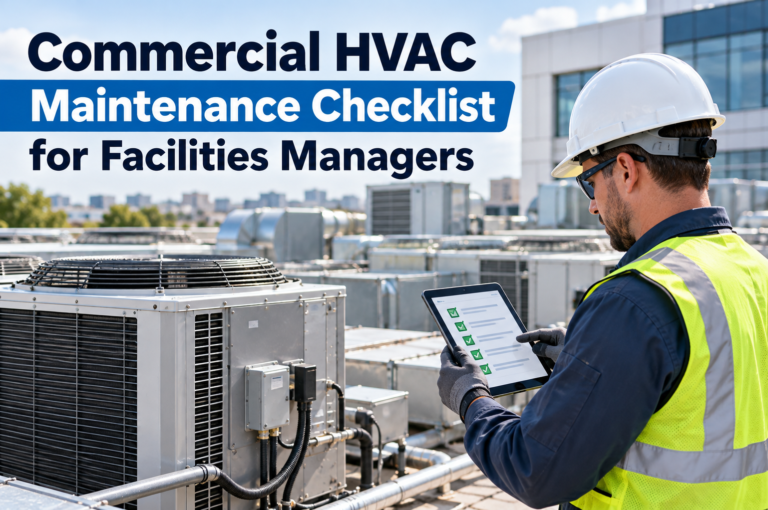
A typical commercial AC maintenance checklist may include:
- Cleaning or checking indoor air filters.
- Inspecting evaporator and condenser coils.
- Checking condensate drains for blockages or leaks.
- Examining electrical connections and controls.
- Assessing fan motors and other moving components.
- Checking thermostat operation and temperature control.
- Measuring relevant system operating conditions.
- Looking for signs of refrigerant leakage.
- Inspecting visible pipework and insulation.
- Identifying unusual noises, vibration or wear.
- Reviewing overall cooling performance.
- Recording defects and recommended corrective work.
The precise tasks depend on the equipment, manufacturer guidance and service specification. Not every visit requires every test, and specialist procedures should only be carried out when appropriate.
For example, a heavily used restaurant system may need more frequent filter attention than an air conditioning unit in a lightly occupied meeting room.
Similarly, equipment operating in dusty environments may require additional cleaning to prevent restricted airflow and declining performance.
The important point is that servicing should reflect actual operating conditions rather than simply following a generic checklist.
2. Filter Cleaning, Coil Maintenance and System Performance
Some of the most valuable maintenance tasks are also among the least dramatic.
A dirty filter doesn’t necessarily cause an immediate breakdown. Instead, it can gradually restrict airflow, reduce comfort and make it harder for the system to deliver the required cooling. But will make the system over work and cause a component failure. A dirty filter can cause unpleasant odours.
Contaminated heat exchanger coils can also affect heat transfer, potentially increasing running costs and placing additional strain on equipment.
Routine cleaning and inspection help prevent these issues from developing unnoticed.
Consider an office where staff regularly complain that one meeting room never feels cool enough.
The problem might not require a replacement air conditioning unit. Restricted airflow, a dirty coil, incorrect settings or a developing component fault could be contributing to the poor performance.
An effective maintenance programme gives engineers opportunities to investigate these issues before the business commits to unnecessary equipment replacement.
That said, maintenance cannot reverse every form of deterioration. Ageing compressors, obsolete controls and seriously damaged components may eventually make replacement more economical than repeated repairs.
3. Refrigerant Checks and Leak Detection
Refrigerant plays a central role in the cooling process, and problems involving refrigerant circuits can affect both system performance and regulatory compliance.
During relevant maintenance work, an engineer may investigate signs of leakage, inspect accessible components and assess whether further testing is required.
Certain equipment containing fluorinated greenhouse gases is subject to statutory leak-check requirements under UK F-Gas regulations.
However, not every air conditioning system requires the same inspection frequency, and routine maintenance visits shouldn’t automatically be treated as legally compliant F-Gas leak checks.
Requirements depend on factors including refrigerant type, quantity, equipment characteristics and the applicable regulations.
Businesses should confirm whether their maintenance agreement specifically includes any required leak checks, documentation and work by appropriately certified personnel.
4. Emergency Call-Outs and Priority Repairs
If you have a maintenance contract then you get priority service callouts and repairs. There is also no call out charge during normal hours.
One of the biggest differences between basic and comprehensive commercial HVAC maintenance contracts is what happens when something goes wrong.
Some air conditioning companies are maintenance only and will not help you with breakdowns especially during peak periods.
Others may provide:
- Priority access to engineers during breakdowns.
- Emergency call-out arrangements.
- Agreed response-time targets.
- Access to replacement parts, subject to availability.
- Extended support outside normal working hours.
For maintenance customers Aircon Group provides 24 hour, 365 days a year cover.
These benefits can be particularly valuable where equipment failure creates immediate business disruption.
However, priority response doesn’t necessarily mean immediate repair. An engineer may attend within the agreed period but still need to order parts or arrange further work.
Businesses should also distinguish between a guaranteed response time and a guaranteed resolution time.
The two are not interchangeable.
A properly defined service level agreement (SLA) should explain what the provider promises, when support is available and what happens if the agreed service standard isn’t achieved.
The Two Main Types of Commercial AC Maintenance Contracts
Although providers use different package names, most agreements fall into three broad categories.
| Contract type | Typical coverage | Most suitable for |
| PPM-only contract | Scheduled maintenance, inspections, cleaning and maintenance reports | Businesses seeking preventative care at a manageable cost |
| PPM with breakdown support | Scheduled maintenance plus agreed priority call-outs or preferential repair rates | Businesses wanting additional reassurance without comprehensive repair cover |
These are general categories rather than standardised industry packages. Actual inclusions vary between providers.
PPM-Only: A Practical Starting Point
For many smaller businesses, a planned preventative maintenance agreement offers a reasonable balance between cost and protection.
The business pays for scheduled maintenance, while repairs and replacement components are quoted separately.
This can work well for relatively modern equipment with a good service history, particularly where a temporary cooling failure wouldn’t cause serious operational problems.
The main limitation is financial uncertainty.
If a compressor fails or a major component needs replacing, the business could still face a substantial additional repair bill.
PPM With Breakdown Support: A Middle Ground
This type of agreement combines routine servicing with additional assistance when equipment develops a fault.
For example, a provider may offer priority call-outs or reduced labour charges to contracted customers.
It’s often attractive to businesses that need dependable access to technical support but don’t necessarily want to pay for comprehensive parts and repair coverage.
However, the wording matters.
A contract advertising priority breakdown assistance may simply mean that existing customers receive preferential scheduling. It doesn’t mean emergency repairs are included in the annual fee.
How Much Do Commercial AC Maintenance Contracts Cost in the UK?
Cost is often the deciding factor when businesses consider commercial air conditioning maintenance contracts.
After all, why commit to an annual maintenance agreement when the air conditioning appears to be working perfectly well?
The answer comes down to predictability, equipment reliability and the potential cost of an unexpected failure.
Commercial AC maintenance costs vary considerably across the UK, depending on the number of units, system type, equipment accessibility, servicing frequency and level of breakdown protection required.
A small office with two wall-mounted air conditioning units will generally have different maintenance requirements from a hotel operating a large VRF system across multiple floors.
And while the hotel may pay considerably more each year, the financial consequences of a cooling failure could also be substantially greater.
A maintenance provider might want to assess the equipment before confirming an appropriate maintenance schedule and contract price.
What Affects Commercial AC Maintenance Costs?
Several factors influence commercial air conditioning service contract pricing.
1. Number of air conditioning units
More equipment generally means more inspection time, cleaning, testing and maintenance documentation.
However, servicing multiple units during a single visit may be more economical per unit than arranging separate appointments.
2. Type and complexity of equipment
Wall-mounted split systems are typically less complex to maintain than extensive VRF/VRV installations, commercial chillers or integrated building cooling systems.
More complicated equipment may require specialist diagnostic procedures and additional engineering time.
3. Age and condition of the system
Older air conditioning equipment may require closer monitoring, particularly where components are deteriorating or replacement parts are becoming difficult to source.
Some providers may also exclude existing defects from breakdown coverage.
4. Frequency of servicing
An office operating air conditioning during normal working hours may have different servicing requirements from a restaurant, hotel or server room where equipment runs for extended periods.
More frequent maintenance visits generally increase annual costs, although they may be justified by operating conditions.
5. Equipment accessibility
Units installed at height, above suspended ceilings or in restricted plant areas can take longer to inspect and maintain.
Special access equipment may also be required.
6. Emergency support and contract coverage
Agreements including out-of-hours attendance, priority breakdown support or specified replacement parts will generally cost more than basic planned preventative maintenance.
This is why businesses should compare the total value of the maintenance agreement, not simply the cheapest annual quotation.
How to Calculate the True Cost of an AC Maintenance Contract
A useful way to evaluate commercial HVAC maintenance contracts is to consider the total cost of ownership (TCO).
This includes more than the original equipment purchase price.
Over its working life, an air conditioning system may generate expenses relating to:
- Preventative maintenance.
- Electricity consumption.
- Replacement filters and components.
- Unexpected repairs and emergency call-outs.
- Business disruption caused by breakdowns.
- Refrigerant-related work and applicable compliance requirements.
- Eventual equipment decommissioning
Seven Benefits of Commercial AC Maintenance Contracts
The benefits of AC maintenance contracts extend beyond keeping equipment clean.
For many businesses, the greatest value comes from avoiding disruption, maintaining predictable operating costs and helping expensive cooling equipment remain reliable for longer.
Here are seven reasons commercial air conditioning servicing can be a worthwhile investment.
1. Fewer Unexpected Breakdowns and Emergency Repairs
Air conditioning systems rarely choose a convenient moment to fail.
An office system might stop cooling during a heatwave. A restaurant could experience problems halfway through a busy evening. A retail premises might lose cooling when customer footfall is at its highest.
These situations are frustrating, but they can also be expensive.
Reactive service calls means arranging repairs after a problem has already developed.
Planned preventative maintenance takes a different approach.
Engineers inspect equipment at agreed intervals, looking for warning signs such as:
- Deteriorating electrical connections.
- Restricted airflow.
- Blocked condensate drainage.
- Unusual operating temperatures.
- Excessive vibration or noise.
- Dirty heat exchanger coils.
- Worn or malfunctioning components.
Identifying these problems early may allow corrective work to be scheduled before a complete system failure occurs.
For example, discovering a partially blocked condensate drain during a routine service could prevent a later water leak that damages ceiling tiles, flooring or nearby equipment.
Similarly, identifying a failing fan motor may allow the business to plan a replacement rather than waiting for the system to stop working.
Not every breakdown is preventable. Electronic components can fail unexpectedly, and even well-maintained equipment eventually reaches the end of its useful life.
Nevertheless, regular inspections reduce the likelihood that obvious maintenance issues will go unnoticed.
2. More Predictable Maintenance Budgets
Unexpected expenditure is rarely welcome.
For small businesses especially, an unplanned repair bill can place pressure on cash flow.
Commercial AC maintenance contracts help businesses forecast at least part of their annual maintenance expenditure.
Instead of arranging maintenance on an ad hoc basis, the business agrees to a defined maintenance schedule and fee.
This can make it easier to:
- Prepare annual facilities management budgets.
- Forecast routine HVAC expenditure.
- Coordinate maintenance across several properties.
- Have maintenance at a time that is best for them.
- Avoid missing scheduled maintenance periods and fail compliance.
- Plan for recommended repairs.
- Maintain consistent equipment records.
3. Better Energy Efficiency and Potentially Lower Electricity Bills
Commercial air conditioning can account for a meaningful proportion of a building’s electricity consumption, particularly where cooling systems operate for long periods.
Poor maintenance can make that consumption unnecessarily high.
Dirty filters restrict airflow. Contaminated coils interfere with heat transfer. Faulty sensors and controls may cause equipment to operate inefficiently.
Over time, these issues can affect cooling performance and increase the energy needed to maintain comfortable indoor temperatures.
Routine servicing helps systems operate closer to their intended performance.
For example, an engineer may identify a blocked filter causing reduced airflow or a control issue leading to unnecessary cooling.
Correcting these problems can improve efficiency without requiring a complete system replacement.
How Much Energy Could Regular Maintenance Save?
There is no reliable universal percentage saving that applies to every commercial air conditioning system.
The result depends on factors such as:
- The equipment’s condition before servicing.
- How heavily the system is used.
- Existing maintenance standards.
- Building insulation and solar heat gain.
- Thermostat settings and operating schedules.
- The nature of any faults discovered.
A well-maintained system may show relatively little improvement following routine servicing because it was already operating efficiently.
A neglected system with severely restricted airflow, however, may benefit considerably from corrective maintenance.
To illustrate the financial impact, consider a commercial cooling system consuming 15,000 kWh annually.
If maintenance and associated adjustments reduced electricity consumption by 5%, the saving would be:
15,000 kWh × 5% = 750 kWh per year
At an illustrative electricity rate of £0.25 per kWh:
750 kWh × £0.25 = £187.50 annual saving
This is a hypothetical calculation, not a predicted saving or guarantee. Actual results depend on measured consumption, electricity tariffs and the work carried out.
The important point is that energy performance belongs in any serious HVAC maintenance cost-benefit analysis.
A contract may provide value through a combination of efficiency improvements, reliability and reduced repair risk rather than one dramatic saving.
4. Longer Equipment Lifespan and Better Asset Protection
Commercial air conditioning equipment represents a substantial capital investment.
Whether a business operates a handful of split systems or an extensive VRF installation, replacing equipment prematurely can be expensive.
Regular maintenance helps protect that investment.
Components such as compressors, fan motors and heat exchangers operate under mechanical and thermal stress.
Poor airflow, contaminated coils and unresolved faults can contribute to unfavourable operating conditions and additional wear.
Preventative maintenance helps identify and correct these issues before they cause further deterioration.
For example, a condenser coil heavily coated in dirt may restrict heat rejection, potentially increasing operating pressures and compressor workload.
Cleaning the coil can help restore normal operating conditions and reduce unnecessary strain.
Maintenance cannot eliminate natural ageing, but it can help equipment achieve a useful service life consistent with its design and operating conditions.
This is particularly important when replacement would involve additional costs such as access equipment, electrical alterations, installation labour or business downtime.
For businesses planning long-term commercial air conditioning asset management, maintenance records can also support better replacement decisions.
Rather than replacing equipment solely because it is old, managers can assess its repair history, operating performance and remaining economic value.
5. Reduced Business Disruption and Operational Downtime
Sometimes, the cost of an air conditioning breakdown has very little to do with the repair itself.
Consider a restaurant during a busy summer weekend.
The dining area becomes uncomfortably hot, customers complain, and staff struggle to maintain a pleasant environment. The refrigeration will have to work harder, costing more to run and risk breakdown.
Even if an engineer repairs the system the following morning, the restaurant may already have experienced cancelled bookings, customer dissatisfaction or reduced trading.
For a hotel, unreliable cooling can lead to guest complaints and room changes.
For an office, uncomfortable temperatures can affect concentration and working conditions.
For a server room, cooling failure may threaten the operation of temperature-sensitive IT equipment.
At a pharmacy the temperature might exceed the max storage temperature.
The financial consequences vary considerably, but the underlying principle is the same:
The true cost of an air conditioning breakdown isn’t always the engineer’s invoice. It’s what happens to the business while the system isn’t working.
Commercial HVAC maintenance agreements can help reduce this exposure through preventative inspections and, where included, priority breakdown support.
Businesses operating critical cooling systems should also consider contingency arrangements.
These might include backup cooling, temporary equipment, temperature monitoring or clearly documented emergency procedures.
For premises where cooling supports temperature-sensitive stock or processes, maintenance planning may need to extend beyond comfort air conditioning to include specialist commercial refrigeration services.
An effective maintenance strategy should reflect the consequences of failure across the whole business, not simply the number of installed units.
6. Support for Manufacturer Warranty Requirements
Many commercial air conditioning manufacturers specify servicing and maintenance requirements within their warranty conditions.
These may include periodic inspections, appropriate maintenance procedures and work carried out by suitably qualified personnel.
Failing to follow the applicable warranty terms can create difficulties when making a claim.
For example, if a component fails and the manufacturer requests evidence of maintenance, a business without maintenance records may struggle to demonstrate that the equipment was maintained as required.
A structured maintenance agreement can help by providing:
- Documented servicing dates.
- Engineer inspection reports.
- Records of maintenance procedures.
- Details of identified defects.
- Evidence of completed corrective work.
- A clearer history of equipment condition.
However, purchasing a maintenance contract doesn’t automatically guarantee warranty protection.
The agreement must provide the maintenance required by the relevant manufacturer, and other warranty conditions may still apply.
Businesses should therefore compare the proposed maintenance schedule with the manufacturer’s documentation. And check with the installation company that they will provide maintenance.
This is particularly important for relatively new commercial systems where maintaining warranty eligibility may provide meaningful financial protection.
7. Easier Maintenance Management and Greater Peace of Mind
There’s also a practical benefit that doesn’t always appear in cost calculations.
Someone has to remember when each air conditioning system was last maintained, arrange engineer visits, coordinate access and keep track of recommended repairs.
For a small business owner, that’s another responsibility competing with day-to-day operations.
For facilities managers overseeing several properties, it can become a significant administrative task.
A well-organised maintenance contract helps bring these responsibilities into a consistent programme.
Scheduled visits can be arranged in advance, maintenance records kept together and developing issues tracked over time.
This is particularly useful for businesses with multiple air conditioning systems, different equipment ages or several commercial premises.
It can also make future decisions easier.
If one unit repeatedly develops faults while the rest remain reliable, the maintenance history may reveal that replacement would be more economical than continuing to repair it.
In that sense, commercial air conditioning maintenance plans can support better long-term decisions.
Aircon Group uses a CRM database that flags when a customer’s maintenance is due. Our staff will contact customers and arrange a suitable appointment.
The Hidden Cost of Reactive-Only
It’s important to distinguish planned maintenance from reactive-only service.
A business can pay for individual maintenance visits and still maintain its equipment responsibly.
Reactive-only service, by contrast, means largely ignoring the system until something fails.
That approach can appear inexpensive when everything is working.
But it may lead to:
- Missed opportunities to identify developing faults.
- Reduced heating/cooling performance.
- Unnecessary energy consumption.
- Greater exposure to emergency call-out costs.
- Poor documentation and failed audits.
- Avoidable disruption when equipment fails.
For many businesses, the sensible comparison isn’t between having a contract and doing nothing.
It’s between a structured maintenance agreement or waiting for failures, the hassle and expense this can cause..
The strongest maintenance strategy is the one that provides appropriate technical care at a cost proportionate to the business’s actual risk.
Can Regular AC Maintenance Reduce Energy Bills?
Energy efficiency is one of the strongest arguments for maintaining commercial air conditioning, particularly in buildings where cooling equipment operates for extended periods.
But does regular maintenance genuinely reduce electricity bills?
It can, especially when maintenance corrects problems that cause the system to work harder than necessary. However, the savings depend on the condition of the equipment, how it’s operated and whether any significant inefficiencies exist in the first place.
Commercial air conditioning systems use electricity to transfer heat from indoor spaces to the outside environment. When airflow becomes restricted or heat transfer is impaired, the equipment may need to operate for longer or under less favourable conditions to achieve the required temperature.
Over months and years, that can contribute to unnecessary energy expenditure.
How Poor Maintenance Increases Running Costs
Several common maintenance issues can affect HVAC energy performance.
Blocked air filters
Dirty filters restrict airflow through indoor units, potentially reducing cooling effectiveness and creating additional strain on system components.
Contaminated condenser coils
Outdoor coils need to reject heat effectively. Dirt, debris and other contamination can interfere with that process, affecting system efficiency.
Incorrect thermostat settings
Poorly configured controls can cause unnecessary cooling, particularly in unoccupied rooms or outside normal business hours.
Refrigerant-related faults
Leaks and other refrigerant circuit problems can reduce performance and may require investigation and repair by appropriately qualified personnel.
Malfunctioning fans or sensors
Faulty components can affect airflow, temperature control and normal system operation.
Regular inspections help identify these issues before they become persistent sources of wasted energy.
Maintenance vs Energy-Efficient Equipment: What’s the Difference?
There’s an important distinction between maintaining an existing system and upgrading to newer, more efficient equipment.
Preventative maintenance helps an air conditioning system operate closer to its intended performance.
It doesn’t fundamentally change the system’s original design efficiency.
For example, maintaining an older fixed-speed air conditioning unit won’t give it the same efficiency characteristics as a modern high-performance inverter system.
However, maintenance may still reduce avoidable energy waste and help the existing equipment remain economical to operate.
For businesses reviewing long-term HVAC lifecycle costs, the best strategy may involve a combination of:
- Routine preventative maintenance.
- Improved thermostat programming.
- Appropriate operating schedules.
- Better temperature zoning.
- Monitoring electricity consumption.
- Repairing inefficient or malfunctioning components.
- Replacing ageing equipment when economically justified.
The decision to repair or replace should consider equipment condition, energy performance, repair history and the cost of installing a new system.
How Can Businesses Measure Energy Savings?
Rather than assuming maintenance automatically produces a particular percentage saving, businesses can compare energy consumption before and after corrective work.
For more meaningful results, the comparison should account for changes in weather, occupancy, operating hours and cooling demand.
For example, an office may consume more electricity during an unusually hot summer even when its air conditioning is operating efficiently.
Similarly, a business extending its opening hours may experience higher energy consumption without any deterioration in equipment performance.
Where appropriate, sub-metering, building management systems and equipment monitoring can help identify unusual operating patterns.
This is particularly useful for larger commercial properties where cooling represents a significant ongoing expense.
The goal isn’t simply to make an air conditioning unit run. It’s to make sure it delivers the required cooling without unnecessary energy consumption.
F-Gas Compliance, TM44 Inspections and Warranty Protection
Commercial air conditioning maintenance isn’t only about reliability and operating costs.
UK businesses may also have responsibilities relating to refrigerants, energy inspections and equipment safety.
However, it’s essential to understand that a maintenance contract is not automatically a legal requirement, and purchasing one does not automatically satisfy every regulatory obligation.
The relevant duties depend on the equipment, building and applicable regulations.
F-Gas Regulations and Commercial Air Conditioning
Most commercial air conditioning systems contain fluorinated greenhouse gases, commonly referred to as F-gases.
These refrigerants are subject to controls intended to reduce emissions and ensure appropriate handling.
Depending on the type and quantity of refrigerant, equipment may be subject to requirements involving:
- Periodic refrigerant leak checks.
- Repairing detected leaks.
- Keeping relevant maintenance and leak-check records.
- Using appropriately certified personnel for regulated work.
- Recovering refrigerant during relevant servicing or decommissioning activities.
The applicable leak-check thresholds and intervals depend on the refrigerant and equipment characteristics, including the relevant carbon dioxide equivalent (CO₂e) calculation or other regulatory threshold.
Not every system is subject to the same obligations.
For example, a small split air conditioning system may have different requirements from a large commercial installation containing substantially more refrigerant.
Businesses should establish which rules apply to their specific equipment rather than assuming every air conditioning unit needs identical F-Gas inspections.
A commercial HVAC maintenance provider can help identify relevant servicing requirements, but the contract must explicitly include any statutory leak checks or associated documentation the business expects the provider to undertake.
What Is a TM44 Air Conditioning Inspection?
TM44 inspections are energy assessments associated with qualifying air conditioning systems in buildings.
In England and Wales, buildings with air conditioning systems having a combined effective rated output greater than 12 kW are generally subject to periodic inspection requirements under the applicable Energy Performance of Buildings regulations.
Qualifying systems must normally be inspected at intervals not exceeding five years.
These inspections assess matters such as system efficiency, sizing and opportunities to improve energy performance.
They are not the same as routine air conditioning maintenance.
A standard servicing visit might include filter cleaning, electrical checks and operational testing.
A TM44 inspection involves a specific energy assessment carried out by an appropriately accredited assessor.
Consequently, a business could have a comprehensive annual maintenance agreement and still need to arrange a separate TM44 inspection.
Requirements can differ across UK jurisdictions, so businesses should check the rules applicable to their premises.
Does a Commercial AC Service Contract Guarantee Compliance?
No.
A maintenance contract may help businesses organise inspections, maintain records and arrange specialist work, but compliance depends on the actual obligations and services provided.
Before signing an agreement, ask:
- Are statutory refrigerant leak checks included where required?
- Will appropriately certified engineers carry out regulated refrigerant work?
- Are maintenance and refrigerant records provided?
- Does the agreement include TM44 inspections, or must these be arranged separately?
- Who is responsible for monitoring inspection deadlines?
Clear answers help prevent misunderstandings and unexpected expenditure.
What About Manufacturer Warranty Requirements?
Commercial air conditioning manufacturers may require equipment to be maintained according to specified schedules and procedures.
A documented maintenance programme can help demonstrate that appropriate servicing has taken place.
However, warranty terms vary.
Some manufacturers may specify particular servicing intervals, installation requirements or qualifications for certain work.
Others may have exclusions relating to misuse, environmental damage, neglected maintenance or unauthorised modifications.
Businesses should therefore check the warranty documentation rather than assuming any annual maintenance agreement is sufficient.
Where warranty protection is important, ask the maintenance provider to confirm that the proposed servicing schedule aligns with the relevant manufacturer’s requirements.
How to Choose the Right Commercial AC Maintenance Contract
Choosing a maintenance provider involves more than comparing quotations.
A contract should reflect the type of equipment installed, how important cooling is to business operations and the level of support required when something goes wrong.
Start With an Air Conditioning Asset Register
Before requesting quotations, establish what equipment needs maintaining.
An asset register can include:
| Information | Why it matters |
| Equipment manufacturer and model | Helps establish servicing requirements |
| Number and location of units | Supports accurate quotations |
| Installation date or estimated age | Indicates potential maintenance and replacement needs |
| Refrigerant type and charge | Helps assess relevant regulatory obligations |
| Previous servicing history | Identifies recurring issues |
| Operating hours | Influences maintenance frequency |
| Business-critical areas | Helps prioritise support requirements |
Even a straightforward equipment list can make it easier to compare quotations on a like-for-like basis.
For businesses managing multiple sites, a centralised asset register can also support maintenance planning and long-term budgeting.
However if this is a problem for you Aircon Group can help with this.
Ask What Is Included in Every Maintenance Visit
A maintenance quotation should clearly explain the work being provided.
Rather than accepting a vague description such as “full air conditioning service”, request details of the inspection, cleaning and testing procedures appropriate to the equipment.
Ask whether the provider supplies written service reports and records of identified defects.
These documents can help the business track system condition and make informed decisions about future repairs.
Aircon group can provide you with a checklist of what a maintenance visit will cover.
Check Emergency Response Arrangements
If heating/cooling is critical to operations, emergency support deserves particular attention.
Ask the provider:
- Is emergency attendance included?
- Are out-of-hours call-outs available?
- What response-time commitments apply?
- Does the response time mean telephone contact, engineer attendance or repair completion?
- What happens if a specialist component isn’t immediately available?
For businesses operating temperature-sensitive environments, temporary heating/cooling or contingency arrangements may also need to be considered.
Understand the Contract Terms Before Signing
Commercial AC service contract exclusions, renewal conditions and cancellation terms can materially affect the overall value.
Check the contract duration, payment schedule and any automatic renewal provisions.
Establish whether prices can increase during the agreement and how additional repair work is authorised.
It’s also worth asking what happens if equipment is replaced, removed or added during the contract period.
A transparent agreement should make these matters reasonably straightforward.
Look for Relevant Technical Experience
Different air conditioning systems require different skills and equipment.
A provider experienced in servicing small split systems may not necessarily have the same expertise with complex VRF installations or commercial chillers.
Businesses should look for relevant technical experience, appropriate qualifications, suitable insurance and clear maintenance documentation.
Where refrigerant work is involved, the provider and personnel should hold the certifications required for the work undertaken.
For businesses reviewing their wider building services, Aircon Group provides a starting point for exploring the company’s services and making enquiries about relevant requirements.
Commercial AC Maintenance: Frequently Asked Questions
Are Commercial AC Service Contracts Worth It for Small Businesses?
They can be, particularly where air conditioning is used frequently or a breakdown would disrupt customers, employees or daily operations.
The decision should reflect equipment condition, maintenance requirements and the potential cost of downtime.
But remember every AC system requires a refrigerant leak test annually, which is covered by a maintenance, so YES>
How Often Should Commercial Air Conditioning Be Serviced?
Many commercial systems are serviced at least annually, manufacturers recommend twice a year, with some requiring more frequent attention depending on operating conditions, manufacturer recommendations and equipment type.
Heavily used systems, dusty environments and business-critical applications may justify additional maintenance visits.
Any statutory inspections or leak checks must also follow their applicable requirements.
Do AC Maintenance Contracts Cover Emergency Repairs?
Yes, but generally not the cost of them. .
Always check whether emergency attendance, repairs and out-of-hours support are included in the quoted price. They should be on the maintenance contract.
Are Air Conditioning Maintenance Contracts Legally Required in the UK?
There is no universal requirement for every UK business to purchase a commercial air conditioning maintenance contract.
However, businesses may have legal responsibilities relating to equipment safety, refrigerants and energy inspections.
Certain systems are subject to F-Gas obligations, while qualifying building air conditioning installations may require periodic energy inspections.
A contract can help organise relevant work, but it is not automatically a substitute for compliance.
Is Planned Preventative Maintenance Better Than Reactive Service?
Generally yes, just like a car.
Spend a little, save a lot!.
Can an AC Maintenance Contract Reduce Electricity Consumption?
It may help reduce unnecessary consumption by addressing issues such as dirty filters, contaminated coils and faulty controls.
However, energy savings aren’t guaranteed and should not be assumed to follow a fixed percentage.
Actual savings depend on the condition and operation of the equipment. But one would expect a saving from a maintained system.
Can I Cancel an Annual Air Conditioning Maintenance Contract?
Cancellation rights depend on the agreement.
Some contracts permit termination with notice, while others may impose minimum terms or early cancellation charges.
Businesses should review cancellation and renewal provisions before signing.
Should Landlords or Tenants Arrange Commercial AC Maintenance?
Responsibility depends on the commercial lease and any relevant agreements.
Some leases place maintenance obligations on tenants, while others allocate responsibility for particular building systems to landlords or managing agents.
The parties should establish who is responsible for servicing, repairs, statutory inspections and associated costs.
Can Maintenance Prevent Every Air Conditioning Breakdown?
No. But it helps.
Regular servicing can identify developing problems and reduce avoidable failures, but components can still fail unexpectedly.
An effective maintenance strategy combines preventative care with appropriate repair arrangements and contingency planning.
Final Verdict: Are Commercial AC Maintenance Contracts Worth It?
For many UK businesses, commercial AC maintenance contracts are a worthwhile investment when they provide maintenance and support proportionate to the cost and consequences of equipment failure.
They can make servicing more predictable, help maintain energy performance, support equipment longevity and reduce the likelihood of avoidable disruption.
But not every business needs the most comprehensive agreement.
A hotel, busy restaurant, large office or facility with business-critical cooling may benefit considerably more from a structured maintenance programme with clearly defined breakdown support.
Ultimately, the decision comes down to three questions:
- How important is reliable air conditioning to the business?
- What would an unexpected breakdown realistically cost?
- Does the proposed maintenance contract provide enough protection and practical value to justify its price?
If the answers point towards significant operational risk, a well-structured maintenance agreement is often a sensible way to manage it.
If the risk is modest, a simpler servicing arrangement may be sufficient.
The important thing is not to confuse avoiding a maintenance contract with avoiding maintenance altogether.
Commercial air conditioning still requires appropriate care, regardless of how that care is purchased.
Protect Your Commercial Air Conditioning Investment
Reliable cooling supports comfortable workplaces, positive customer experiences and uninterrupted business operations.
Whether you’re reviewing an existing maintenance arrangement, planning future servicing or assessing the condition of commercial equipment, the best starting point is understanding your system’s requirements.
A properly planned approach can help reduce unnecessary repairs, improve maintenance budgeting and identify when equipment needs additional attention.
The goal isn’t to spend more on maintenance. It’s to avoid spending unnecessarily on problems that sensible maintenance could have helped prevent.
For businesses looking to discuss their commercial air conditioning requirements, contact Aircon Group to explore the appropriate next steps for your premises.