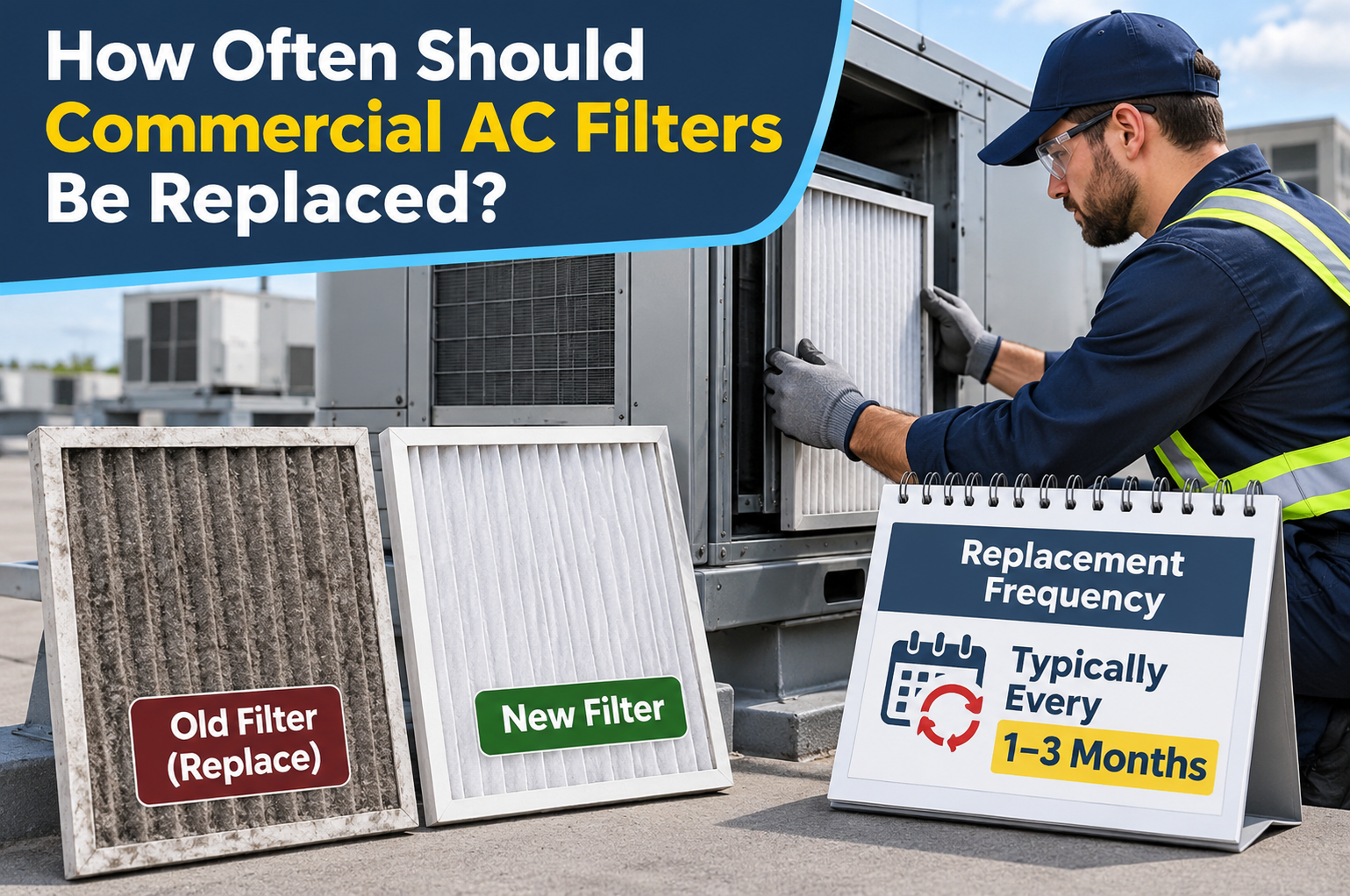
How Often Should Commercial AC Filters Be Replaced? A UK Business Guide
Quick Answer: How Often Should You Change Commercial AC Filters?
Commercial air conditioning filters should be inspected regularly, with many systems benefiting from checks every month and cleaning or replacement every 1–6 months, depending on their design, operating conditions and manufacturer recommendations. However, there is no universal replacement schedule.
- Busy offices and retail spaces: Inspect filters monthly and clean or replace them according to their condition and the manufacturer’s instructions.
- Restaurants and high-traffic premises: More frequent inspections may be necessary because of increased dust, grease and airborne contaminants. Especially in kitchens.
- Warehouses and industrial environments: Dust levels and operating hours can shorten filter lifespan considerably.
- Washable filters: Clean at the recommended intervals and replace when damaged, deteriorated or no longer effective.
- Disposable filters: Replace rather than wash, following the manufacturer’s specifications.
- Larger commercial HVAC systems: Use maintenance records, manufacturer guidance and, where applicable, differential pressure readings to determine replacement intervals.
The bottom line: Don’t wait until your air conditioning stops performing properly. Routine filter inspections, timely cleaning and appropriate replacement help protect indoor air quality, maintain energy efficiency and reduce avoidable strain on commercial HVAC equipment.
Aircon Group staff will advise you, they are the experts with over 60 years experience.
We asked the branch manager at the Teesside branch. He said for a normal AC unit it should be every 6 months definitely annually. It depends on the environment and usage. For instance a vets due to the pet hair and dander filters should be checked/cleaned every couple of months. However a system that is used for cooling only for a few months during the summer every 6 months is fine.
How Often Should You Change Commercial Air Conditioning Filters?
Your commercial air conditioning system works hard behind the scenes. It keeps offices comfortable, retail spaces welcoming and workplaces productive. But there’s one relatively small component that can have an enormous impact on how efficiently everything runs: the air filter.
Over time, commercial air conditioning filters collect dust, pollen, fibres and other airborne particles. That’s precisely what they’re designed to do.
The problem starts when those contaminants accumulate faster than the filter is cleaned or replaced.
A heavily loaded filter can restrict airflow, increase resistance within the system and make it harder to maintain comfortable indoor temperatures. Depending on the equipment, this may increase energy consumption, affect cooling performance and contribute to unnecessary wear.
So, how frequently should commercial air filters actually be changed?
But some filters are washable and should not normally require changing.
Is Every 1–3 Months the Right Replacement Schedule?
For many commercial air conditioning installations, one to three months is a useful starting point for reviewing filter condition, but it shouldn’t be treated as a compulsory replacement interval.
Some systems have washable mesh filters designed for regular cleaning rather than frequent replacement. Others use disposable panel, pleated or bag filters that must be changed when they reach their recommended service limit.
Larger air handling units (AHUs) may require a more structured approach, particularly where filter pressure drop can be monitored.
The most suitable commercial AC filter replacement schedule depends on several considerations:
- Manufacturer recommendations: Different equipment and filter designs have different maintenance requirements.
- Building occupancy: Busy commercial premises generally introduce more airborne particles than lightly occupied spaces.
- Operating hours: Equipment running continuously may accumulate contaminants faster than systems used intermittently.
- Environmental conditions: Dust, pollution, construction activity and other airborne contaminants can accelerate filter loading.
- Filter type and efficiency: Washable mesh filters, disposable filters and higher-efficiency filtration systems require different maintenance approaches.
- Existing filter condition: Visible contamination, restricted airflow and elevated pressure drop can indicate that attention is needed sooner.
A sensible maintenance programme considers all six rather than relying entirely on the calendar.
For businesses operating multiple systems, professional commercial air conditioning services can help establish appropriate inspection and servicing arrangements for the equipment installed.
Recommended Commercial AC Filter Inspection Intervals
The following table provides practical starting points for planning inspections. These are illustrative guidelines, not universal manufacturer-approved replacement intervals.
| Commercial environment | Suggested initial inspection frequency | Key considerations |
| Standard offices | 3 Monthly | Occupancy, operating hours and dust accumulation |
| Retail shops | 3 Monthly | Customer footfall, entrance doors and airborne dust |
| Restaurants and hospitality | Monthly | Grease, cooking particles and ventilation conditions |
| Warehouses | Every 2–4 weeks in dusty environments | Packaging fibres, dust and industrial activity |
| Schools and educational premises | Quarterly | Occupancy fluctuations and seasonal usage |
| Healthcare environments | According to the facility’s approved maintenance programme | Filtration specifications and infection-control requirements |
| Industrial facilities | Based on site conditions and filter monitoring | Process-generated particles and continuous operation |
Important: Inspection frequency is not the same as replacement frequency. A filter may only need cleaning, while another may require immediate replacement. Always follow the equipment manufacturer’s instructions and any applicable site-specific requirements.
For commercial properties with significant fresh-air requirements, maintaining the wider ventilation system is equally important. Air conditioning and ventilation equipment often work together to support comfortable, healthy indoor environments.
What Factors Affect Commercial AC Filter Replacement Frequency?
Two businesses can install similar air conditioning equipment and still need completely different filter maintenance schedules.
Why?
Because the environment surrounding an air conditioning system matters just as much as the system itself.
A quiet office operating five days a week doesn’t expose its filters to the same conditions as a busy warehouse, restaurant kitchen or manufacturing facility.
Understanding these differences is essential when deciding how often to change commercial air filters.
1. Building Occupancy and Foot Traffic
People introduce particles into indoor environments through clothing, footwear, everyday movement and normal building activity.
In a busy commercial property, doors open frequently, occupants move between rooms and dust is continually disturbed.
As a result, filters may accumulate contaminants more quickly.
Consider two workplaces:
- Office A: A small administrative office with ten employees, limited visitors and standard weekday opening hours.
- Office B: A busy customer-facing office with sixty employees, frequent visitors and extended opening hours.
Even with comparable air conditioning equipment, Office B may experience higher particulate loading.
That doesn’t automatically mean its filters must be replaced twice as often. It does mean its maintenance schedule should reflect actual usage and filter condition.
Practical tip: If your business experiences significant seasonal changes in occupancy, consider reviewing filter inspection intervals during its busiest periods.
2. Dust, Pollution and Airborne Contaminants
Not all commercial environments have the same indoor air quality challenges.
A modern office with relatively low dust levels may place modest demands on its filtration system. By contrast, a distribution centre handling cardboard packaging or a workshop generating airborne particles may load filters much faster.
Common sources of airborne contamination include:
- Dust entering through doors, windows and ventilation openings.
- Packaging fibres and particles from stored materials.
- Outdoor pollution entering through fresh-air intakes.
- Building and refurbishment activities.
- Textile fibres and general workplace dust.
- Cooking-related airborne particles in hospitality environments.
As contaminants accumulate, filter airflow resistance can increase.
In systems where filters are monitored using differential pressure measurements, a rising pressure drop may indicate increasing filter loading. However, the appropriate replacement threshold must come from the filter and equipment specifications.
A useful rule: The dustier the environment, the more important regular filter inspections become. Replace or clean filters based on their condition and the manufacturer’s requirements, not simply because a certain number of weeks have passed.
3. Daily Operating Hours and System Usage
An air conditioning system operating for eight hours a day will generally process less air over a given period than a comparable system running around the clock, assuming similar airflow and environmental conditions.
That difference can significantly affect filter loading.
For example, commercial premises operating extended hours may include:
- Hotels and hospitality venues.
- Supermarkets and convenience stores.
- Call centres and continuously occupied offices.
- Warehouses with multiple shifts.
- Manufacturing and production facilities.
Where equipment operates continuously, maintenance planning becomes particularly important.
However, operating hours alone don’t determine air filter lifespan. A system running continuously in a clean environment may still experience less filter loading than one operating fewer hours in a dusty facility.
The best approach is to combine operating-hour records with routine inspections and, where appropriate, condition-based filter monitoring.
4. Filter Type, Design and Efficiency
Not all commercial HVAC filters are interchangeable.
Different filtration technologies are designed to capture different types and sizes of airborne particles, and their maintenance requirements can vary considerably.
A basic washable mesh filter found in some air conditioning units serves a different purpose from a high-efficiency filter installed within a commercial air handling unit.
Common examples include:
| Filter type | Typical application | Maintenance approach |
| Washable mesh filters | Many split and cassette AC units | Regular cleaning; replacement when damaged or ineffective |
| Disposable panel filters | Commercial ventilation and HVAC equipment | Replacement according to condition and manufacturer guidance |
| Pleated air filters | Commercial air handling and ventilation systems | Condition-based or scheduled replacement |
| Bag filters | Larger air handling units | Replacement based on specifications, loading and pressure drop |
| Higher-efficiency particulate filters | Applications requiring enhanced particulate filtration | Specialist maintenance according to system requirements |
For larger commercial ventilation systems, ISO 16890 filter classifications, including ePM1, ePM2.5 and ePM10, can help describe a filter’s ability to capture different particle-size fractions.
You may also encounter MERV ratings, particularly in American equipment documentation. These describe filtration performance using a different classification system and should not be treated as directly interchangeable with ISO 16890 ratings.
The important point is that filter efficiency, design and maintenance requirements should be considered together.
Installing an unsuitable filter can increase airflow resistance or compromise equipment performance, even when the filter itself is new.
5. Seasonal Changes and Weather Conditions
Commercial air conditioning filters don’t necessarily accumulate contaminants at the same rate throughout the year.
During warmer months, businesses often rely more heavily on their cooling systems. Longer operating hours mean more air passes through the filters, potentially increasing the rate at which dust and airborne particles accumulate.
Spring and summer can also introduce additional challenges, particularly in buildings exposed to pollen, outdoor dust and increased ventilation demands.
Winter presents different considerations. Some commercial HVAC systems continue operating throughout the colder months to provide heating, ventilation or temperature control, meaning their filters still require attention.
Seasonal factors worth considering include:
- Spring: Increased pollen levels and airborne allergens may contribute to filter loading.
- Summer: Greater cooling demand can increase system operating hours and airflow through filters.
- Autumn: Outdoor debris, dust and changing ventilation conditions may affect filtration requirements.
- Winter: Continued heating and ventilation operation can lead to ongoing dust accumulation.
Rather than automatically replacing every filter at the beginning of each season, consider incorporating seasonal inspections into your commercial HVAC maintenance schedule.
This approach helps identify filters that need attention while avoiding unnecessary replacement of components that remain serviceable.
7 Signs Your Commercial AC Filters Need Replacing
A neglected air filter rarely announces itself with a dramatic breakdown.
More often, the warning signs develop gradually.
Perhaps the office feels slightly warmer than usual. The air conditioning seems to run for longer. Or employees begin noticing more dust around supply air vents.
These changes can have several causes, but dirty or clogged air filters are worth investigating.
Here are seven signs that your commercial air conditioning filters may need cleaning or replacement.
1. Reduced Airflow From Air Conditioning Vents
One of the most recognisable symptoms of a blocked air filter is reduced airflow.
As dust and debris accumulate, the filter creates greater resistance to the movement of air through the system.
Depending on the equipment, this can reduce the volume of conditioned air reaching occupied spaces.
You might notice:
- Weaker airflow from ceiling cassette units.
- Reduced air movement through supply vents.
- Certain rooms taking longer to reach their target temperature.
- Uneven cooling across different areas of the building.
However, restricted airflow isn’t always caused by dirty filters. Blocked ductwork, fan problems and other mechanical faults can produce similar symptoms.
What to do: Arrange a filter inspection and check for visible contamination. If cleaning or replacing the filter doesn’t restore normal airflow, further investigation by a qualified air conditioning engineer may be necessary.
2. Increasing Energy Bills Without an Obvious Explanation
Has your business noticed a gradual increase in electricity consumption despite relatively consistent operating hours?
A dirty air filter could be one contributing factor.
When airflow becomes restricted, some HVAC systems must operate for longer to maintain the desired indoor temperature. In certain installations, increased filter resistance can also raise fan energy consumption.
The exact impact depends on the system’s design, fan controls and operating conditions.
For businesses running multiple commercial air conditioning units, inefficient operation across several systems can become an expensive problem.
Of course, rising energy bills may also result from changes in tariffs, weather conditions, occupancy or equipment usage.
That’s why filter maintenance should form part of a wider investigation rather than being treated as the automatic explanation.
Remember: A clean, correctly specified filter supports efficient airflow, but replacing a filter alone won’t resolve every cause of excessive HVAC energy consumption.
3. Visible Dust and Dirt Accumulation
Sometimes the most obvious warning sign is also the easiest to overlook.
If a filter is heavily coated in dust, lint or debris, it deserves attention.
During a routine air filter inspection, maintenance personnel may discover:
- Thick dust deposits across the filter surface.
- Lint and fibres trapped within the filter material.
- Darkened or heavily contaminated filter sections.
- Debris obstructing the filter’s intake area.
- Damaged, distorted or deteriorating filter media.
However, a filter looking dirty doesn’t automatically mean it has reached the end of its useful life.
After all, collecting particles is its job.
For disposable commercial HVAC filters, the manufacturer’s recommended final pressure drop or other replacement criteria may provide a more reliable indication than appearance alone.
Washable filters should be cleaned using the approved procedure and allowed to dry where required before being reinstalled.
Never attempt to wash a disposable filter unless its manufacturer specifically states that it is suitable for cleaning.
4. Inconsistent Cooling and Uncomfortable Indoor Temperatures
Commercial air conditioning should provide reliable temperature control throughout the areas it serves.
If some rooms remain comfortable while others become noticeably warmer, restricted airflow may be contributing to the problem.
For example, an office meeting room might struggle to cool down during the afternoon, while an adjacent workspace maintains its usual temperature.
A clogged filter can contribute to reduced airflow and diminished cooling performance, particularly when the system is already operating under significant demand.
Other possible causes include incorrect thermostat settings, refrigerant-related faults, poorly balanced airflow or inadequate system capacity.
If temperature inconsistencies persist after routine filter maintenance, the equipment should be assessed professionally.
5. Unusual Odours When the AC Is Running
An unpleasant smell coming from an air conditioning unit can indicate that something requires attention.
Dust accumulation, moisture and microbial contamination within parts of an HVAC system can contribute to musty or stale odours.
Filters may be involved, but they’re not always the source.
Condensate trays, drainage components, coils and internal surfaces can also become contaminated, particularly where moisture isn’t being managed effectively.
If you notice persistent musty smells:
- Check whether the filter is visibly contaminated.
- Follow the manufacturer’s recommended cleaning or replacement procedure.
- Inspect accessible components for signs of moisture or drainage problems, where safe and appropriate.
- Arrange professional servicing if the odour continues.
A filter change may help, but persistent odours should not be ignored or assumed to be resolved simply because a new filter has been fitted.
6. Increased Dust Around Vents and Workspaces
Dust collecting around air conditioning vents, ceiling grilles or nearby surfaces can raise questions about filtration performance.
Possible causes include damaged filters, poorly fitted filter frames, filter bypass or contamination elsewhere within the ventilation system.
In some cases, dust accumulation may have little to do with the filter itself.
Nevertheless, it is worth checking whether the correct filter has been installed and whether it sits securely within its housing.
A gap around the filter can allow unfiltered air to bypass the media, reducing the effectiveness of the filtration arrangement.
This is particularly important in commercial buildings where maintaining consistent indoor air quality is a priority.
7. More Frequent System Faults or Unusual Operating Noise
Air conditioning equipment that repeatedly develops faults may be experiencing underlying maintenance problems.
Severely restricted airflow can contribute to operational difficulties, including reduced heat transfer and abnormal operating conditions in certain systems.
Depending on the equipment and its protective controls, this may result in performance problems or shutdowns.
Unusual fan noises, repeated fault codes or unexpected interruptions should therefore be investigated.
However, these symptoms aren’t specific to blocked filters.
If your commercial AC system is repeatedly shutting down, making unusual noises or struggling to maintain temperature, don’t assume that changing the filter will solve the problem.
A qualified engineer should identify the underlying cause before the equipment is returned to normal operation.
Why Regular Air Filter Replacement Matters for Commercial Buildings
Changing or cleaning an air conditioning filter might seem like a minor maintenance task.
Compared with repairing a compressor or replacing an entire commercial HVAC system, it certainly appears straightforward.
But filter maintenance can influence several aspects of building performance, from workplace comfort to equipment reliability.
Improved Indoor Air Quality
Indoor air quality plays an important role in creating comfortable commercial environments.
Depending on their design and filtration efficiency, HVAC filters can capture airborne particles such as dust, pollen and other particulate contaminants as air passes through the system.
Maintaining these filters helps preserve their intended performance.
However, filtration effectiveness depends on more than simply keeping a filter clean.
The filter’s efficiency rating, correct installation, airflow and overall ventilation strategy all matter.
For example, a basic washable mesh filter is not designed to provide the same fine-particle filtration performance as a suitably specified higher-efficiency filter.
Similarly, air conditioning filtration does not replace the need for appropriate fresh-air ventilation.
For offices, retail environments and other occupied commercial buildings, the most effective approach considers filtration and ventilation as complementary parts of the wider indoor environment.
Better Energy Efficiency and Lower Running Costs
Commercial HVAC systems can account for a substantial proportion of a building’s energy use.
Maintaining appropriate airflow helps equipment operate as intended.
When filters become excessively loaded, the additional resistance may increase fan energy demand or contribute to longer operating periods, depending on the system.
Routine filter maintenance can therefore help prevent avoidable inefficiencies.
Consider a business operating several ceiling cassette units throughout its premises.
If their filters are neglected, the resulting airflow restrictions may gradually affect cooling performance and comfort.
Addressing those issues through regular maintenance is generally preferable to waiting until occupants complain or equipment begins developing faults.
That said, the energy savings from filter replacement vary by system. A new filter should be installed when necessary, rather than assuming that replacing serviceable filters more frequently will always reduce electricity costs.
Reduced Wear on Commercial HVAC Equipment
Air conditioning systems contain numerous interconnected components.
Fans, heat exchangers, compressors, sensors and control systems must work together to deliver reliable cooling or heating.
When airflow is significantly restricted, some equipment may operate outside its intended conditions.
Over time, unresolved problems can contribute to additional strain, reduced performance or premature component failure.
Regular air conditioning filter maintenance helps reduce one avoidable source of airflow restriction.
It also gives maintenance personnel an opportunity to identify other issues, including damaged filter housings, unusual contamination or poor installation.
For facilities managers, this makes filter inspections a useful part of planned preventative maintenance (PPM).
Greater Workplace Comfort and Productivity
An uncomfortable workplace can quickly become a distraction.
Employees may complain about warm meeting rooms, stuffy offices or inconsistent temperatures between different parts of the building.
Customers may also notice when retail or hospitality environments feel uncomfortable.
While many factors influence indoor comfort, properly maintained air conditioning helps support consistent airflow and temperature control.
A well-managed commercial AC filter replacement programme can contribute to this by ensuring filters aren’t allowed to become excessively restrictive.
The result is a more reliable system and fewer avoidable comfort-related complaints.
Fewer Unexpected Maintenance Problems
Commercial air conditioning breakdowns rarely happen at convenient times.
An unexpected fault during a busy trading period can disrupt operations, affect staff comfort and create unplanned repair costs.
Routine inspections cannot prevent every mechanical failure, but they can help identify developing maintenance issues before they become more serious.
This is particularly valuable for businesses that rely on temperature-controlled environments or operate equipment for extended hours.
In facilities where air conditioning operates alongside specialist cooling equipment, maintaining an appropriate service schedule for each system is important. Commercial refrigeration services address different equipment requirements and should not be confused with routine AC filter maintenance.
Ultimately, preventative maintenance is about keeping essential building systems reliable rather than waiting for something to go wrong.
Can Commercial AC Filters Be Cleaned Instead of Replaced?
Not every dirty air conditioning filter needs to go straight into the bin.
In fact, many commercial AC systems are designed with washable filters that can be cleaned and reused repeatedly. Others contain disposable filters that must be replaced once they reach the end of their service life.
Knowing which type your equipment uses is essential.
Attempting to wash a disposable filter can damage its filtration media, reduce its effectiveness and potentially introduce additional airflow problems. Equally, replacing a perfectly serviceable washable filter every few weeks creates unnecessary expense.
The key is understanding the difference.
Washable vs Disposable Commercial AC Filters
| Feature | Washable AC filters | Disposable AC filters |
| Typical construction | Reusable mesh or other washable materials | Pleated, panel or specialist filter media |
| Maintenance | Clean according to manufacturer instructions | Replace when required |
| Replacement frequency | When damaged, deteriorated or no longer effective | Based on service limits, condition and manufacturer guidance |
| Reusability | Designed for repeated cleaning | Generally single-use |
| Common applications | Split systems, cassette units and some fan coil units | Air handling units and commercial ventilation systems |
| Main consideration | Correct cleaning and drying procedures | Correct specification, fit and replacement timing |
When Should a Washable AC Filter Be Replaced?
Reusable doesn’t mean everlasting.
Even a washable filter will eventually need replacing.
Replacement may be necessary if the filter has:
- Torn, damaged or deteriorated mesh.
- A cracked or distorted frame.
- Persistent contamination that cannot be removed using approved cleaning methods.
- Lost its ability to fit securely within the filter housing.
- Reached a manufacturer-specified replacement limit.
For businesses using multiple air conditioning units, recording filter condition during each service can help identify when replacements are becoming necessary.
How Often Should Different Commercial Buildings Change Their Filters?
Commercial air conditioning maintenance should reflect how a building is actually used.
A quiet office, a busy restaurant and a distribution warehouse have very different operating conditions. Applying the same filter replacement schedule to all three would overlook important differences in occupancy, airborne contamination and equipment usage.
Here’s how maintenance priorities can vary across commercial environments.
Office Buildings and Corporate Workspaces
Office air conditioning systems often operate during standard working hours, although larger buildings may require extended cooling or ventilation.
Dust from clothing, carpets, furniture, outdoor air and everyday activity gradually accumulates on filters.
For many offices, monthly filter inspections provide a reasonable starting point, with cleaning or replacement determined by filter condition and manufacturer guidance.
Facilities managers should pay particular attention to meeting rooms, heavily occupied areas and systems serving spaces with extended operating hours.
Retail Shops and Shopping Centres
Retail environments can experience significant fluctuations in occupancy.
Busy shopping periods, frequently opening entrance doors and continuous customer movement can introduce additional dust and airborne particles.
For these premises, regular inspections are especially valuable during peak trading periods.
A clogged filter may contribute to reduced airflow and uneven temperatures, affecting both employees and customers.
Maintenance priority: Review filters regularly, particularly in heavily used areas and units positioned near busy entrances.
Restaurants, Cafés and Hospitality Venues
Hospitality businesses face additional filtration challenges.
Cooking activities, airborne grease, customer movement and extended operating hours can all affect indoor environmental conditions.
However, it’s important to distinguish between ordinary air conditioning filters and specialist kitchen extraction filters.
Commercial kitchen grease filters are designed for different purposes and require their own cleaning and maintenance procedures.
For general air conditioning systems serving dining areas, bars or customer spaces, more frequent inspections may be appropriate where contamination levels are high.
Maintenance priority: Check filters for dust and contamination, and ensure that air conditioning maintenance is coordinated with the building’s wider ventilation arrangements.
Warehouses and Industrial Facilities
Warehouses can present particularly demanding conditions for commercial HVAC filters.
Cardboard fibres, packaging dust, vehicle movements, loading activities and industrial processes may increase airborne particle concentrations.
In dusty environments, filters can become heavily loaded much faster than they would in a typical office.
This makes condition-based maintenance especially valuable.
For larger systems, differential pressure monitoring can help maintenance teams identify when filter resistance approaches the manufacturer’s recommended limit.
Maintenance priority: Establish inspection intervals based on actual site conditions, particularly where equipment operates continuously or processes generate substantial dust.
Schools and Educational Buildings
Schools, colleges and training facilities often experience high occupancy during term time, followed by quieter periods.
Classrooms, communal areas and administrative spaces may have different ventilation and filtration requirements.
Regular inspections can help maintain system performance throughout busy teaching periods.
Maintenance teams should also consider scheduling more extensive servicing during holidays when disruption to building users can be minimised. Aircon Group work with a lot of schools, colleges and trusts. They generally work around the hours when students are learning.
Healthcare and Specialist Commercial Environments
Healthcare facilities, laboratories and other specialist environments may require enhanced filtration and more stringent maintenance procedures.
These systems should never be managed using a generic monthly or quarterly replacement rule.
Instead, filter inspections, replacement thresholds and maintenance procedures must follow the facility’s approved specifications and applicable operational requirements.
Where specialist filtration is installed, appropriately trained personnel should undertake the work.
Commercial AC Filter Maintenance Best Practices
An effective commercial HVAC maintenance schedule shouldn’t rely on someone remembering to check the filters when the air conditioning starts struggling.
It should be planned, documented and tailored to the building.
For facilities managers and business owners, the following practices provide a useful starting point.
Create a Filter Maintenance Schedule
Begin by identifying every air conditioning and ventilation unit within the premises.
Record the equipment type, location, filter specification and manufacturer-recommended maintenance requirements.
Then establish appropriate inspection intervals.
These can be adjusted as maintenance records reveal how quickly filters accumulate contamination under normal operating conditions.
Maintain an HVAC Maintenance Log
A straightforward maintenance log can make a significant difference, particularly in buildings containing multiple systems.
Useful information includes:
| Maintenance record | Information to capture |
| Equipment identification | Unit reference and location |
| Filter specification | Filter type, dimensions and efficiency classification where applicable |
| Inspection date | When the filter was last checked |
| Filter condition | Visible contamination, damage or relevant pressure readings |
| Action taken | Cleaned, replaced or left in service |
| Next inspection | Planned inspection date |
| Engineer or technician | Person responsible for the work |
Keeping accurate records helps facilities teams identify recurring issues, plan replacement stock and avoid unnecessary maintenance.
Follow Manufacturer Replacement Guidelines
Filter maintenance requirements vary between equipment manufacturers.
Always check the relevant service documentation before establishing a replacement schedule or fitting an alternative filter.
Using the wrong filter can affect airflow, filtration performance and equipment operation.
For larger commercial air handling systems, the filter’s recommended final pressure drop may also be an important replacement criterion.
Check Filter Fit and Installation
A replacement filter is only effective when correctly installed.
An incorrectly sized filter, damaged frame or poorly sealed housing can allow air to bypass the filtration media.
Before returning equipment to service, confirm that the filter:
- Matches the required specification and dimensions.
- Is installed in the correct orientation where applicable.
- Fits securely within its housing.
- Has no visible gaps or damaged seals.
- Does not obstruct components or prevent proper access-panel closure.
Include Filters in Planned Preventative Maintenance
Commercial AC filter replacement is only one part of keeping air conditioning equipment in good working order.
A broader planned preventative maintenance programme may include checking condensate drainage, inspecting coils, assessing airflow, examining electrical components and verifying overall system performance.
The exact tasks and frequency depend on the equipment and manufacturer’s requirements.
Combining routine filter checks with appropriate professional servicing can help identify developing problems before they cause significant disruption.
Frequently Asked Questions About Commercial AC Filter Replacement
How long do commercial air conditioning filters last?
Commercial AC filter lifespan depends on the filter type, operating hours, airborne contamination and manufacturer specifications.
Some washable filters can remain serviceable through many cleaning cycles, while disposable filters must be replaced when they reach their recommended service limit.
For many premises, monthly inspections are a useful starting point, but replacement should be based on the equipment’s requirements and actual filter condition.
Should commercial AC filters be changed every month?
Not necessarily.
Monthly inspections may be appropriate for some commercial environments, but that doesn’t mean every filter requires monthly replacement.
A lightly loaded disposable filter may remain serviceable for longer, while a filter operating in a dusty environment may require earlier attention.
Follow the manufacturer’s recommendations and adjust the maintenance schedule to suit the building.
What happens if commercial air filters are not changed?
Neglected filters can become heavily loaded with dust and airborne particles.
This may restrict airflow, reduce heating or cooling performance, increase energy consumption in some systems and contribute to equipment operating problems.
Poor filter maintenance may also affect the system’s intended filtration performance.
Do dirty AC filters increase electricity bills?
They can.
Excessive filter resistance may increase fan energy consumption or cause some air conditioning systems to operate for longer to maintain the required temperature.
However, the effect varies depending on equipment design, fan controls and operating conditions.
Dirty filters are one potential cause of increased energy use, not the only explanation.
Can a clogged air filter damage commercial air conditioning?
Severely restricted airflow can contribute to abnormal operating conditions and equipment faults in certain systems.
Over time, unresolved airflow problems may increase strain on components or contribute to premature failures.
If an air conditioning unit repeatedly shuts down or displays fault codes, a qualified engineer should investigate rather than assuming the filter is the only problem.
How often should air handling unit filters be replaced?
Air handling unit (AHU) filters should be replaced according to their specifications, manufacturer recommendations and operating conditions.
For systems equipped with differential pressure monitoring, readings can help determine when filters have reached their recommended final resistance.
A fixed replacement interval isn’t appropriate for every AHU.
How often should fan coil unit filters be cleaned?
Fan coil unit (FCU) filters often require regular inspection and cleaning, particularly in heavily occupied or dusty environments.
Monthly checks may provide a practical starting point, but the correct cleaning interval depends on the unit, filter design and manufacturer’s instructions.
How much does commercial AC filter replacement cost in the UK?
The cost varies depending on the type and quantity of filters, equipment accessibility, labour requirements and whether replacement is included within an existing maintenance agreement.
Basic washable filter cleaning and specialist AHU filter replacement can involve very different levels of work.
For accurate budgeting, businesses should obtain a quotation based on their installed equipment rather than relying on a universal price.
Are there UK regulations specifying how often commercial AC filters must be changed?
There is no single universal UK rule requiring every commercial air conditioning filter to be replaced after a fixed number of days or months.
However, businesses may have relevant duties concerning workplace ventilation, equipment maintenance and safe operation.
Specific buildings or specialist environments may also have additional requirements.
Maintenance schedules should therefore reflect applicable obligations, manufacturer guidance and the building’s operational needs.
Who is responsible for changing commercial air conditioning filters?
Responsibility generally depends on the building’s ownership arrangements, maintenance contracts and lease terms.
In some premises, the building owner or facilities management company organises servicing. Elsewhere, the tenant or business operator may be responsible.
Routine cleaning may be undertaken by suitably trained personnel where the manufacturer permits it, while more complex maintenance should be carried out by appropriately qualified professionals.
What is the difference between an AC filter change and a full air conditioning service?
A filter change addresses one specific maintenance component.
A full air conditioning service involves a broader assessment of the equipment and may include cleaning, inspections, operational checks and other manufacturer-recommended tasks.
Replacing a dirty filter is useful, but it doesn’t replace comprehensive servicing.
Keep Your Commercial Air Conditioning Running Efficiently
Commercial air conditioning filters are easy to overlook, particularly when the system appears to be working normally.
Yet these relatively simple components play an important role in maintaining airflow, supporting filtration performance and helping HVAC equipment operate as intended.
The most effective approach isn’t to replace every filter automatically after a fixed number of weeks.
It’s to understand your equipment, inspect filters regularly and respond to their actual condition.
For many commercial premises, monthly checks are a sensible starting point. Busy, dusty or continuously operating environments may need closer attention, while specialist filtration systems should follow their own approved maintenance requirements.
The key takeaways are straightforward:
- Inspect commercial AC filters regularly rather than waiting for performance problems.
- Follow manufacturer guidance for cleaning and replacement.
- Consider occupancy, operating hours and environmental conditions.
- Replace damaged or unsuitable filters promptly.
- Keep maintenance records to support consistent servicing.
- Include filter care within a wider preventative maintenance programme.
At Aircon Group, we understand that reliable temperature control matters to businesses. Whether you’re managing an office, retail premises, hospitality venue or larger commercial facility, maintaining your air conditioning equipment is an important part of keeping your workplace comfortable and operational.
Don’t wait for a clogged filter to become a bigger problem. Take a proactive approach to commercial air conditioning maintenance and help keep your systems performing as they should.