The Relationship Between Air Conditioning And Humidity
Humidity can make a comfortable room feel sticky and oppressive even when the thermometer suggests the temperature should be pleasant. Air conditioning helps solve both sides of that problem: as well as removing heat from indoor air, a correctly operating AC system removes moisture through condensation. This dehumidification can make a room feel considerably more comfortable without simply driving the thermostat lower.
The key points at a glance:
- Air conditioning normally reduces indoor humidity while cooling the air.
- Temperature and relative humidity work together to determine how warm or comfortable a room actually feels.
- High humidity increases the latent cooling load on an air conditioner because the system has moisture as well as heat to remove.
- An incorrectly sized AC system can cool a room without providing sufficient dehumidification.
- Very high or very low humidity can affect comfort, indoor air quality and the building itself.
- For many occupied indoor spaces, roughly 40–60% relative humidity is a useful comfort range, although the appropriate target depends on the building, conditions and application.
- Good humidity control is not simply about turning the temperature down. AC sizing, airflow, ventilation, maintenance and moisture entering the building all matter.
In simple terms: an air conditioner does more than make warm air colder. During normal cooling it can also extract water from the air. That is why effective air conditioning can make a humid room feel dramatically more comfortable even before there is a large change in temperature.
What is the relationship between air conditioning and humidity?
Air temperature gets most of the attention when we talk about indoor comfort. Humidity is the less obvious half of the equation.
Walk into two rooms at exactly the same temperature and they can feel remarkably different. One may feel fresh and comfortable. The other can feel heavy, sticky and warmer than the thermostat suggests.
The difference may be their relative humidity (RH).
Relative humidity describes the amount of water vapour in the air relative to the maximum amount that air can hold at its current temperature. Because that capacity changes with temperature, temperature and humidity are closely connected rather than being two completely independent measurements.
Air conditioning influences both.
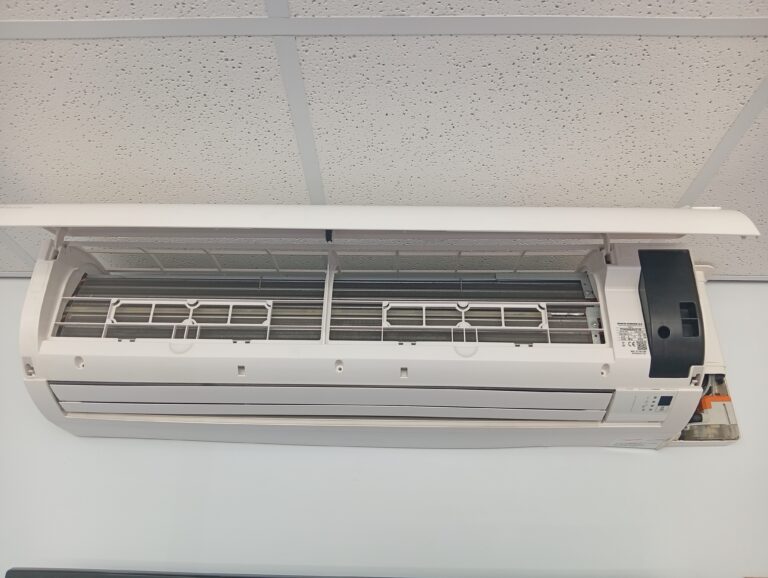
During the cooling cycle, an air conditioning unit draws warm indoor air across a cold evaporator coil. Heat transfers from the air into the refrigerant system, reducing the air temperature. At the same time, if the surface of the coil is below the air’s dew point, some of its water vapour condenses on the coil.
The AC therefore deals with two different loads:
- Sensible heat — the heat that changes the measured air temperature.
- Latent heat — the energy associated with moisture in the air.
Removing sensible heat makes the room cooler. Latent heat removal provides dehumidification.
That distinction explains why judging AC performance purely by the temperature displayed on a thermostat can be misleading.
A system could make a room cold yet leave it uncomfortably humid. Another system maintaining a slightly higher temperature but controlling moisture effectively may produce a much more pleasant indoor climate.
This interaction is one reason correct system design matters. At Aircon Group, cooling requirements need to be considered alongside the conditions in which the equipment will actually operate rather than treating thermostat temperature as the only measure of comfort. In industrial setting there might be a requirement for temperature and humidity levels.
Does air conditioning reduce humidity?
Yes. A conventional air conditioner will generally reduce humidity as a natural consequence of the cooling process.
The important word is generally.
An AC unit is not necessarily the same thing as a dedicated dehumidifier, and the amount of moisture it removes depends on system design, operating conditions, airflow, runtime and the moisture load within the building.
To understand why, imagine taking a cold drink outside on a humid summer day. Before long, droplets appear on the outside of the glass.
The glass isn’t leaking.
Water vapour in the surrounding air has encountered a surface cold enough for that vapour to condense into liquid water. An air conditioner’s evaporator coil uses the same basic physical principle.
How an AC system removes moisture from the air
During normal cooling, the process broadly looks like this:
- Warm indoor air enters the system.
- The air passes over the cold evaporator coil.
- Refrigerant within the system absorbs heat from the air.
- The air temperature falls.
- When the coil surface is below the air’s dew-point temperature, water vapour begins to condense.
- Condensation collects on the evaporator coil.
- The resulting condensate is collected and carried away through the drainage system.
- Cooler, drier air is returned to the occupied space.
So when somebody asks, “Does AC remove humidity?”, the answer is more precise than a simple yes: the air conditioner removes moisture, and reducing the amount of moisture present can lower indoor humidity.
This is dehumidification occurring alongside cooling.
It is also why an air conditioning system can sometimes produce a striking improvement in comfort without needing an extreme thermostat setting.
Why does humidity make a room feel hotter?
Anyone who has experienced a humid British summer day knows the sensation. The temperature may not look extraordinary, yet the air feels close and uncomfortable.
Your body relies heavily on the evaporation of sweat to release heat. When the surrounding air already contains a large amount of moisture, evaporation becomes less effective.
The result is a higher perceived temperature.
This is why simply asking, “What temperature is the room?” doesn’t tell the whole comfort story.
The precise sensation varies between people and buildings, but the principle remains: thermal comfort is affected by both temperature and humidity.
That has practical implications for energy efficiency too.
If high humidity makes occupants feel hotter, the natural response is often to lower the thermostat. But driving the temperature lower is not necessarily the most efficient solution to a moisture problem.
Effective humidity control may allow comfortable conditions to be maintained without unnecessary overcooling.
What is relative humidity?
Humidity terminology can become technical quickly, so it helps to distinguish a few measurements.
Relative humidity is the percentage most people encounter on a hygrometer, weather forecast or humidity sensor. A reading of 60% RH does not mean that 60% of the room’s air is water.
It means the air contains 60% of the water vapour it could hold at that particular temperature before reaching saturation.
This matters because warmer air can support more water vapour than cooler air.
As air cools, its relative humidity can therefore increase even when no additional moisture has entered the room. Continue cooling it far enough and it eventually reaches its dew point.
At that temperature, the air becomes saturated. Further cooling causes water vapour to condense.
That is precisely the phenomenon an evaporator coil exploits.
Relative humidity vs absolute humidity
There is another useful distinction:
- Relative humidity (RH) describes moisture relative to the air’s saturation point at its current temperature.
- Absolute humidity describes the actual quantity of water vapour present in a given volume of air.
- Humidity ratio is another HVAC measurement describing the mass of water vapour relative to the mass of dry air.
- Dew point tells us the temperature at which the air reaches saturation and condensation begins.
HVAC engineers can go considerably further, using measurements such as dry-bulb temperature, wet-bulb temperature, enthalpy and sensible heat ratio (SHR) to understand air conditions and cooling requirements.
Collectively, the science of analysing the thermodynamic properties of moist air is known as psychrometrics.
What is the ideal indoor humidity with air conditioning?
There isn’t one magic humidity percentage suitable for every building and every situation.
As a general comfort benchmark, however, an indoor relative humidity of approximately 40–60% is often a useful range to consider.
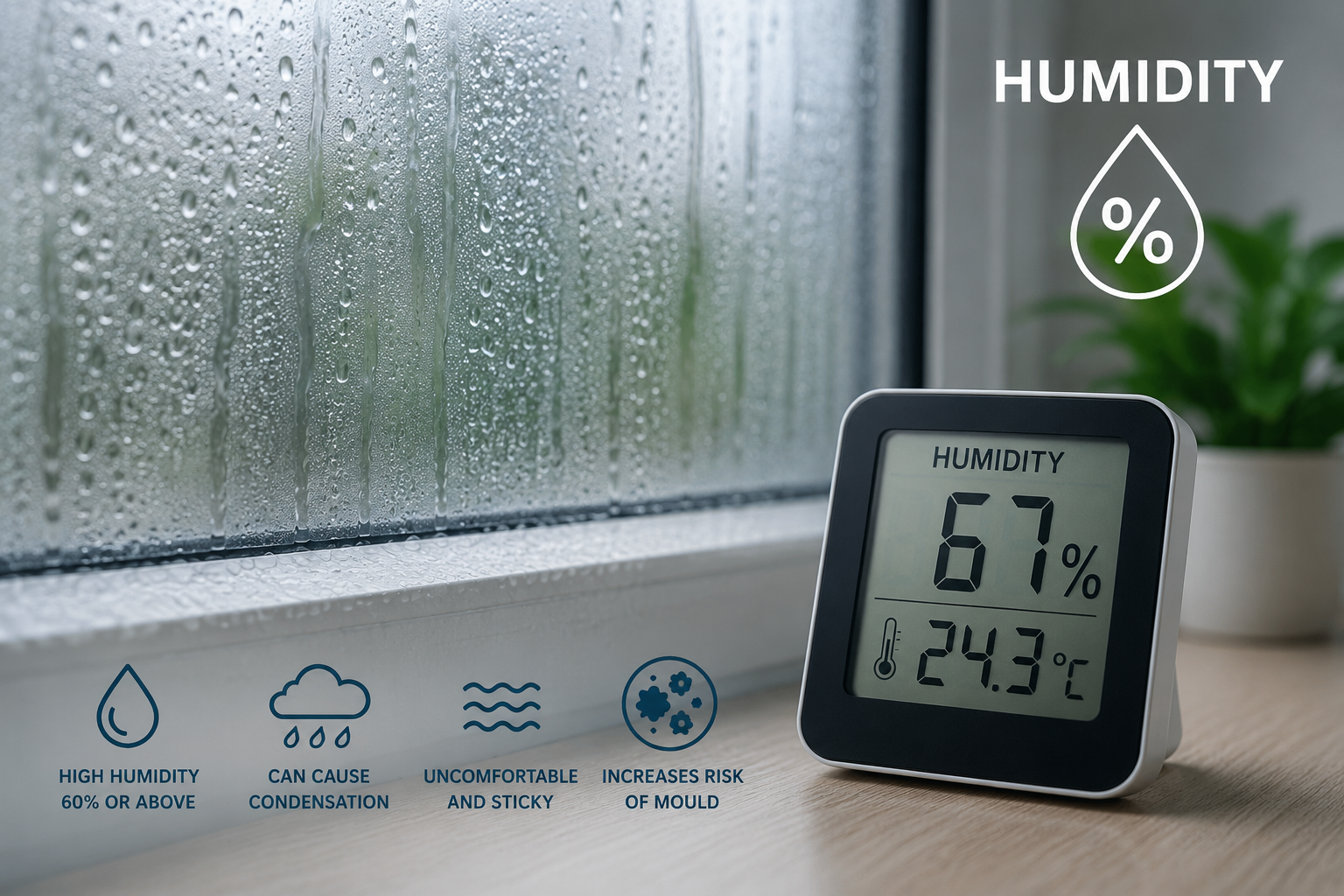
Once humidity rises substantially, occupants may begin to notice that familiar sticky or clammy feeling. Persistent excess moisture can also contribute to unwanted condensation and conditions in which mould or mildew can become more likely.
At the opposite extreme, very low humidity can produce excessively dry air.
The goal, then, isn’t “the lowest humidity possible.”
It is comfortable, controlled humidity.
For air-conditioned buildings, that means considering:
- indoor and outdoor temperature;
- outdoor humidity;
- occupancy levels;
- sources of moisture inside the building;
- ventilation and air infiltration;
- the building envelope and insulation;
- required cooling capacity;
- AC runtime and airflow; and
- how the space is actually used.
Ventilation deserves particular attention because cooling and fresh-air requirements are interconnected. A well-considered ventilation system can form part of the broader strategy for managing indoor conditions, but bringing outside air into a building also means its temperature and moisture content must be considered.
How high humidity affects air conditioning
High humidity doesn’t merely affect the people inside a building. It changes the work the AC system has to perform.
When an air conditioner encounters hot, humid air, there are effectively two jobs waiting for it: heat removal and moisture removal.
That additional moisture represents a latent cooling load.
The greater the latent load, the more of the system’s available capacity may be involved in dehumidifying the air rather than simply lowering its dry-bulb temperature.
This helps explain why an air conditioner can appear to behave differently on two days with similar outdoor temperatures.
On a relatively dry day, the system may primarily be dealing with sensible heat. On a humid day, there may be substantially more water vapour to remove as well.
High humidity can affect AC runtime
Where cooling and moisture loads are high, an AC system may need to operate for longer to reach and maintain the desired indoor conditions.
That can affect:
- AC runtime
- system workload
- compressor operation
- energy consumption
- electricity costs
- component wear
- overall cooling efficiency
This doesn’t mean that longer cycles are automatically evidence of a fault. Air conditioning equipment is designed to operate.
What matters is whether the system is correctly selected, installed and maintained for the load it is being asked to handle.
A persistent situation where the AC runs but the building remains humid deserves investigation rather than endlessly reducing the thermostat.
And this brings us to one of the most counter-intuitive parts of the entire subject: an air conditioner can sometimes be powerful enough to cool a room and still be poorly suited to controlling its humidity.
Can an air conditioner be too powerful for humidity control?
Yes. In fact, an oversized air conditioner can be one of the reasons a room reaches the desired temperature but remains uncomfortably humid.
At first, that may seem backwards. Surely a more powerful air conditioning unit should remove more heat and more moisture?
The problem is runtime.
An oversized AC system may reduce the sensible temperature of a room very quickly. The thermostat reaches its set point, the compressor switches off, and the cooling cycle ends.
That rapid cooling can mean the system has not operated for long enough to provide the level of moisture removal the space requires.
This behaviour is commonly associated with short cycling.
Oversized AC and high humidity
Imagine that a room needs a certain amount of continuous cooling and dehumidification during warm, humid conditions.
A correctly selected system runs for an appropriate period, allowing warm indoor air to repeatedly pass across the cold evaporator coil. Water vapour condenses, condensate drains away and both temperature and humidity gradually move towards comfortable levels.
An oversized system may reach the thermostat temperature much sooner.
The room is technically cool, so the cooling demand stops.
But the latent moisture load may remain.
The result can be an unusual combination:
low enough temperature + excessive indoor humidity = a cool but clammy room.
This is why simply installing the highest-capacity air conditioner available isn’t necessarily an upgrade.
Correct AC sizing involves matching equipment to the actual requirements of the space.
Factors can include:
- room dimensions and volume;
- glazing and solar gain;
- insulation;
- orientation;
- occupancy;
- heat-producing equipment;
- ventilation;
- air leakage and infiltration;
- outdoor design conditions; and
- sensible and latent cooling loads.
For commercial properties in particular, occupancy and equipment loads can vary considerably between spaces. Professional commercial air conditioning design should therefore consider the building’s real cooling requirements rather than relying on floor area alone.
What about an undersized air conditioner?
The opposite problem can occur when an AC system is undersized.
An undersized unit may run for extended periods because it struggles to satisfy the cooling load. During very demanding conditions, it may be unable to achieve the required indoor temperature.
Long runtime can provide moisture removal, but that doesn’t mean undersizing is a good strategy for dehumidification.
The system may:
- operate almost continuously;
- struggle to reach the thermostat set point;
- consume unnecessary energy;
- place additional demand on components; and
- fail to maintain comfortable conditions during peak loads.
The objective is therefore neither an oversized nor undersized air conditioner.
It is a properly sized system capable of handling the building’s sensible and latent loads.
Why is my house or room humid when the AC is running?
If the air conditioner is operating but the room still feels humid, there are several possible explanations.
Some relate directly to the AC equipment. Others originate elsewhere in the building.
The first step is recognising that an air conditioner cannot control unlimited quantities of incoming moisture. If humid outdoor air is continually entering a building, or substantial moisture is being generated internally, the system has a larger latent load to overcome.
Here are some of the most common possibilities.
1. The air conditioner is oversized
As explained above, an oversized unit can satisfy the temperature requirement too quickly.
Short cooling cycles reduce the time available for moisture to condense on the evaporator coil and drain away.
If the pattern is “AC reaches temperature quickly, switches off, but the room still feels clammy,” equipment sizing is one factor worth investigating.
2. Humid outdoor air is entering the building
Every time humid outside air enters an air-conditioned space, the AC system inherits the moisture contained within it.
This can occur through:
- open windows;
- frequently opened external doors;
- gaps in the building envelope;
- poorly sealed penetrations;
- uncontrolled ventilation; or
- general air infiltration.
The effect can be particularly noticeable when outdoor dew points are high.
Rather than treating the AC unit in isolation, persistent humidity problems may therefore require looking at the whole building.
3. The building is generating a lot of moisture
People themselves release moisture through breathing and perspiration.
Additional indoor moisture can come from activities such as:
- cooking;
- showering;
- washing and drying clothes;
- cleaning;
- boiling water; and
- processes associated with particular commercial or industrial environments.
A crowded room consequently has a different latent load from an empty one.
Likewise, a kitchen, gym, restaurant, server-adjacent office, pharmaceutical or manufacturing environment can present very different requirements from a lightly occupied portacabin.
4. Airflow is incorrect
Airflow across the evaporator coil influences heat transfer and moisture removal.
If airflow is outside the conditions the equipment was designed for, performance can suffer.
Potential causes include dirty filters, obstructed airflow, fan problems, unsuitable settings or issues elsewhere within the system.
This is one reason routine air conditioning maintenance matters for more than preventing breakdowns. Keeping filters, coils, drainage and other components in appropriate condition helps the equipment perform as intended.
5. The evaporator coil or drainage system has a problem
Moisture removed from the air has to go somewhere.
Once water vapour condenses on the evaporator coil, the condensate must be collected and discharged correctly.
A blocked or poorly functioning condensate drain can cause water-management problems. Dirty coils can also interfere with normal heat exchange.
Signs that warrant professional attention can include:
- unexpected water around the unit;
- persistent damp smells;
- reduced cooling performance;
- unusually high indoor humidity;
- ice formation;
- abnormal cycling; or
- water failing to drain correctly.
A leaking indoor unit should not simply be accepted as evidence that the air conditioner is “removing lots of humidity.” Condensate should be managed and discharged through the system as designed.
6. The thermostat or controls are not supporting dehumidification
Control strategy can also affect humidity.
For example, continually changing temperature settings or operating the system in ways that produce very short cooling periods may not give the AC much opportunity to remove moisture.
Some modern systems offer operating modes specifically intended to prioritise moisture reduction.
That leads to a common question.
What does dry mode do on an air conditioner?
Many modern air conditioning systems include a dry mode, often represented by a water-drop symbol on the controller.
Dry mode is intended primarily to reduce moisture rather than provide maximum cooling.
Exactly how it operates depends on the manufacturer and model, but the system will typically adjust compressor and fan behaviour so that air continues to encounter a sufficiently cold evaporator surface for condensation to occur.
The objective is to extract moisture while avoiding unnecessary cooling.
This can be useful when conditions are humid but not particularly hot.
Think of a muggy day when the room temperature is reasonably close to comfortable, but the air feels sticky. Full cooling may leave occupants feeling colder than necessary, whereas dry mode may help address the moisture responsible for the discomfort.
Dry mode is not, however, a universal replacement for a dedicated dehumidifier.
Its effectiveness and operating logic vary between air conditioning systems, so manufacturer guidance should be followed.
Air conditioner vs dehumidifier: what’s the difference?
Air conditioners and dehumidifiers both cause moisture to condense from air, but their primary purposes are different.
An air conditioner is principally designed to control temperature while also providing dehumidification during cooling.
A dehumidifier is principally designed to reduce moisture.
The difference becomes clearer when we follow the heat.
An AC system transfers heat from inside the conditioned space to somewhere else, typically outdoors. That is why the room gets cooler.
A conventional portable or fixed dehumidifier removes moisture by cooling air sufficiently for condensation to occur, but then reheats the processed air before returning it to the room. The overall result is drier air without providing the same net room-cooling effect as an air conditioner.There are therefore circumstances where air conditioning alone is sufficient for humidity control, and circumstances where dedicated dehumidification may be appropriate.
They are complementary technologies rather than interchangeable ones.
Should you run a dehumidifier and air conditioner together?
Potentially, but not automatically.
If an appropriately designed AC system is maintaining both temperature and humidity, adding another appliance simply for the sake of it may provide little benefit.
Where there is a persistent or unusually large moisture load, however, dedicated dehumidification can allow each system to concentrate on the job for which it is designed.
The AC manages sensible cooling while the dehumidifier handles more of the latent load.
This approach can be relevant in buildings or rooms where humidity control is particularly important, but the correct solution depends on the source of the moisture.
If excessive humidity is being caused by a building defect, water ingress or uncontrolled infiltration, installing more equipment without addressing the underlying cause may simply treat the symptom.
Does high humidity make air conditioning use more electricity?
It can.
An air conditioner working in humid conditions isn’t only lowering air temperature. It is also expending cooling capacity on latent heat removal.
As warm, humid air passes across the evaporator coil, energy must be removed for water vapour to condense.
A greater cooling and moisture load can result in longer operation, depending on the equipment, controls and conditions.
Longer compressor operation generally means greater electricity consumption.
Can better humidity control reduce air-conditioning costs?
Potentially, although there is no universal percentage saving that applies to every building.
The relationship comes back to thermal comfort.
When humidity is well controlled, occupants may feel comfortable at a less aggressive cooling set point. When humidity is high, they may respond by demanding a colder room because evaporation from the skin is less effective.
How do temperature and humidity affect each other?
This relationship is important because relative humidity is relative to temperature.
Suppose a sealed quantity of air is cooled without initially removing any water vapour.
As its temperature falls, its capacity to hold water vapour decreases.
Its relative humidity therefore rises.
Continue cooling and the air eventually reaches 100% relative humidity — its saturation point at that temperature.
The corresponding temperature is the dew point.
Cool the air below its dew point and some of the water vapour has to change state.
It becomes liquid water.
That is condensation.
An AC evaporator coil deliberately creates a cold surface where this process can occur, which is why temperature reduction and dehumidification happen together during normal cooling.
How does ventilation affect indoor humidity?
Ventilation is essential in many buildings, but its relationship with humidity depends heavily on outdoor conditions and how the system operates.
If outdoor air is cooler and drier than indoor air, appropriate ventilation may help remove heat and moisture.
If outdoor air is warm and moisture-laden, bringing large quantities of it indoors creates an additional cooling and latent load.
Mechanical systems therefore need to balance fresh-air requirements, temperature control and humidity management.
Extraction is particularly important around significant moisture sources.
Bathrooms, kitchens and other areas where water vapour is produced can benefit from effective local extraction because removing moist air near its source can prevent that moisture spreading throughout the building.
Humidity management is therefore rarely the responsibility of a single appliance.
The best indoor environment comes from treating air conditioning, ventilation, moisture sources and the building envelope as parts of the same system.
And once those elements are considered together, the next question becomes practical: what humidity level should you actually aim for, how can you measure it accurately, and what should you do when your AC isn’t maintaining it?
What humidity level should you aim for with air conditioning?
For many occupied indoor environments, around 40–60% relative humidity is a sensible general target range.
The appropriate level depends on factors including:
- indoor temperature;
- outdoor weather conditions;
- how the building is constructed;
- occupancy;
- ventilation;
- the activities taking place inside;
- condensation risk; and
- any specialist requirements of the space.
A comfortable office, for example, may have different environmental requirements from a server room, restaurant, retail unit or industrial facility.
Temperature tells you how hot or cold the air is. Relative humidity helps tell you how that air is likely to feel and how much moisture is present relative to its current temperature.
Is 60% humidity too high for an air-conditioned room?
A brief reading around 60% RH isn’t necessarily evidence that something is wrong.
Persistent humidity substantially above this level deserves more attention, particularly if accompanied by condensation, musty odours, visible mould or a consistently clammy indoor environment.
It is also important to consider where the measurement was taken.
Humidity immediately beside a shower, kitchen appliance, open window or external door may be very different from the average condition throughout the room.
One reading is therefore useful.
A pattern of readings is much more informative.
Can high humidity cause mould and condensation?
Persistent excess moisture can contribute to conditions favourable to condensation, mould and mildew.
These problems are related but not identical.
Condensation
Condensation occurs when moist air encounters a surface cold enough for the air immediately beside it to reach its dew point.
Water vapour then changes into liquid water.
Common locations can include:
- windows;
- cold walls;
- poorly insulated surfaces;
- thermal bridges;
- pipework; and
- other surfaces that remain significantly cooler than surrounding air.
Reducing excess indoor moisture can lower condensation risk, but insulation, ventilation, heating patterns and building construction may also need consideration.
Mould
Mould requires suitable environmental conditions to grow, with moisture being one of the most important factors.
Persistently damp surfaces or high local humidity can create favourable conditions.
Air conditioning may help by controlling temperature and removing moisture, but AC should not be regarded as a cure for structural damp, leaks or water ingress.
Can air conditioning make the air too dry?
It can under some circumstances, although excessive indoor humidity is often the more obvious concern during warm weather.
Because an air conditioner removes water whenever moisture condenses on its evaporator, prolonged operation can contribute to drier indoor conditions.
Whether that becomes excessive depends on the starting humidity, climate, runtime, ventilation and characteristics of the building.
This is another reason that “lower humidity is always better” is the wrong objective.
Humidity control is about balance.
If the indoor air is already dry, additional dehumidification provides little benefit.
Likewise, lowering the thermostat simply to force longer AC operation is not a sensible way to control humidity.
How can you improve humidity control with air conditioning?
Good humidity control is usually the result of several measures working together rather than one setting or piece of equipment.
1. Use an appropriately sized AC system
Correct equipment selection is fundamental.
An oversized system may satisfy sensible cooling demand too quickly. An undersized system may struggle under peak loads.
Professional design should consider both sensible and latent heat.
2. Avoid unnecessarily low thermostat settings
A lower set point is not automatically a solution to high humidity.
If the temperature is already comfortable, investigate why excess moisture remains.
3. Use dry mode appropriately
Where the installed equipment provides it, dry mode can be useful during muggy conditions when significant additional cooling isn’t required.
Follow the manufacturer’s operating guidance because control strategies differ between systems.
4. Maintain the equipment
Filters, evaporator coils, fans and condensate drainage all contribute to correct operation.
Planned servicing can identify deterioration before it becomes an obvious comfort or reliability problem.
5. Control moisture at source
Use suitable extraction around activities that generate water vapour.
Avoid introducing unnecessary moisture into conditioned spaces.
6. Reduce uncontrolled infiltration
Leaving windows open while operating AC can introduce both heat and humidity.
Likewise, building-envelope defects can continually add load to the system.
7. Measure rather than guess
A basic temperature-and-humidity monitor can help distinguish between:
“This room feels hot”
and
“The temperature is 22°C but relative humidity is 70%.”
Those observations point towards very different solutions.
8. Consider dedicated dehumidification when necessary
Where latent loads are unusually high, a dedicated dehumidification strategy may be appropriate.
The decision should be based on actual moisture conditions and their causes rather than assuming every humid space needs another appliance.
Air conditioning and humidity: common myths
Several misunderstandings repeatedly appear around this subject.
Myth: Air conditioners only change temperature
Reality: During normal cooling, AC systems can also remove water vapour through condensation.
Myth: The colder the thermostat setting, the lower the humidity
Reality: Temperature and humidity interact, but simply selecting an extremely low temperature isn’t an efficient humidity-control strategy.
Myth: Bigger AC systems control humidity better
Reality: Oversizing can result in short cycles that satisfy the temperature requirement before sufficient moisture has been removed.
Myth: Any water around an AC unit is normal condensation
Reality: Condensate production is normal. Water leaking into an inappropriate location is not and should be investigated.
Myth: A dehumidifier and air conditioner are the same
Reality: Both can condense moisture, but their primary purposes and treatment of heat are different.
Myth: If the room is humid, the AC must be faulty
Reality: It might be, but excess moisture can also originate from ventilation, infiltration, occupancy, internal activities, building defects or unsuitable system sizing.
Myth: Zero humidity would be ideal
Reality: No. The aim is controlled humidity within an appropriate range, not complete removal of moisture from the air.
Frequently asked questions about air conditioning and humidity
Does air conditioning remove humidity?
Yes. During cooling, warm indoor air passes over a cold evaporator coil. If the coil is below the air’s dew point, water vapour condenses into liquid water and is drained away. This provides dehumidification alongside temperature reduction.
Why does my AC cool the room but not remove humidity?
Possible explanations include an oversized system and short cycling, excessive outdoor-air infiltration, high internal moisture loads, airflow problems, unsuitable control settings or equipment faults.
Measurements and professional diagnosis are preferable to guessing at the cause.
What is a good indoor humidity level?
For many occupied indoor environments, approximately 40–60% relative humidity is a useful general comfort range. The appropriate target varies with the building, season, use and environmental requirements.
Does high humidity make AC work harder?
It can. Humid air creates a larger latent cooling load because the system has moisture as well as sensible heat to remove. Depending on conditions, this can contribute to longer runtime and increased energy consumption.
Does lowering the thermostat reduce humidity?
It may increase cooling runtime and therefore moisture removal, but lowering the thermostat is not necessarily the correct solution to a humidity problem.
The cause of excessive humidity should be identified.
Why does humid air feel hotter?
High humidity reduces the effectiveness of sweat evaporation from the skin. That can make the perceived temperature higher and leave people feeling sticky or uncomfortable even when the measured temperature is moderate.
Can an oversized air conditioner cause high humidity?
Yes. An oversized system can cool a space so quickly that it switches off before providing adequate moisture removal. This is one reason AC sizing matters.
Is dry mode better than cool mode for humidity?
Dry mode can be useful when humidity is high but substantial cooling isn’t needed. Its exact operation varies by manufacturer and model, so it isn’t automatically better in every situation.
Should I use a dehumidifier with my air conditioner?
Not necessarily.
If the AC system already maintains comfortable temperature and humidity, additional dehumidification may not be required. Dedicated dehumidification can be useful where latent moisture loads are unusually high or humidity must be controlled independently of temperature.
Does opening windows help when AC is running?
Usually not during warm, humid outdoor conditions.
Opening windows allows unconditioned outside air into the building, potentially adding both sensible heat and moisture that the AC then has to remove.
Can AC prevent mould?
Air conditioning can help control one important contributor to mould growth by reducing excess moisture. It cannot fix leaks, structural damp, water ingress or other underlying building problems.
Why is there water coming from my air conditioner?
Producing condensate is normal because moisture removed from indoor air becomes liquid water.
That water should be collected and drained correctly. If water is leaking from the unit or appearing where it shouldn’t, the system should be inspected.
Does air conditioning improve indoor air quality?
Air conditioning can contribute to a controlled indoor environment, but indoor air quality depends on more than cooling. Ventilation, filtration, pollutant sources, occupancy, maintenance and humidity all matter.
Can AC make a room too dry?
Potentially. Because cooling can remove moisture, prolonged operation under already-dry conditions may contribute to low humidity. The goal should be balanced humidity rather than maximum dehumidification.
The relationship between air conditioning and humidity: the bottom line
Air conditioning and humidity are inseparable parts of indoor climate control.
An air conditioner doesn’t simply make warm air colder.
As humid indoor air passes across the cold evaporator coil, heat transfers out of the air and water vapour can condense. The system therefore removes sensible heat and latent heat, producing cooler and drier air.
That relationship explains several otherwise confusing situations.
A humid room can feel warmer than its measured temperature. An oversized AC system can make a room cold without controlling moisture effectively. High outdoor humidity can increase the latent cooling load. And repeatedly lowering the thermostat may be a poor substitute for addressing the real source of excess moisture.
For effective control, look at the complete indoor environment:
temperature + relative humidity + moisture sources + ventilation + airflow + system sizing + maintenance.
When those factors work together, air conditioning can provide far more than a lower number on the thermostat. It can help create a genuinely comfortable and controlled indoor environment.
If your existing system is struggling to maintain comfortable conditions, or you’re planning air conditioning for a new space, correct equipment selection and professional installation are important from the outset. AirCon Group provides air conditioning installation for domestic and commercial applications, with systems selected around the requirements of the property rather than temperature alone.
Understanding humidity is ultimately about understanding what air conditioning is really doing.
It isn’t just cooling the air. It’s managing heat and moisture together.