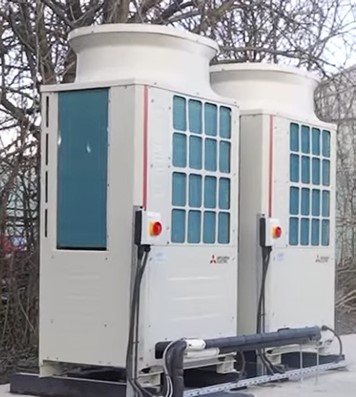
VRF Commercial Air Conditioning Systems Explained
Whether you’re designing a new commercial property, replacing an ageing HVAC system, or simply researching modern climate control technology, Variable Refrigerant Flow (VRF) systems have become one of the most efficient solutions available. Unlike conventional air conditioning, a VRF system continuously adjusts refrigerant flow to match the precise heating and cooling demand of individual spaces. The result is lower energy consumption, improved occupant comfort, quieter operation, and exceptional flexibility across offices, hotels, schools, healthcare facilities, retail buildings and other commercial environments. This guide explores how VRF technology works, why it has become increasingly popular, where it performs best, and the important considerations before investing in a commercial installation.
Commercial buildings rarely have uniform heating and cooling requirements. A south-facing meeting room filled with people may require cooling even during winter, while an office on the opposite side of the building could need heating at the same time. Traditional HVAC systems often struggle with these constantly changing demands, leading to wasted energy, uncomfortable occupants and higher operating costs.
Modern Variable Refrigerant Flow (VRF) technology was developed specifically to solve these challenges.
Rather than treating an entire building as a single climate zone, VRF systems intelligently distribute refrigerant only where it is needed, allowing multiple indoor units to operate independently while connected to a single outdoor unit. The result is highly efficient building climate control that delivers precise comfort throughout the day without unnecessarily increasing energy consumption.
For businesses seeking a future-proof commercial air conditioning solution, VRF has become one of the most widely specified HVAC technologies available.
If you’re exploring professional climate control solutions, the team at Air Con Group’s Commercial Air Conditioning Services can advise on the most appropriate installation for your building and operational requirements.
What Is a VRF System?
A VRF system, short for Variable Refrigerant Flow, is an advanced commercial HVAC system that regulates the exact amount of refrigerant supplied to each indoor unit.
You may also encounter the term Variable Refrigerant Volume (VRV).
Did you know?
VRV is a trademarked name originally introduced by Daikin, while VRF has become the generic industry term. In practical terms, both describe the same technology.
Instead of operating at a fixed output, VRF equipment uses inverter technology and sophisticated controls to continually vary compressor speed according to the building’s real-time cooling demand or heating demand.
This means the HVAC system only uses the energy required at any given moment.
A typical VRF installation consists of:
- One or more outdoor condensers
- Multiple indoor units
- Refrigerant piping connecting every zone
- Electronic expansion valves (EEVs)
- Intelligent sensors
- Thermostats or remote controllers
- Building Management System (BMS) integration where required
- Control wiring linking all components together
Because refrigerant is distributed directly between indoor and outdoor equipment, extensive ductwork is often unnecessary, making VRF an attractive solution for buildings where installation space is limited.
How Does Variable Refrigerant Flow Work?
At the heart of every VRF system is a highly efficient variable speed compressor.
Unlike conventional HVAC systems that repeatedly switch on and off, inverter compressors continuously adjust their output depending on actual demand.
The process is remarkably efficient:
- Sensors monitor room temperatures.
- Indoor units communicate their heating or cooling requirements.
- The outdoor unit adjusts refrigerant flow accordingly.
- Electronic expansion valves precisely regulate refrigerant entering each evaporator.
- Individual zones receive only the cooling or heating capacity they require.
Because refrigerant flow is constantly modulated, the system avoids the energy spikes associated with traditional HVAC technology.
This process, known as compressor modulation, delivers:
- Higher energy efficiency
- Improved indoor comfort
- Reduced carbon emissions
- Lower running costs
- More stable room temperatures
- High seasonal efficiency
Instead of large temperature swings, occupants experience consistent comfort throughout the day.
Why Commercial Buildings Choose VRF Technology
The popularity of VRF systems has grown rapidly across commercial buildings for one simple reason—they solve problems that conventional HVAC systems often cannot.
Modern workplaces require flexibility.
Meeting rooms become occupied without notice.
Retail stores experience fluctuating customer numbers.
Hotels have continuously changing occupancy.
Healthcare environments require dependable temperature control around the clock.
Schools and universities have different usage patterns throughout the day.
A single central air conditioning system cannot always react efficiently to these changing conditions.
A VRF system can.
Key advantages include
- Independent room control
- Individual temperature control
- Zoned cooling and zoned heating
- Low noise operation
- Flexible installation
- Minimal ductwork
- Space-saving installation
- Reduced maintenance requirements
- Excellent load matching
- High energy savings
These benefits make VRF particularly attractive for:
- Office buildings
- Hotels
- Hospitals
- Healthcare facilities
- Retail stores
- Shopping centres
- Mixed-use developments
- Commercial property portfolios
- Apartment buildings
- Education buildings
As sustainability becomes increasingly important, many building owners are replacing ageing conventional HVAC equipment with scalable VRF systems that support long-term decarbonisation goals.
Understanding Zone Control
One of the defining features of Variable Refrigerant Flow technology is zone control.
Traditional HVAC equipment generally treats large areas as a single conditioned space.
VRF works differently.
Each indoor unit operates independently, allowing different temperatures across separate rooms without affecting neighbouring spaces.
Imagine a commercial office where:
- Reception requires cooling
- Boardrooms need comfortable temperatures during meetings
- Server rooms require continuous cooling
- Individual offices have different occupancy levels
Rather than conditioning the entire building equally, the VRF system adjusts refrigerant volume to each zone.
This delivers:
- Better occupant comfort
- Lower energy consumption
- Greater flexibility
- Reduced operating costs
- More efficient building management
The larger and more diverse the building, the greater these benefits become.
The Importance of Inverter Technology
Without inverter technology, modern VRF systems simply wouldn’t exist.
Traditional compressors operate like a household light switch.
They’re either:
- Fully on
- Completely off
Every restart consumes additional electricity while placing greater wear on system components.
VRF systems instead use sophisticated inverter compressors that vary motor speed continuously.
This allows precise refrigerant management while reducing unnecessary compressor cycling.
The outcome includes:
- Lower electricity usage
- Extended equipment lifespan
- Reduced maintenance
- Better temperature stability
- Improved efficiency
- Lower lifecycle costs
This continuous modulation is one of the primary reasons why Variable Refrigerant Flow systems consistently outperform older commercial HVAC technologies in real-world energy performance.
VRF vs VRV: Is There a Difference?
The terms VRF and VRV are often used interchangeably.
VRF means Variable Refrigerant Flow.
VRV means Variable Refrigerant Volume.
From a technical perspective, both terms refer to systems that vary the refrigerant supplied to multiple indoor units in response to changing load conditions.
The main distinction is commercial rather than mechanical: VRV is a branded term, while VRF is the widely used generic name for the HVAC technology.
For building owners, architects, M&E consultants and facility managers, the practical questions are therefore not whether VRF or VRV is “better”, but whether the proposed system offers:
- Appropriate system capacity
- Accurate VRF sizing
- Reliable controls
- Suitable indoor unit options
- Good seasonal efficiency
- Effective refrigerant management
- Long-term service support
- Integration with the wider building design
The quality of the HVAC design, installation and commissioning process will usually matter far more than the label used.
VRF vs Multi-Split Air Conditioning
A multi-split system and a VRF system may appear similar because both connect multiple indoor units to outdoor equipment.
The difference lies in scale, sophistication and control.
A conventional multi-split system is usually designed for smaller properties. It may connect several indoor units to one outdoor unit, but its piping lengths, system capacity and control options are generally more limited.
VRF technology is designed for larger and more demanding commercial HVAC applications.
Key differences
| Feature | Multi-Split System | VRF System |
| Typical application | Homes and small commercial spaces | Medium and large commercial buildings |
| Number of indoor units | Usually limited | Potentially many indoor units |
| Refrigerant control | Basic modulation | Advanced refrigerant flow control |
| Pipe runs | Shorter | Longer pipe runs possible |
| Zone control | Available | Highly sophisticated |
| Heating and cooling | Usually one operating mode | Heat recovery options available |
| BMS integration | Often limited | Commonly supported |
| Scalability | Moderate | High |
For a small shop, clinic or office, a multi-split system may be sufficient.
For hotels, universities, healthcare HVAC projects, shopping centres and complex commercial property, VRF usually provides greater installation flexibility and more advanced building climate control.
VRF vs Central Air Conditioning
Central air conditioning often relies on a large air-handling system and extensive ductwork to distribute conditioned air throughout a building.
VRF systems distribute refrigerant instead.
This distinction affects almost every aspect of the installation.
Central systems may require:
- Large ceiling voids
- Extensive ducted air conditioning infrastructure
- Plant rooms
- Air handling units
- Large distribution shafts
- Complex balancing work
VRF systems may offer:
- Minimal ductwork
- Smaller refrigerant pipework
- Flexible indoor unit placement
- Easier zoning
- Reduced space requirements
- Modular design
- Independent room control
This does not mean VRF eliminates the need for ventilation.
Air conditioning controls temperature, while ventilation supplies and removes air. Commercial buildings still require a properly designed fresh air strategy to support Indoor Air Quality, moisture management and occupant wellbeing.
For this reason, VRF systems are often combined with dedicated commercial ventilation solutions rather than treated as a complete replacement for mechanical ventilation.
The strongest HVAC solutions consider heating, cooling and ventilation together.
VRF vs Chilled Water Systems
Chilled water systems use water as the primary medium for transporting cooling around a building. They are widely used in very large commercial buildings, hospitals, industrial sites and major mixed-use developments.
A chiller system may include:
- Chillers
- Pumps
- Cooling towers
- Air handling units
- Fan coil units
- Water pipework
- Plant rooms
- Water treatment systems
VRF systems instead use refrigerant piping between the outdoor condenser and indoor units.
VRF may be preferred where:
- Floor space is limited
- Roof or plant-room space is restricted
- Independent zone control is important
- The building has changing occupancy patterns
- Phased installation is required
- Long pipe runs are needed
- Modular expansion is likely
A chilled water system may be preferred where:
- The building has extremely high cooling loads
- Central plant is already available
- Very large air handling systems are required
- The project involves a campus-scale development
- Specialist process cooling is needed
The decision should not be made on equipment cost alone. Building owners should consider energy consumption, HVAC lifecycle costs, maintenance requirements, system redundancy, available space and long-term expansion.
Where Are VRF Systems Used?
VRF technology is highly adaptable, but it is especially well suited to properties with many rooms, changing occupancy and varied thermal loads.
Office buildings
Office air conditioning must respond to people, computers, lighting, meeting-room use and solar heat gain.
A VRF system can divide an office into separate zones so that boardrooms, open-plan workspaces, private offices and reception areas operate independently.
Occupancy sensors, smart controls and BMS integration can also reduce output when areas are empty.
Hotels
Hotel air conditioning presents a unique challenge because every room may have a different set point.
Guests expect individual temperature control, quiet operation and rapid comfort, while hotel operators need to manage energy use across vacant and occupied rooms.
VRF systems can support:
- Independent guest-room controls
- Central monitoring
- Occupancy-based energy management
- Simultaneous heating and cooling
- Low noise operation
- Reduced operating costs
Hospitals and healthcare buildings
Healthcare HVAC requires stable temperatures, dependable operation and careful coordination with ventilation and air-quality systems.
VRF may be suitable for consulting rooms, offices, waiting areas and certain non-clinical spaces.
However, specialist clinical environments may require dedicated ventilation, filtration, humidity control and pressure regimes.
The air conditioning design must therefore be coordinated with the wider mechanical services strategy.
Retail buildings
Retail stores experience rapid changes in cooling demand due to lighting, customer numbers, equipment and external weather conditions.
VRF allows different departments, stock rooms and staff areas to operate as separate zones.
This can improve customer comfort while reducing unnecessary energy use in lightly occupied areas.
Schools and universities
Classrooms, lecture halls, offices, libraries and laboratories all have different usage patterns.
A scalable HVAC system makes it easier to condition only the rooms being used rather than operating the entire building at full capacity.
Mixed-use developments
Mixed-use developments may combine retail, offices, apartments, hospitality and leisure facilities within one property.
These areas rarely require identical heating and cooling at the same time.
VRF’s modular design and zone control make it particularly suitable for complex building layouts and changing occupancy profiles.
Indoor Unit Options
One of the strengths of VRF design is the wide selection of indoor units available.
The chosen unit should suit the room layout, ceiling structure, acoustic requirements and aesthetic expectations.
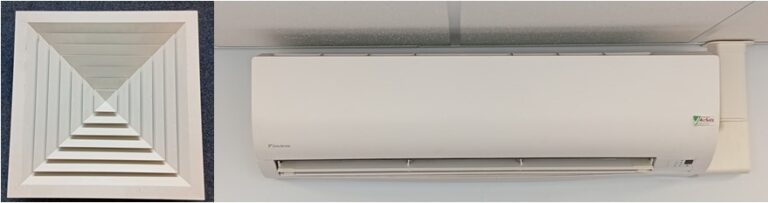
Indoor cassette unit
Cassette units are installed within a suspended ceiling and distribute air in several directions.
They are commonly used in:
- Offices
- Retail stores
- Restaurants
- Classrooms
- Meeting rooms
They provide broad air distribution without occupying wall space.
Wall-mounted unit
Wall-mounted units are practical, visible and usually easier to access for maintenance.
They may be suitable for:
- Small offices
- Server rooms
- Reception areas
- Clinics
- Individual retail spaces
Ducted unit
A ducted unit is concealed above a ceiling and connected to discreet supply grilles.
This can produce a cleaner appearance while allowing conditioned air to reach several points within a room.
Ducted indoor units are often selected for hotels, premium offices and areas where visible equipment is undesirable.
Ceiling concealed unit
Ceiling concealed units are hidden within the ceiling void and provide a low-profile solution.
Correct access must still be provided for filters, fan components, drain trays and future servicing.
Floor-standing unit
Floor-standing units can be useful where wall or ceiling installation is difficult.
They may be installed in older buildings, perimeter zones or spaces with restricted ceiling access.
The final selection should balance:
- Air distribution
- Cooling capacity
- Heating capacity
- Noise levels
- Maintenance access
- Ceiling height
- Interior design
- Cost
- Condensate drainage
Refrigeration Principles Behind VRF
Although a VRF system is used for building climate control, it operates through the same core refrigeration principles used in many cooling applications.
The refrigeration cycle relies on four essential stages:
- Compression
- Condensation
- Expansion
- Evaporation
The compressor raises the refrigerant pressure.
The condenser rejects heat.
The electronic expansion valve reduces pressure and regulates refrigerant flow.
The evaporator absorbs heat from the indoor environment.
This cycle repeats continuously, with smart controls adjusting output as conditions change.
Businesses with broader cooling requirements may also need specialist commercial refrigeration services alongside comfort cooling, particularly in hospitality, food retail and temperature-controlled environments.
Smart Controls and Building Management Integration
Modern VRF systems can do far more than respond to a wall-mounted thermostat.
They can form part of a wider building automation strategy.
Possible controls include:
- Centralised controllers
- Remote controllers
- Smart thermostats
- Occupancy detection
- Scheduling
- Energy monitoring
- Fault alerts
- Set-point restrictions
- Remote access
- BMS integration
A Building Management System can monitor indoor units, operating modes, temperatures and system faults from one interface.
This can help facility managers identify unusual energy consumption, prevent conflicting settings and respond quickly to maintenance issues.
Are VRF Systems Energy Efficient?
VRF systems can be highly energy efficient because they continuously match output to demand.
Their efficiency comes from several features working together:
- Variable speed technology
- Compressor modulation
- Individual zone control
- Reduced on-off cycling
- Heat recovery
- Smart scheduling
- Part-load performance
- Precise refrigerant control
Commercial HVAC systems rarely operate at maximum load throughout the entire year.
Traditional HVAC equipment can struggle at these part-load conditions.
VRF systems are designed to reduce output rather than repeatedly switching between full capacity and off.
VRF and Building Regulations
Commercial HVAC installation in the UK must be considered alongside relevant energy, safety and building-performance requirements.
Depending on the project, this may include:
- Part L Building Regulations
- Energy Performance Certificates
- Refrigerant regulations
- Electrical standards
- Fire safety requirements
- Ventilation requirements
- Planning restrictions
- Noise limits
- Manufacturer installation standards
What Affects VRF Installation Cost?
There is no single standard VRF installation cost.
The final price depends on the complexity of the building and the required system design.
Important cost factors include:
- Number of indoor units
- Outdoor unit capacity
- Heat pump or heat recovery configuration
- Pipework length
- Electrical upgrades
- Access equipment
- Ceiling modifications
- Control systems
- BMS integration
- Condensate drainage
- Ventilation requirements
- Commissioning
- Noise-control measures
A simple open-plan office will generally cost less than a multi-storey hotel with dozens of independently controlled rooms.
Lower initial cost should not be the only objective.
Building owners should also compare:
- Energy consumption
- Maintenance requirements
- Expected service life
- Replacement-part availability
- Warranty support
- Downtime risk
- Lifecycle costs
The lowest quotation may not offer the lowest long-term cost.
What Happens During VRF Installation?
A professional commercial air conditioning installation normally progresses through several stages.
1. Site survey
The contractor inspects the building, available plant space, electrical supply, ceiling voids, access routes and potential outdoor unit locations.
2. Heat-load calculations
Heating and cooling loads are calculated for each zone.
3. System design
The contractor selects outdoor units, indoor units, pipework routes, controls and drainage arrangements.
4. Coordination
The HVAC design is coordinated with electrical services, ventilation, fire protection, ceilings and interior finishes.
5. Installation
Outdoor units, indoor units, refrigerant pipework, control wiring and drainage are installed.
6. Pressure testing and evacuation
The refrigerant circuit is checked for leaks and evacuated to remove moisture and non-condensable gases.
7. Refrigerant charging
Additional refrigerant is added where required according to pipework length and manufacturer instructions.
8. System commissioning
Each indoor unit, controller, sensor and operating mode is tested.
9. Handover
The building operator receives instructions, records and maintenance guidance.
A thorough commissioning process is essential. It confirms that the system performs as intended rather than merely switching on.
VRF Maintenance and Servicing
Even highly efficient HVAC technology requires regular maintenance.
VRF maintenance may include:
- Cleaning filters
- Inspecting indoor coils
- Inspecting outdoor coils
- Checking condensate drains
- Testing controls
- Reviewing fault history
- Checking refrigerant pressures
- Inspecting pipe insulation
- Checking electrical connections
- Confirming compressor operation
- Cleaning grilles and diffusers
- Verifying set points
Preventive maintenance supports:
- Improved efficiency
- Quiet operation
- Better indoor air comfort
- Reduced breakdown risk
- Longer equipment life
Indoor Air Quality and Ventilation Integration
VRF systems are designed primarily to control temperature.
They do not automatically provide sufficient fresh air.
A comfortable room can still have poor Indoor Air Quality if ventilation is inadequate.
Ventilation integration should be considered during the earliest stages of HVAC design.
What Are the Disadvantages of a VRF System?
VRF technology offers substantial advantages, but it is not the right answer for every commercial building.
A balanced specification should consider the limitations as carefully as the benefits.
Higher initial investment
A professionally designed VRF system can cost more upfront than a basic split system or smaller multi-split installation.
The higher capital cost may be justified through energy savings, flexible operation and lower lifecycle costs, but the financial case should be assessed over the expected life of the equipment rather than through purchase price alone.
Specialist design requirements
VRF is not a plug-and-play HVAC solution.
An experienced commercial HVAC contractor should complete the VRF design and verify that the proposed equipment remains within the manufacturer’s operating limits.
Is VRF Suitable for Commercial Buildings?
In many cases, yes.
VRF is particularly effective in commercial buildings that contain numerous rooms or zones with different operating patterns.
The technology is especially well suited to hotels, office buildings, retail buildings, schools, universities, apartment buildings and mixed-use developments.
Common VRF Design Mistakes
Many operational problems can be traced back to decisions made before installation begins.
Oversizing the system
Oversizing may appear to provide a safety margin, but excessive capacity can reduce efficiency and increase cost.
A system that is much larger than the actual building load may operate poorly at low demand.
Accurate calculations should replace guesswork.
Poor indoor unit positioning
An indoor unit can have adequate nominal capacity and still provide poor comfort if it is badly positioned.
Common problems include:
- Air blowing directly onto occupants
- Obstructed return-air paths
- Uneven air distribution
- Sensors positioned near heat sources
- Units placed too close to doors
- Insufficient access for maintenance
Air movement matters as much as equipment output.
Forgetting future maintenance access
Filters, fan motors, drain trays, electronic expansion valves and control boards will eventually need inspection.
Indoor units concealed above ceilings require properly positioned access panels.
Outdoor units need safe working space and unobstructed airflow.
Designing for maintenance from the outset can reduce future disruption and labour costs.
Why Commissioning Matters
Commissioning turns installed equipment into a functioning HVAC system.
It confirms that every component operates correctly and that the controls respond as intended.
A proper commissioning process may include:
- Verifying pipework installation
- Confirming pressure-test results
- Checking evacuation records
- Recording the refrigerant charge
- Testing control wiring
- Confirming indoor unit addresses
- Checking sensor readings
- Testing heating and cooling modes
- Verifying condensate drainage
- Confirming central controller operation
- Testing BMS integration
- Recording operating data
For heat recovery VRF, commissioning should also confirm that simultaneous heating and cooling operate correctly across different zones.
The handover should also include operating instructions, maintenance requirements, system records and guidance for facility managers.
How VRF Supports Energy Management
Energy efficiency is not created by equipment ratings alone.
The way a building is operated can have an equally significant effect.
VRF systems can support energy management through:
- Scheduled operation
- Set-point restrictions
- Occupancy detection
- Centralised monitoring
- Demand-based control
- Heat recovery
- Fault reporting
- Energy-use data
- Automatic seasonal changeover
For example, a facility manager may prevent occupants from setting one office to aggressive cooling while another office calls for maximum heating.
Training should therefore form part of the handover process.
VRF, Sustainability and Decarbonisation
Commercial property owners are increasingly under pressure to reduce carbon emissions and improve building energy performance.
VRF can support this transition by delivering heating and cooling through high-efficiency electric technology.
Potential sustainability benefits include:
- Reduced reliance on fossil-fuel heating
- Lower energy consumption
- Heat recovery between zones
- Improved part-load performance
- Better operational control
- Reduced carbon footprint
- Compatibility with renewable electricity
- Support for wider Net Zero strategies
However, sustainable HVAC requires more than replacing one piece of equipment.
A low carbon HVAC strategy should account for both operational energy and refrigerant management.
Can VRF Improve an Energy Performance Certificate?
A new VRF system may contribute to better building energy performance, but it does not guarantee a particular Energy Performance Certificate rating. But will help towards it.
An EPC considers several elements of the property, including:
- Building fabric
- Heating
- Cooling
- Lighting
- Hot water
- Controls
- Ventilation
- Renewable technologies
Replacing inefficient conventional HVAC with high-efficiency VRF equipment may improve the assessment, particularly when combined with effective controls and building-fabric upgrades.
The likely impact should be modelled as part of the project rather than assumed.
How Many Indoor Units Can Connect to a VRF System?
The number of indoor units depends on the selected manufacturer, outdoor unit combination, total connected capacity and system design.
Can VRF Heat and Cool at the Same Time?
A heat recovery VRF system can provide simultaneous heating and cooling in different zones.
A heat pump VRF system generally provides one mode across the connected system at a time.
This distinction is important in buildings with varied thermal conditions.
Is VRF the Same as Ductless HVAC?
VRF is often described as ductless HVAC because many installations use wall-mounted, cassette or floor-standing indoor units without large air-distribution ducts.
However, VRF is not always completely ductless.
The key distinction is that refrigerant piping distributes heating and cooling around the building rather than a large central duct network.
Does VRF Provide Fresh Air?
Not by itself.
Most VRF indoor units recirculate and condition room air.
How Long Does a VRF System Last?
Service life depends on equipment quality, operating hours, installation standards, maintenance and environmental conditions.
A system that is correctly designed, commissioned and serviced is likely to last considerably longer than one that is neglected.
Lifecycle planning should include expected component replacement, not just the outdoor unit itself.
Controls, fan motors, sensors and condensate pumps may require attention at different stages.
What Maintenance Does a VRF System Need?
Maintenance requirements vary by building and usage, but routine work generally includes:
- Cleaning or replacing filters
- Inspecting heat exchangers
- Checking condensate systems
- Reviewing fault codes
- Testing controllers
- Inspecting electrical connections
- Checking pipe insulation
- Assessing refrigerant performance
- Cleaning outdoor units
- Confirming airflow
- Verifying temperatures and pressures
A maintenance schedule should reflect operating hours, environmental conditions and the consequences of equipment failure.
Does VRF Work in Cold Weather?
Many modern VRF systems are designed to operate in low outdoor temperatures, but heating performance depends on the specific model and design conditions.
As outdoor temperatures fall, available heating capacity and efficiency may change.
What Should Be Included in a VRF Quotation?
A useful quotation should provide enough detail to compare the proposed solutions properly.
It should identify:
- Outdoor unit models and capacities
- Indoor unit types and quantities
- Heat pump or heat recovery configuration
- Control systems
- Refrigerant pipework
- Drainage
- Electrical requirements
- Ventilation interfaces
- Access equipment
- Commissioning
- Warranty
- Maintenance options
- Exclusions
- Estimated programme
Comparing only the final price can be misleading.
One quotation may include commissioning, controls and electrical work while another excludes them.
The specification should be reviewed line by line.
Questions to Ask Before Choosing a VRF System
Before approving a commercial air conditioning installation, building owners and property managers should ask:
- Has a room-by-room heat-load calculation been completed?
- Why has VRF been selected over other HVAC solutions?
- Is heat pump or heat recovery VRF more appropriate?
- How will fresh air be provided?
- Are refrigerant concentration limits satisfied?
- What controls are included?
- Can the system integrate with the Building Management System?
- What seasonal efficiency can be expected?
- How will maintenance access be provided?
- What happens if an outdoor unit fails?
- What warranty and service support are available?
- Has future expansion been considered?
- What commissioning records will be supplied?
- What are the estimated lifecycle costs?
- How will energy use be monitored?
Clear answers to these questions can reveal whether the proposal has been designed around the building or assembled around a preferred product.
The Final Verdict on VRF Commercial Air Conditioning
Variable Refrigerant Flow technology has changed the way commercial buildings are heated and cooled.
Instead of forcing every room to operate under one broad climate-control strategy, a VRF system responds to individual zones.
It adjusts compressor speed.
It varies refrigerant flow.
It matches output to real demand.
It can recover heat from one part of a building and move it to another.
For the right property, these capabilities can provide:
- Precise temperature control
- Better occupant comfort
- Lower running costs
- Reduced energy consumption
- Flexible installation
- Improved building management
- High seasonal efficiency
- Long-term scalability
Yet VRF is not automatically the best system simply because it is advanced.
Its success depends on accurate sizing, thoughtful design, competent installation, thorough commissioning and planned maintenance.
The most effective commercial HVAC solution is the one that fits the building’s actual needs—not the one with the longest feature list.
For office buildings, hotels, schools, healthcare environments, retail buildings and mixed-use developments, VRF can be an exceptionally capable option. When integrated with appropriate ventilation, smart controls and a wider energy strategy, it becomes more than an air conditioning system.
It becomes a responsive building climate control platform designed around how modern commercial spaces are actually used.
Frequently Asked Questions About VRF Commercial Air Conditioning Systems
1. Can a VRF system be retrofitted into an existing commercial building?
Yes. VRF systems are often suitable for refurbishment projects because refrigerant pipework generally requires less space than large air ducts.
A retrofit may be especially practical where:
- Ceiling voids are restricted
- Existing ductwork is unsuitable
- Different areas are refurbished in phases
- Individual rooms need separate temperature control
2. How long does a commercial VRF installation take?
Installation time depends on the size, layout and complexity of the property.
A smaller office installation may take several weeks, while a multi-storey hotel, school or mixed-use development may require a much longer programme.
3. Can a VRF system be expanded later?
Many VRF systems offer useful expansion potential, but future capacity must be considered during the original design.
4. How noisy is a VRF system?
VRF systems are generally designed for low noise operation, particularly during part-load conditions when the inverter compressor and indoor fans can operate at reduced speed.
5. Can different tenants be billed separately for VRF energy use?
Potentially, yes.
Some commercial VRF control platforms can record estimated energy consumption by indoor unit, tenant area or zone.
6. What happens to condensate produced by VRF indoor units?
During cooling, indoor units remove moisture from the air and produce condensate water.
This water must be directed safely to a suitable drain.
Poor drainage design can cause leaks, ceiling damage, unpleasant odours and microbial growth.
Condensate pumps should also be inspected regularly because pump failure can interrupt operation or cause water damage.
7. Can VRF systems operate during a power cut?
A standard VRF system will stop operating if the electrical supply fails.
It will not normally provide heating or cooling during a power cut unless the building has an appropriate backup power system.
8. How does a VRF system deal with refrigerant leaks?
Modern VRF systems may use pressure monitoring, fault codes and system diagnostics to identify abnormal operating conditions.
9. Do VRF systems require planning permission?
Planning permission is not always required, but external equipment can be subject to local planning rules.
10. Can VRF controls be managed remotely?
Many modern VRF systems support remote monitoring and control through a secure web platform, mobile application or Building Management System.