Key Takeaways: Is Your Commercial Air Conditioning Trying to Tell You Something?
A commercial air conditioning system rarely fails without giving some warning. The trouble is that those early signs can be surprisingly easy to overlook, especially in a busy workplace.
Here’s what you need to know:
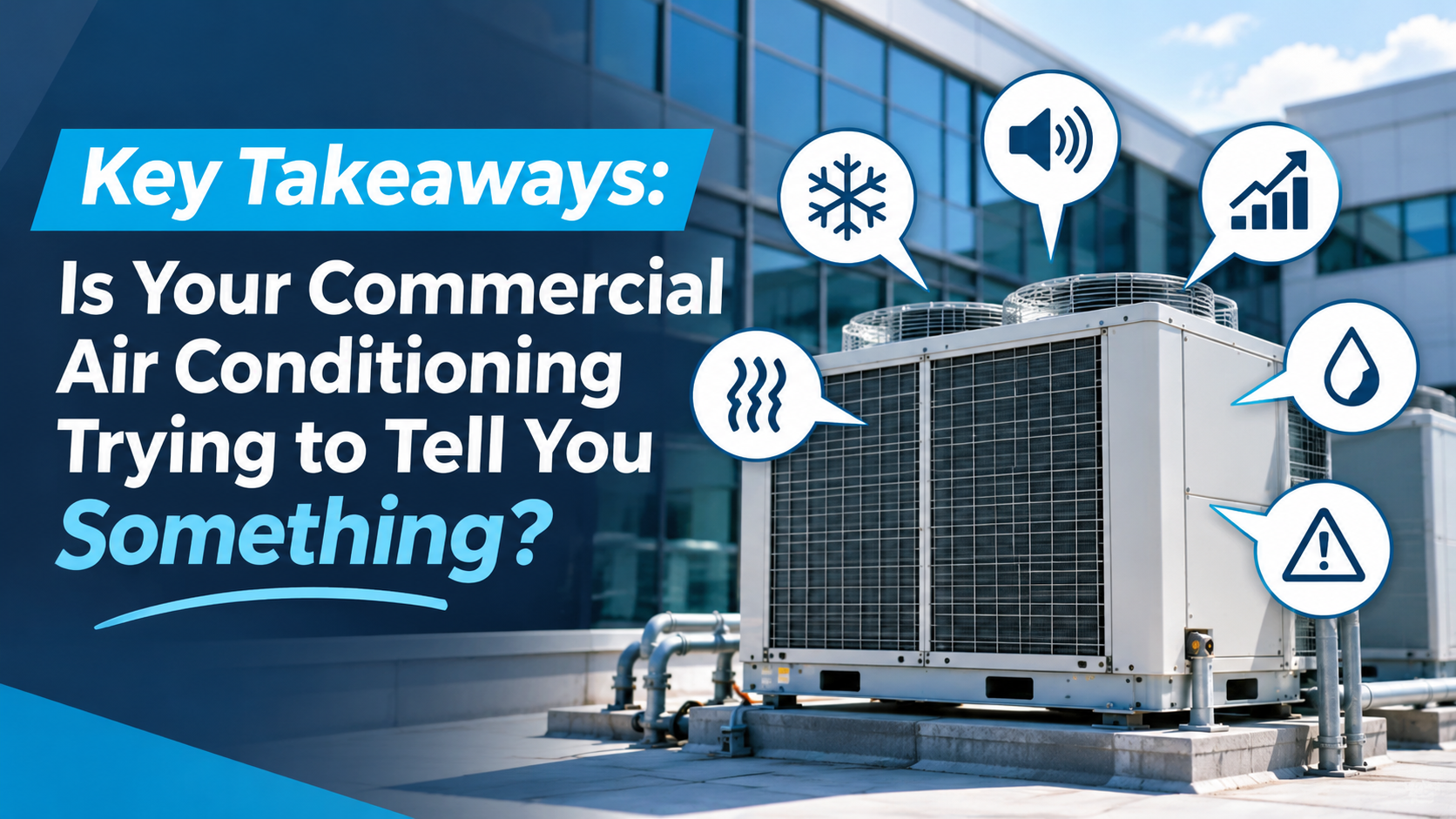
- Poor or uneven cooling: Hot and cold spots, warm air from vents, or rooms struggling to reach the desired temperature can indicate underlying performance problems.
- Weak airflow: Blocked filters, faulty fan motors, restricted ductwork, or other mechanical issues can prevent conditioned air from circulating properly.
- Unusual noises: Grinding, rattling, buzzing, squealing, or hissing sounds may indicate worn components, electrical faults, or refrigerant problems.
- Rising energy bills: An unexplained increase in electricity consumption could mean your air conditioning is working harder than necessary.
- Water leaks and unusual smells: Excess moisture, musty odours, and burning smells should never be ignored.
- Frequent shutdowns or short cycling: A system that repeatedly switches on and off may have problems with its controls, airflow, or refrigeration circuit.
- Professional intervention matters: Early commercial AC repair can prevent relatively minor faults from developing into expensive breakdowns.
- Preventative maintenance helps: Regular commercial air conditioning servicing supports energy efficiency, equipment reliability, and a longer operational lifespan.
The bottom line: If your commercial air conditioning isn’t cooling effectively, sounds different, develops leaks, or behaves unpredictably, arrange a professional inspection before the problem escalates. Burning smells, electrical faults, and repeated circuit breaker trips require particularly prompt attention.
Why Recognising Commercial Air Conditioning Problems Early Matters
Picture a busy office on a warm Monday morning.
Employees are arriving, computers are running, meetings are getting underway, and everything appears business as usual.
Except the air conditioning isn’t quite right.
One meeting room feels uncomfortably warm. The reception area is noticeably stuffy. Somewhere above the ceiling, an air conditioning unit has developed a persistent rattling sound.
Nothing has stopped working completely, so the problem gets pushed down the priority list.
A few weeks later, the cooling system fails altogether.
What might have been a relatively straightforward repair has now become an urgent operational headache.
It’s a situation many businesses would prefer to avoid.
Commercial air conditioning does much more than maintain a comfortable temperature. In offices, retail environments, restaurants, hospitality venues, and other commercial premises, effective cooling contributes to a pleasant working environment and helps maintain appropriate conditions for equipment and day-to-day operations.
When a system begins to deteriorate, the consequences can extend beyond uncomfortable temperatures.
The Hidden Business Costs of Ignoring AC Warning Signs
Delaying commercial air conditioning repair can result in:
- Higher electricity bills: Inefficient components may force the system to run for longer to achieve the same cooling performance.
- Unexpected operational disruption: A complete commercial AC breakdown can interrupt normal business activities, particularly during warmer periods.
- Reduced employee comfort: Inconsistent temperatures and poor airflow can make working environments unpleasant.
- More expensive repairs: Some minor faults can place additional strain on other components when left unresolved.
- Shortened equipment lifespan: Repeated overheating, excessive cycling, and neglected maintenance can contribute to premature component wear.
For businesses relying on consistent indoor temperatures, recognising commercial AC warning signs is therefore a practical part of protecting their premises and controlling operating costs.
At Aircon Group, we understand the importance of dependable climate control in commercial environments. Identifying potential problems early is an essential first step towards maintaining a reliable, efficient air conditioning system.
Remember: An air conditioning system doesn’t have to stop working completely to need professional attention. Changes in performance, sound, energy consumption, or operating behaviour can all be early indications of a developing fault.
10 Warning Signs Your Commercial Air Conditioning Needs Repair
Some commercial air conditioning problems are immediately obvious. Others develop gradually, making them harder to recognise until cooling performance has already deteriorated.
Knowing what to look for can help facilities managers, business owners, and maintenance teams decide when professional air conditioning repair is necessary.
Let’s examine the warning signs, starting with one of the most common.
1. Poor Cooling or Inconsistent Temperatures Throughout Your Building
Does one part of your building feel perfectly comfortable while another feels like a greenhouse?
Perhaps the reception area is cool, but meeting rooms remain warm. Or the air conditioning runs continuously without bringing the temperature down to the thermostat setting.
Inconsistent cooling performance is one of the clearest signs your commercial AC may need repair.
A properly functioning system should provide reasonably consistent temperature control across the areas it is designed to serve, taking account of individual zones, occupancy, and building conditions.
When that stops happening, there may be an underlying fault.
What Causes Uneven Cooling in Commercial Buildings?
Several issues can contribute to poor cooling performance:
- Dirty evaporator coils: Dust and contamination can restrict heat transfer, reducing the system’s ability to cool effectively.
- Low refrigerant charge: Refrigerant leaks can reduce cooling capacity and may eventually damage the compressor.
- Faulty thermostats or temperature sensors: Incorrect readings can prevent the system from responding appropriately to actual room temperatures.
- Restricted airflow: Blocked filters, damaged ductwork, or poorly functioning fans can limit the delivery of cooled air.
- Compressor problems: A failing compressor may struggle to maintain the refrigeration process required for effective cooling.
- Control or zoning faults: Incorrect damper operation, sensor problems, or building management system faults can produce uneven temperatures.
It’s also worth considering whether your building’s cooling requirements have changed.
Additional equipment, increased occupancy, altered room layouts, or changes to ventilation arrangements can all affect temperature distribution.
When Should You Call an Engineer?
Occasional temperature variations don’t automatically mean something is broken.
However, professional commercial air conditioning troubleshooting is advisable if:
- Rooms consistently fail to reach their set temperatures.
- The system blows warm air when cooling is required.
- Previously comfortable areas develop persistent hot spots.
- Cooling performance deteriorates despite normal operating settings.
- The air conditioning runs for unusually long periods without achieving the desired temperature.
A qualified engineer can investigate refrigerant pressures, temperature sensors, airflow, electrical controls, and mechanical components to establish the cause.
Don’t assume that lowering the thermostat will solve the problem. If the equipment has developed a fault, demanding more cooling may simply increase running time without improving comfort.
2. Weak Airflow or Blocked Air Conditioning Vents
Temperature isn’t the only thing that matters.
Air needs to circulate effectively throughout your commercial premises for the cooling/heating system to perform as intended.
If you’ve noticed that air is barely coming through certain vents, or that some rooms feel stagnant despite the air conditioning being switched on, restricted airflow could be responsible.
Poor commercial AC airflow can reduce cooling efficiency, contribute to uneven temperatures, and place unnecessary strain on system components.
Common Causes of Weak AC Airflow
Clogged air filters
Air filters collect dust and airborne particles to help protect equipment and maintain airflow quality.
Over time, accumulated debris can restrict the volume of air passing through the system.
A heavily blocked filter may reduce cooling performance and contribute to other operating problems.
Faulty fan motors
Commercial air conditioning systems depend on fans to move air across heat exchangers and, depending on the system design, distribute conditioned air.
If a fan motor is failing, airflow may become weak, inconsistent, or stop altogether.
Blocked or damaged ductwork
In ducted installations, obstructions, disconnected sections, damaged ducts, and incorrectly positioned dampers can restrict airflow.
This can create noticeable differences in cooling performance between rooms.
Dirty cooling coils
Contamination on evaporator coils can restrict airflow and reduce heat transfer.
In some circumstances, insufficient airflow can also contribute to coil icing, making the restriction progressively worse.
Restricted return airflow
Supply vents receive plenty of attention, but return air paths are equally important.
Furniture, stored materials, or blocked return grilles can interfere with circulation and prevent the system from operating efficiently.
Why Ventilation Matters Too
Air conditioning and ventilation perform different but complementary functions.
Air conditioning primarily controls indoor temperature and, depending on the equipment, humidity. Ventilation introduces or exchanges air to support indoor air quality.
Where a building has interconnected systems, problems with airflow, ductwork, or air distribution can affect overall comfort.
Businesses experiencing persistent stuffiness, poor circulation, or inadequate fresh air may benefit from assessing their commercial ventilation systems alongside their air conditioning equipment.
What Can You Safely Check?
Before arranging professional commercial HVAC repair, building managers can carry out a few straightforward visual checks:
- Ensure accessible supply and return grilles aren’t obstructed.
- Confirm that the thermostat and operating mode are correctly set.
- Check whether airflow problems affect one room or multiple areas.
- Review the date of the last filter inspection or replacement.
- Record any unusual sounds or changes in system performance.
- Has something been put against the condenser reducing air flow, such as boxes beside it.
Avoid opening electrical compartments, dismantling equipment, or attempting repairs beyond your training.
If airflow remains weak, a professional inspection can determine whether the cause is a blocked filter, fan failure, ductwork restriction, control fault, or another issue.
3. Strange Noises Coming From Your Commercial Air Conditioning Unit
Commercial air conditioning systems aren’t completely silent.
Fans move air, compressors operate, and some equipment produces a low, steady background hum.
That’s normal.
What isn’t normal is a system that suddenly starts grinding, banging, screeching, or making noises you’ve never heard before.
Unusual AC noises often provide an early warning that a mechanical or electrical component requires attention.
And the type of noise can offer useful clues.
What Different Air Conditioning Noises Might Mean
| Unusual noise | Possible underlying problem |
| Rattling | Loose panels, fixings, debris, or vibrating components |
| Grinding | Worn bearings or mechanical damage in a motor or fan assembly |
| Squealing | Motor bearing problems or belt-related faults where belt-driven equipment is fitted |
| Buzzing | Electrical component faults, loose parts, or abnormal vibration |
| Hissing | Possible refrigerant leakage or pressure-related noise |
| Banging | Loose or damaged moving components |
| Repeated clicking | Control, relay, or electrical switching problems |
These are possible explanations rather than definitive diagnoses. The same noise can have several causes, and some normal operating sounds vary between system types.
Why You Shouldn’t Ignore Grinding or Banging Sounds
Imagine a fan bearing beginning to wear.
Initially, the problem might produce little more than a faint grinding noise.
As the bearing deteriorates, friction and vibration can increase. Eventually, the fan assembly may fail, potentially causing additional damage.
A relatively minor component problem can therefore develop into a more disruptive repair.
The same principle applies to loose parts, failing motors, and other mechanical faults.
If your air conditioning develops a persistent or worsening noise, arrange an inspection rather than waiting for the equipment to stop.
Important: If you hear loud mechanical impacts, notice severe vibration, or suspect an electrical fault, stop using the affected equipment where it is safe to do so and seek professional assistance. Never investigate moving machinery or live electrical components yourself.
4. Rising Energy Bills Without an Obvious Explanation
Your electricity bill arrives.
It’s noticeably higher than usual. Check the usage and compare it to the previous couple of years.
Business hours haven’t changed. You haven’t installed any major new equipment. And the weather hasn’t been dramatically different from previous months.
So, what’s happening?
Your commercial air conditioning system could be part of the problem.
An unexpected increase in energy consumption is one of the less obvious signs your commercial AC needs repair.
When air conditioning equipment operates inefficiently, it may consume more electricity to maintain the same indoor temperature.
And because commercial systems often operate for extended periods, even relatively small reductions in efficiency can contribute to higher running costs over time.
How Faulty Air Conditioning Increases Energy Consumption
Several common commercial air conditioning problems can affect energy efficiency.
Dirty condenser coils
The condenser releases heat collected from inside the building.
When its coils become covered in dirt or debris, heat transfer becomes less effective. This can increase the workload on the compressor and reduce overall system efficiency.
Restricted airflow
Blocked filters, dirty evaporator coils, and faulty fans can prevent air from moving efficiently through the system.
As a result, the equipment may struggle to achieve the required temperature.
Refrigerant problems
Incorrect refrigerant charge, including that caused by leaks, can reduce cooling performance and increase strain on the refrigeration circuit.
Faulty thermostats and controls
A malfunctioning temperature sensor or control system may cause equipment to operate longer than necessary or respond incorrectly to changing conditions.
Ageing or worn components
Motors, compressors, and other mechanical components can become less efficient as they deteriorate.
How Can You Tell Whether Your AC Is Responsible?
A higher electricity bill doesn’t automatically indicate an air conditioning fault.
Changes in energy tariffs, building occupancy, operating hours, weather conditions, and other electrical equipment can all affect consumption.
However, certain patterns deserve attention:
- Electricity usage rises despite similar operating conditions.
- The air conditioning runs longer than it previously did.
- Rooms take noticeably more time to reach their set temperatures.
- Cooling performance declines while energy consumption increases.
- The system appears to operate continuously during periods of relatively low demand.
Where possible, compare actual electricity consumption in kWh rather than looking only at the amount charged.
A professional HVAC performance assessment can help establish whether the cooling system is operating efficiently.
Regular commercial air conditioning maintenance also provides opportunities to identify dirty coils, deteriorating components, and other issues before they cause more significant problems.
Efficiency tip: Don’t assume that an air conditioning system is performing properly simply because it still produces cold/hot air. Equipment can continue functionally while operating considerably less efficiently than it should.
5. Water Leaks, Excess Moisture or Condensation Around Your AC Unit
A small puddle beneath an indoor air conditioning unit might not seem particularly serious.
Perhaps someone assumes it’s ordinary condensation.
Maybe the water disappears before anyone investigates.
But water appearing where it shouldn’t can be an important warning sign.
Commercial air conditioning systems often remove moisture from indoor air as part of the cooling process. That moisture is normally collected and directed away through a condensate drainage system. A pump might be failing or the drainage pipe clogging.
Water leaking into occupied spaces, dripping from indoor equipment, or accumulating around electrical components is not normal operation.
What Causes Commercial AC Water Leaks?
There are several possible explanations.
Blocked condensate drains
Dust, dirt, biological growth, and other debris can obstruct drainage pipework.
When water cannot flow away correctly, it may overflow from the condensate tray.
Condensate pump failure
Some installations use a pump to move collected water to a suitable drainage point.
If the pump stops working, water can accumulate and eventually leak.
Frozen evaporator coils
Restricted airflow, refrigerant problems, and other faults can cause an evaporator coil to become excessively cold.
Ice may form on the coil and subsequently melt, sometimes producing more water than the drainage arrangement can handle.
Damaged condensate trays or pipework
Cracked trays, disconnected drainage lines, and poorly positioned pipework can allow water to escape.
Insulation problems
Inadequately insulated cold pipework can cause condensation to form on external surfaces, particularly in humid environments.
Why Water Leaks Should Be Investigated Promptly
Ignoring a commercial AC water leak can lead to problems beyond the air conditioning equipment itself.
Depending on the location and severity, escaping water may contribute to:
- Damage to ceilings, walls, flooring, and furnishings.
- Moisture-related deterioration of building materials.
- Mould growth where damp conditions persist.
- Electrical hazards if water reaches unsuitable components.
- Disruption to occupied workspaces or sensitive equipment.
In commercial premises, even a relatively small leak can become inconvenient when it affects offices, retail areas, or electrical installations.
What Should You Do If Your Commercial AC Is Leaking?
If you notice water escaping from an indoor unit, arrange for the fault to be investigated.
Where safe, stop using the affected system and keep people away from any wet electrical equipment.
Avoid opening electrical panels or attempting to clear inaccessible drainage components yourself.
A qualified engineer can inspect the condensate tray, drain lines, pumps, insulation, and evaporator coil to identify the source of the problem.
A blocked drain may be straightforward to resolve, but repeated leaks can indicate a more complicated underlying fault.
6. Strange Smells Coming From Your Commercial Air Conditioning
You walk into the office and notice an unpleasant smell.
At first, it’s difficult to identify.
Perhaps it’s musty, damp, or stale. Or maybe there’s a sharp, unfamiliar odour whenever the air conditioning starts.
Whatever the smell, it’s worth investigating.
Commercial air conditioning should not introduce persistent unpleasant odours into occupied spaces.
And while some smells are associated with relatively routine maintenance issues, others can indicate potentially serious faults.
What Different AC Odours May Indicate
| Smell | Possible cause | Recommended response |
| Musty or damp | Moisture accumulation, dirty coils, or microbial growth | Arrange cleaning and inspection |
| Stale or dusty | Contaminated filters or accumulated debris | Check maintenance records and arrange servicing |
| Burning or electrical | Overheating components, wiring faults, or damaged electrical equipment | Stop using the affected system safely and seek urgent professional assistance |
| Chemical or unusual | Possible contamination or equipment-related issues | Avoid exposure and arrange professional investigation |
| Sewage-like | Potential drainage or plumbing-related problems | Investigate drainage and surrounding building services |
Smells alone cannot reliably identify a fault, and not every unusual odour originates from the air conditioning system.
However, persistent smells should not be dismissed.
Musty Smells and Indoor Air Quality
Air conditioning equipment can collect moisture during normal operation.
If condensate drainage is inadequate or components remain damp, conditions may develop that encourage microbial growth.
Dirty filters and contaminated coils can also contribute to unpleasant odours.
In workplaces where multiple people share the same indoor environment, maintaining clean air conditioning equipment is an important part of responsible building management.
Routine inspections and cleaning can help prevent avoidable contamination and support more comfortable indoor conditions.
What About a Burning Smell?
A burning smell is different.
It may indicate overheating wiring, an electrical component fault, or another potentially hazardous condition.
Do not continue running equipment that produces a persistent burning or electrical smell.
Stop using the affected system where safe, avoid touching suspect electrical equipment, and arrange urgent assessment by a suitably qualified professional.
If there are signs of fire or smoke, follow the building’s emergency procedures.
7. Frequent Cycling, Unexpected Shutdowns or Continuous Running
Your air conditioning starts.
A few minutes later, it stops.
Then it starts again.
And again.
Or perhaps the opposite happens: the equipment runs continuously, even when the building should have reached a comfortable temperature.
Both behaviours can indicate commercial air conditioning problems.
However, the significance depends on the system design, operating mode, and conditions.
What Is Commercial AC Short Cycling?
Short cycling describes a situation where an air conditioning system repeatedly starts and stops over unusually short intervals instead of completing its expected operating cycle.
Some commercial systems are designed to vary their output, cycle individual components, or respond dynamically to changes in demand.
That means frequent changes in operation aren’t always evidence of a fault.
But a noticeable change from normal behaviour deserves attention.
Common Causes of Short Cycling
Possible causes include:
- Thermostat faults: Incorrect temperature readings can cause unnecessary switching.
- Restricted airflow: Blocked filters or airflow problems can contribute to protective shutdowns.
- Refrigerant circuit faults: Abnormal operating pressures may activate safety controls.
- Electrical problems: Faulty relays, contactors, or control components can interrupt operation.
- Incorrect system sizing: Equipment that is poorly matched to the cooling load may cycle more frequently than intended.
- Sensor or control faults: Incorrect signals can interfere with normal operating sequences.
Repeated starts can place additional stress on some components, particularly where equipment is not designed for such frequent cycling.
Why Does My Commercial AC Run Continuously?
Continuous operation can also be a warning sign, especially if the system never achieves the required temperature.
Potential explanations include dirty coils, refrigerant problems, restricted airflow, excessive cooling demand, or faulty controls.
That said, some variable-speed and inverter-driven commercial systems are designed to operate for extended periods at reduced output.
The important question is whether the behaviour is normal for the equipment and whether it is maintaining the desired indoor conditions.
If your system has suddenly changed its operating pattern, professional air conditioning fault diagnosis can help identify the cause.
8. Frozen Evaporator Coils or Ice Forming on Refrigerant Pipes
Ice on an air conditioning system might sound like a sign that it’s cooling particularly well.
Unfortunately, it can mean the opposite.
Ice forming on indoor evaporator coils or refrigerant pipework can indicate that the refrigeration system is not operating correctly.
And when ice builds up, it can restrict airflow and make cooling performance progressively worse.
Why Do Commercial Air Conditioning Coils Freeze?
An evaporator coil absorbs heat from indoor air.
During normal cooling operation, the coil becomes cold, but its temperature should generally remain within the intended operating range.
When conditions cause the coil surface to fall below freezing, moisture can accumulate as ice.
Possible causes include:
Insufficient airflow
Dirty filters, blocked coils, or failing fans can reduce the amount of warm indoor air passing across the evaporator.
This can allow the coil temperature to drop excessively.
Refrigerant faults
Leaks, incorrect refrigerant charge, and certain refrigeration circuit restrictions can produce abnormal operating conditions.
Faulty sensors or controls
Incorrect temperature readings or malfunctioning controls may prevent the system from regulating cooling correctly.
Mechanical or system-specific problems
Expansion valve faults and other refrigeration circuit issues can also contribute to icing.
What Are the Warning Signs?
Look out for:
- Visible ice on accessible refrigerant pipework.
- Frost or ice around the indoor cooling coil.
- Reduced airflow from vents.
- Water dripping after the ice melts.
- Poor cooling despite the equipment running.
- Repeated icing after the system has been inspected or restarted.
Not all ice formation is abnormal. For example, some heat pump systems may develop frost on their outdoor coils during heating operation and use automatic defrost cycles.
The concern here is abnormal icing during cooling operation or ice that persists outside the equipment’s expected operating behaviour.
Why You Shouldn’t Simply Remove the Ice
Scraping ice from coils or pipework can damage delicate components.
Likewise, repeatedly restarting a system without addressing the cause may allow the problem to return.
If you suspect abnormal icing, stop using the affected cooling system where safe and arrange professional inspection.
A qualified engineer can investigate airflow, refrigerant conditions, controls, and other relevant components.
Refrigerant handling and repairs must be carried out by appropriately qualified personnel in accordance with applicable UK requirements.
9. Faulty Thermostats, Error Codes and Warning Lights
Sometimes the problem isn’t obvious from the temperature or airflow.
Instead, the first indication appears on a wall controller, thermostat, or building management system.
An unfamiliar fault code.
A flashing warning light.
A controller that refuses to respond.
Or a room temperature reading that doesn’t seem remotely accurate.
Modern commercial air conditioning equipment uses electronic controls and sensors to regulate operation, monitor performance, and identify certain faults.
When those systems detect abnormal conditions, they may display an error code or trigger a protective shutdown.
Common Control-Related Warning Signs
You may notice:
- The air conditioning doesn’t respond to thermostat adjustments.
- A controller displays an unfamiliar error code.
- Warning lights flash repeatedly.
- The system shuts down unexpectedly.
- Temperature readings appear incorrect.
- Different zones fail to respond independently.
- The building management system reports an HVAC fault.
- Equipment restarts but repeatedly returns to the same error.
What Causes Commercial AC Control Problems?
Potential causes include faulty temperature sensors, communication errors, damaged wiring, control board faults, or problems with connected equipment.
In larger commercial buildings, building management systems may also coordinate multiple air conditioning units and ventilation equipment.
A fault in one component can therefore affect the operation of an entire zone or group of connected systems.
Should You Reset the System?
Before taking action, record the error code and any associated warning messages.
Check the manufacturer’s operating instructions for the specific equipment.
Some alerts relate to routine operational conditions, while others indicate faults that require professional attention.
Avoid repeatedly resetting equipment that continues to display the same fault.
Protective shutdowns may exist to prevent damage or unsafe operation.
A qualified commercial air conditioning engineer can interpret manufacturer-specific diagnostic information and investigate the underlying cause.
10. Repeated Breakdowns and Increasing Repair Calls
One repair doesn’t necessarily mean your air conditioning system is unreliable.
Components wear out. Unexpected faults happen. Even well-maintained equipment occasionally needs attention.
But when breakdowns become a regular occurrence, it’s time to look at the bigger picture.
Perhaps the same unit has required several repairs within a relatively short period.
Maybe one component is replaced, only for another fault to appear weeks later.
Or the system seems to struggle every time cooling demand increases.
Frequent commercial AC breakdowns can indicate an unresolved underlying problem, deteriorating equipment, or a system that is no longer suitable for its operating requirements.
Why Does Commercial Air Conditioning Keep Breaking Down?
Recurring faults can result from:
- Inadequate preventative maintenance.
- Ageing or worn mechanical components.
- Persistent refrigerant leaks.
- Electrical and control system deterioration.
- Incorrect installation or system configuration.
- Excessive operating demands.
- Poor airflow or neglected coil cleaning.
- Previous repairs that addressed symptoms rather than root causes.
In some cases, repeated problems are linked.
For example, a persistent airflow restriction may contribute to abnormal operating conditions and additional component stress.
Replacing individual parts without resolving the original restriction may not provide a lasting solution.
When Is Another Repair No Longer the Best Option?
The answer depends on the equipment’s condition, repair history, efficiency, and expected remaining service life.
Consider the following questions:
- How frequently has the system required professional attention?
- Are repair costs increasing?
- Are replacement components readily available?
- Does the equipment still meet the building’s cooling requirements?
- Has energy efficiency deteriorated significantly?
- Would a replacement system offer better long-term reliability?
A professional assessment can help establish whether further commercial air conditioning system repair is economically sensible or whether replacement deserves consideration.
This is particularly important for businesses where unexpected cooling failures can interrupt operations.
Commercial premises containing temperature-sensitive equipment or processes may also have additional requirements.
For businesses operating dedicated cooling and temperature-control equipment, understanding the condition of associated commercial refrigeration systems can form part of a wider approach to maintaining reliable building services.
The goal isn’t simply to keep repairing equipment indefinitely.
It’s to make an informed decision that balances reliability, safety, performance, and long-term operating costs.
When Does Commercial AC Repair Require Urgent Attention?
Not every air conditioning problem is an emergency.
A slightly warmer meeting room or a gradual reduction in cooling efficiency may allow time to arrange a scheduled inspection.
Other warning signs require a much faster response.
Knowing the difference can help businesses protect employees, property, and essential operations.
Warning Signs That Need Immediate Attention
The following situations should be treated as potentially urgent:
| Warning sign | Why it matters | Recommended action |
| Burning smell or visible smoke | Possible overheating, electrical fault, or fire | Follow emergency procedures; stop using the equipment if safe |
| Repeated circuit breaker trips | Possible electrical fault or excessive current | Do not repeatedly reset; arrange urgent professional assessment |
| Water reaching electrical equipment | Potential electric shock or equipment damage | Keep clear and arrange safe isolation by a competent person |
| Loud grinding or banging | Possible serious mechanical damage | Stop using the affected unit safely and request inspection |
| Suspected refrigerant leak | Potential exposure and equipment safety concerns | Avoid the affected area if necessary and seek qualified assistance |
| Complete cooling failure in a critical area | Possible disruption to temperature-sensitive operations | Activate contingency arrangements and request urgent support |
When a Cooling Failure Becomes a Business Emergency
The urgency of a commercial AC breakdown depends partly on the environment.
A cooling fault in an ordinary office may be inconvenient, while the same failure in a server room or another temperature-sensitive space could threaten equipment or interrupt essential operations.
Businesses should consider:
- The consequences of rising indoor temperatures.
- Whether vulnerable occupants may be affected.
- The presence of temperature-sensitive equipment.
- How quickly indoor conditions are deteriorating.
- Whether alternative cooling arrangements are available.
- The likely impact of prolonged downtime.
- Is stock temperature dependant
Where cooling is essential to business continuity, a documented contingency plan can make a substantial difference.
This may include identifying critical equipment, monitoring temperatures, and establishing who is authorised to request emergency commercial AC repair.
Why Professional Fault Diagnosis Matters
Commercial air conditioning systems contain electrical components, moving machinery, pressurised refrigerant circuits, and complex controls.
Although building managers can carry out basic visual checks, technical repairs should be left to appropriately qualified professionals.
Professional commercial HVAC repair may involve electrical testing, refrigerant leak detection, component inspection, airflow measurements, and manufacturer-specific diagnostics.
An experienced engineer can identify not only which component has failed, but also why the fault occurred.
That distinction matters.
Replacing a damaged component without correcting the conditions that caused it to fail may simply lead to another breakdown.
The key principle: If a commercial air conditioning fault presents an immediate safety concern, prioritise people and safe isolation over restoring cooling. Where the issue is operational rather than hazardous, early professional assessment can help minimise disruption and prevent further deterioration.
What Can You Check Before Calling a Commercial Air Conditioning Engineer?
Your air conditioning isn’t performing as expected.
Perhaps the cooling feels weaker than usual. Maybe a particular room won’t reach the desired temperature, or the system seems to be running longer than it should.
Before assuming the worst, there are a few straightforward checks worth making.
Not every performance issue indicates a serious mechanical failure. Sometimes, the explanation is as simple as an incorrect thermostat setting or an obstructed air vent.
However, there’s an important distinction between basic commercial air conditioning troubleshooting and attempting technical repairs.
Building managers and facilities teams can safely investigate certain visible or operational issues. Electrical testing, refrigerant handling, internal component repairs, and other specialist work should be left to appropriately qualified engineers.
A Simple Commercial AC Troubleshooting Checklist
Use the following checklist to gather useful information before requesting professional assistance.
| What to check | What to look for | Why it matters |
| Thermostat settings | Incorrect temperature, operating mode, or schedule | The system may not be receiving the intended cooling demand |
| Air vents | Furniture, boxes, or other obstructions | Restricted airflow can reduce cooling performance |
| Air filters | Visible contamination on accessible filters | Blocked filters can affect airflow and efficiency |
| Controller display | Error codes, warning lights, or unusual readings | Diagnostic information can help identify the fault |
| Operating patterns | Unexpected shutdowns, short cycling, or continuous running | Changes in behaviour may indicate control or mechanical problems |
| Visible moisture | Water around indoor units or accessible pipework | Leaks may indicate drainage or condensation problems |
| Unusual sounds | Grinding, rattling, buzzing, or hissing | New noises can suggest developing equipment faults |
| Maintenance records | Previous repairs and the last service date | Recurring issues may point to unresolved problems |
These checks should remain visual and non-invasive.
Don’t remove protective covers, access electrical compartments, disconnect refrigerant pipework, or attempt to repair unfamiliar equipment.
If there is a burning smell, visible smoke, suspected electrical danger, or another immediate safety concern, stop using the affected equipment where safe and arrange urgent assistance.
Record the Symptoms Before the Engineer Arrives
A little preparation can make professional air conditioning fault diagnosis more efficient.
Where possible, note:
- When the problem started: Was the change sudden or gradual?
- Which areas are affected: Is the issue limited to one room, one unit, or an entire building?
- What the system is doing: Is it running continuously, shutting down, or failing to start?
- Any displayed error codes: Record the exact code and equipment model.
- Recent changes: Have operating hours, occupancy levels, or room layouts changed?
- Previous repairs: Has the same problem occurred before?
Photographs of accessible error displays or visible leaks may also be helpful, provided they can be taken safely.
This information gives the engineer a clearer starting point and may help reduce unnecessary investigation time.
Useful rule of thumb: If the problem persists after checking normal operating settings and obvious external obstructions, don’t keep adjusting controls or repeatedly restarting the equipment. Arrange a professional inspection to establish the underlying cause.
What Happens During a Professional Commercial Air Conditioning Inspection?
Calling an engineer isn’t simply about getting the air conditioning running again.
A thorough inspection should aim to establish what has gone wrong, why it happened, and what needs to be done to prevent the problem from returning.
Commercial air conditioning systems can be complex.
Depending on the installation, a building might use wall-mounted split units, ceiling cassettes, ducted equipment, multi-split arrangements, or larger VRF and VRV systems.
Each configuration has its own operating characteristics, components, and diagnostic requirements.
That’s why professional commercial air conditioning services should take account of the actual equipment and the conditions in which it operates.
1. Initial System Assessment
The engineer will typically begin by reviewing the reported symptoms and inspecting the affected equipment.
This may involve checking:
- The type, age, and condition of the air conditioning system.
- Current operating settings and temperature readings.
- Reported warning lights or manufacturer error codes.
- The location and extent of cooling problems.
- Previous servicing and repair history.
- Visible signs of damage, leaks, or deterioration.
The objective is to identify likely causes before carrying out more detailed testing.
2. Airflow and Cooling Performance Checks
If the complaint involves poor cooling, uneven temperatures, or weak airflow, the engineer may assess how effectively the system is moving and conditioning air.
Depending on the equipment, this could include examining filters, coils, fans, accessible ductwork, and air distribution arrangements.
Temperature measurements and other performance checks may help establish whether the system is operating within its expected range.
For example, restricted airflow might explain why an evaporator coil is freezing or why certain rooms are not receiving adequate cooling.
Identifying that restriction is important because simply replacing a damaged component may not resolve the original problem.
3. Electrical and Control System Diagnostics
Modern commercial air conditioning equipment relies on sensors, circuit boards, motors, and electronic controls.
A professional inspection may therefore involve checking electrical connections, protective devices, temperature sensors, communication faults, and relevant control components.
For larger installations, this can also include investigating building management system faults or communication errors between indoor and outdoor units.
Electrical testing should only be carried out by competent personnel using appropriate procedures and equipment.
4. Refrigerant Circuit Inspection
The refrigeration circuit is central to the cooling process.
Where symptoms suggest a refrigerant-related fault, an appropriately qualified engineer may investigate operating pressures, temperatures, refrigerant charge, and potential leakage.
Refrigerant should not simply be added to a leaking system without addressing the underlying problem.
In the UK, work involving regulated fluorinated greenhouse gases must comply with applicable F-Gas requirements, including relevant personnel and company certification obligations.
A properly diagnosed repair may involve locating and rectifying a leak, testing the system, and restoring the correct refrigerant charge in accordance with the manufacturer’s specifications and applicable regulations.
5. Repair Recommendations and Follow-Up
Once the fault has been identified, the next step is deciding how best to resolve it.
Depending on the problem, professional air conditioning repair may involve:
- Replacing a faulty sensor or electrical component.
- Repairing or replacing a fan motor.
- Clearing or repairing condensate drainage arrangements.
- Rectifying a refrigerant leak.
- Cleaning heavily contaminated components.
- Repairing damaged controls or communication connections.
- Replacing worn mechanical components.
Some faults can be resolved during an initial visit. Others require replacement parts, additional testing, or more extensive work.
A useful repair recommendation should explain the likely cause, the proposed solution, and any concerns about the equipment’s overall condition.
The best outcome isn’t merely a system that starts running again. It’s a system that operates safely, reliably, and as efficiently as its condition and design allow.
Commercial Air Conditioning Repair vs Replacement: Which Is the Better Investment?
There’s a point in the life of almost every air conditioning system when an important question arises.
Should you pay for another repair?
Or would replacing the equipment make better financial sense?
It’s rarely a decision based on one factor alone.
A relatively new system with a faulty fan motor may be an obvious candidate for repair.
An ageing installation with recurring compressor problems, declining efficiency, and difficult-to-source replacement parts presents a different situation entirely.
The key is to consider the total long-term cost and reliability of the equipment, rather than focusing exclusively on the immediate repair bill.
When Commercial AC Repair Makes Sense
Repairing your existing system may be the most practical option when:
- The equipment is relatively young and generally in good condition.
- The fault is isolated to a replaceable component.
- Replacement parts remain readily available.
- The repair cost is reasonable compared with replacement.
- The system continues to meet the building’s cooling requirements.
- Previous maintenance records show relatively few recurring problems.
- The repair is expected to provide a dependable, lasting solution.
For example, replacing a failed temperature sensor or condensate pump may restore normal operation without requiring major investment.
However, the suitability of a repair depends on the complete condition of the equipment.
When Replacement Deserves Serious Consideration
Replacement may be worth investigating when:
- The system experiences frequent breakdowns.
- Repair costs are becoming increasingly expensive.
- Major components are approaching the end of their service life.
- The equipment no longer provides adequate cooling.
- Energy consumption has increased significantly.
- Suitable replacement parts are difficult to obtain.
- The system uses refrigerant that creates servicing or availability challenges.
- The building’s cooling requirements have changed substantially.
A replacement installation may also provide an opportunity to improve temperature control, zoning, and energy efficiency.
However, potential savings should be assessed against actual building requirements, equipment specifications, installation costs, and expected operating conditions.
Comparing Repair and Replacement
| Consideration | Repair existing system | Replace existing system |
| Initial cost | Often lower for minor faults | Usually involves greater upfront investment but gets a warranty. |
| Installation disruption | May be limited for straightforward repairs | Can require more extensive planning and installation work |
| Energy efficiency | Generally retains the existing system’s performance characteristics | May offer improved efficiency with suitable modern equipment |
| Equipment lifespan | Depends on the age and condition of remaining components | Starts a new equipment service life |
| Reliability | Depends on whether underlying problems are fully resolved | New equipment may reduce age-related failure risks |
| Parts availability | May become challenging with older systems | Generally better for current models |
| Long-term value | Often favourable for isolated faults | May be favourable when major repairs and operating costs are high |
Consider the Whole-Life Cost
Imagine two possible solutions.
One involves a relatively inexpensive repair to an older unit that has already broken down several times.
The other involves replacing the equipment with a correctly sized system designed for the building’s current requirements.
The repair may look more attractive initially.
But if additional breakdowns follow, the combined cost of repeat engineer visits, replacement components, energy consumption, and business disruption could change the calculation.
A sensible commercial AC repair versus replacement assessment should therefore consider:
Total expected cost = Initial investment + anticipated maintenance and repair costs + estimated energy costs + relevant downtime costs
The most economical choice depends on the figures for the particular installation.
There is no universal age or repair-cost threshold that automatically makes replacement the correct decision.
A professional assessment can help businesses compare their options before committing to major expenditure.
How Preventative Maintenance Helps Avoid Costly Commercial AC Breakdowns
The most convenient air conditioning breakdown is the one that never happens.
Of course, no maintenance programme can eliminate every possible equipment failure.
Components can fail unexpectedly, electrical faults can develop, and systems may encounter problems even when they have been properly maintained.
But planned preventative maintenance can reduce avoidable faults and help identify deterioration before it becomes a major operational issue.
That’s particularly valuable for commercial premises where air conditioning operates for long periods or supports important business activities.
What Does Commercial Air Conditioning Maintenance Include?
The exact maintenance requirements depend on the equipment, operating environment, manufacturer recommendations, and applicable regulations.
A planned commercial HVAC maintenance programme may include:
- Inspecting and cleaning air filters.
- Checking evaporator and condenser coils.
- Assessing fan operation and airflow.
- Inspecting condensate trays and drainage systems.
- Checking electrical connections and controls.
- Reviewing temperature sensors and thermostat operation.
- Investigating abnormal vibration or noise.
- Assessing refrigerant circuit performance.
- Checking for visible signs of leaks or deterioration.
- Reviewing fault histories and operating conditions.
- Recording findings and recommending corrective action.
Not every task is required at every visit, and specialist testing should be performed only where appropriate.
The aim is to maintain reliable performance while identifying issues that could affect safety, efficiency, or equipment life.
How Often Should Commercial Air Conditioning Be Maintained?
There isn’t one maintenance interval that suits every commercial installation.
A lightly used system in a relatively clean environment may have different requirements from equipment operating continuously in a busy restaurant, retail space, or temperature-sensitive facility.
Maintenance frequency should consider:
- Manufacturer guidance: Follow the servicing requirements for the specific equipment.
- Operating hours: Systems running for extended periods may require more frequent attention.
- Environmental conditions: Dust, grease, airborne contamination, and outdoor exposure can increase maintenance needs.
- Equipment age: Older systems may benefit from closer monitoring.
- Business criticality: Essential cooling installations may justify more frequent inspections.
- Regulatory requirements: Applicable refrigerant leak-check obligations and other statutory duties must be considered.
Some commercial installations may benefit from multiple maintenance visits each year, but the appropriate schedule should be determined individually.
Regular servicing should also be distinguished from mandatory inspections or checks required under relevant regulations.
The Benefits of Planned Preventative Maintenance
Improved energy efficiency
Clean coils, unobstructed airflow, and correctly functioning controls help equipment operate closer to its intended performance.
Fewer avoidable breakdowns
Routine inspections can reveal developing faults before they cause more extensive damage.
Better temperature consistency
Well-maintained components support effective cooling and more dependable indoor comfort.
Longer equipment service life
Reducing unnecessary strain and addressing wear promptly can help protect major components.
More predictable maintenance expenditure
Planned servicing allows businesses to schedule inspections and budget for foreseeable maintenance work.
Reduced operational disruption
Identifying faults during scheduled visits can reduce the likelihood of inconvenient, unplanned repair work.
Preventative maintenance is not simply about cleaning filters. It’s about understanding the condition of your equipment, identifying developing problems, and making informed decisions before reliability suffers.
Build a Maintenance Record for Every Commercial AC System
For buildings containing multiple air conditioning units, keeping accurate records can be particularly useful.
A maintenance log should ideally include:
| Information | Why it is useful |
| Equipment identification and location | Makes individual units easier to track |
| Installation date and model | Helps assess age and parts availability |
| Service dates | Supports maintenance scheduling |
| Reported faults | Reveals recurring performance problems |
| Repairs completed | Provides a history of component failures |
| Refrigerant-related work | Supports appropriate technical and compliance records |
| Engineer recommendations | Helps prioritise future maintenance |
| Next scheduled inspection | Reduces the risk of missed servicing |
Over time, these records can reveal patterns that might otherwise go unnoticed.
For example, repeated faults affecting the same unit could indicate that a more detailed investigation or replacement assessment is required.
Frequently Asked Questions About Commercial Air Conditioning Repair
How Do I Know If My Commercial Air Conditioner Needs Repairing?
Common warning signs include poor cooling, weak airflow, unusual noises, rising energy consumption, water leaks, unpleasant odours, frequent shutdowns, and recurring fault codes.
If the system’s performance has changed noticeably or it no longer maintains the required temperature, a professional inspection is advisable.
Why Is My Commercial AC Blowing Warm Air When Set to Cooling?
Warm air can result from incorrect operating settings, dirty coils, refrigerant faults, compressor problems, or malfunctioning controls.
The cause depends on the system design and operating conditions.
If the equipment continues blowing warm air despite the correct cooling settings, arrange professional fault diagnosis.
Is It Safe to Run a Faulty Commercial Air Conditioning System?
That depends on the fault.
Some minor performance issues may not present an immediate danger, while electrical problems, burning smells, serious mechanical noises, and suspected refrigerant leaks can require urgent attention.
If there is any indication of a safety hazard, stop using the affected equipment where safe and seek professional assistance.
How Much Does Commercial Air Conditioning Repair Cost in the UK?
Commercial AC repair costs vary according to the type of equipment, the nature of the fault, replacement parts, labour requirements, access arrangements, and whether emergency attendance is needed.
Minor repairs are generally less involved than compressor replacement or extensive refrigerant circuit work.
An accurate quotation normally requires sufficient information about the system and the fault, often including an engineer’s inspection.
Can a Refrigerant Leak Be Repaired?
Many refrigerant leaks can be repaired, depending on their location, the condition of the equipment, and the availability of suitable components. Often leaks root cause is poor installation, poor brazing of pipe joints.
Leak detection, repair, refrigerant recovery, and related work must be undertaken by appropriately qualified personnel in accordance with applicable requirements.
Repeatedly adding refrigerant without addressing an identified leak is not an appropriate long-term solution.
Why Does My Commercial Air Conditioning Keep Tripping the Circuit Breaker?
Repeated circuit breaker trips may indicate an electrical fault, excessive current, a failing motor or compressor, or another equipment problem.
Do not repeatedly reset the breaker or attempt to bypass protective devices.
Arrange for a competent professional to investigate the cause.
Can Regular Maintenance Prevent Commercial AC Breakdowns?
Regular maintenance can reduce the likelihood of some avoidable breakdowns by identifying contamination, wear, drainage problems, and developing faults.
However, it cannot guarantee that equipment will never fail.
A maintenance schedule tailored to the installation provides a more dependable approach than waiting until a fault becomes disruptive.
How Long Does Commercial Air Conditioning Equipment Last?
Service life varies considerably according to system type, installation quality, operating hours, maintenance history, and environmental conditions.
Rather than relying on a fixed lifespan, businesses should assess the actual condition, reliability, efficiency, and repair history of their equipment.
Should I Repair or Replace My Commercial Air Conditioning?
Repair is often appropriate when the equipment is in generally good condition and the fault can be resolved economically.
Replacement becomes more attractive when breakdowns are frequent, major components are deteriorating, or the system no longer meets the building’s requirements.
A professional assessment can help compare upfront costs, expected reliability, and longer-term operating expenditure.
When Should I Call a Commercial Air Conditioning Engineer?
Arrange professional assistance when cooling performance deteriorates, unusual noises or smells develop, water leaks appear, fault codes persist, or the equipment behaves unpredictably.
Electrical hazards, burning smells, severe mechanical problems, and failures affecting critical environments should receive particularly urgent attention.
Final Thoughts: Don’t Wait for a Complete Air Conditioning Breakdown
Commercial air conditioning problems rarely become more convenient with time.
A strange noise today could become a failed motor tomorrow.
A gradual reduction in airflow could develop into more serious cooling problems.
And a system that struggles to maintain temperature may continue consuming electricity while delivering increasingly disappointing performance.
The encouraging part?
Many warning signs can be recognised before the equipment stops working altogether.
By paying attention to changes in cooling performance, airflow, noise, moisture, energy consumption, and operating behaviour, businesses can make more informed decisions about when to seek professional help.
The most effective approach combines early fault identification, appropriate professional repairs, and planned preventative maintenance.
That means treating unusual symptoms seriously, avoiding unsafe DIY repairs, and maintaining accurate records of servicing and equipment performance.
It also means recognising when continued repairs are no longer the most economical option.
Whether you’re responsible for a small office, a busy retail environment, or a larger commercial building, dependable air conditioning plays an important role in maintaining comfortable and functional premises.
Need Expert Advice About Your Commercial Air Conditioning?
If your system is showing signs of deteriorating performance, don’t wait until a minor issue becomes a major disruption.
Aircon Group provides a starting point for businesses looking to explore professional air conditioning solutions and discuss their requirements.
Whether you’re concerned about inconsistent cooling/heating, unusual equipment behaviour, or the condition of an existing installation, seeking specialist advice can help you understand the available options.
Explore Aircon Group’s air conditioning services and take the next step towards a more reliable, comfortable commercial environment.
The sooner you understand what’s happening with your equipment, the better placed you’ll be to protect its performance, manage operating costs, and avoid unnecessary downtime.